
QUICK REVIEW
[论文解读] Building population models for large-scale neural recordings: opportunities and pitfalls
Cole Hurwitz, Nina Kudryashova|arXiv (Cornell University)|Feb 2, 2021
Neural dynamics and brain function参考文献 109被引用 34
一句话总结
对大规模神经记录的完全观测模型与潜变量模型的比较综述,详细介绍方法、局限性,以及在何种情形下各自更具信息量。
ABSTRACT
Modern recording technologies now enable simultaneous recording from large numbers of neurons. This has driven the development of new statistical models for analyzing and interpreting neural population activity. Here we provide a broad overview of recent developments in this area. We compare and contrast different approaches, highlight strengths and limitations, and discuss biological and mechanistic insights that these methods provide.
研究动机与目标
- 从高通道数记录中动机化基于模型的分析来研究群体神经活动。
- 综述完全观测与潜变量建模框架,了解它们的假设、优势与局限。
- 强调在大规模数据集中数据提取、峰值排序和模型拟合的实际考虑。
- 讨论这些模型如何获得生物学见解并指导解码与信息理论分析。
提出的方法
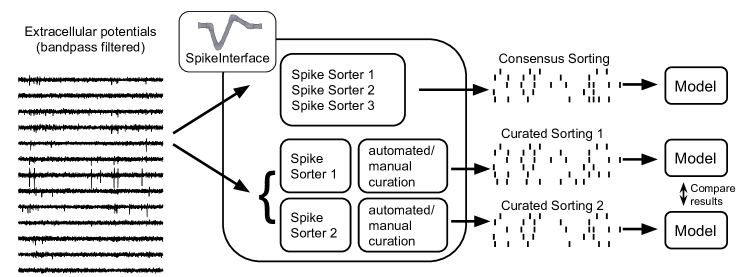
- 用 SpikeInterface 进行峰值提取与排序的考虑以及基于真实基准的评估。
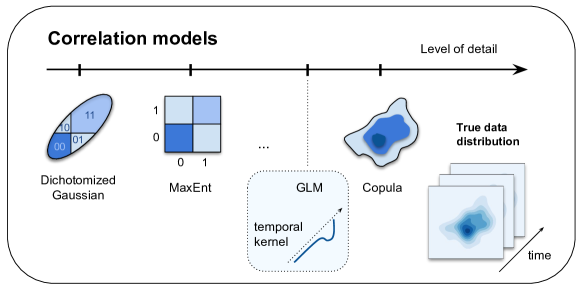
- 比较完全观测模型(MaxEnt、Dichotomized Gaussian、GLMs、copula-based models)及其可扩展性、可解释性与适用性。
- 讨论潜变量模型(状态空间和基于 GP 的模型),包括 LFADS、GPFA、GPFADS 及相关方法,强调动态、映射和观测模型。
- 概述如何将外部协变量和行为整合以提高可解释性并约束潜在动态。
- 就参数唯一性、不确定性量化和模型选择提供指导。
- 总结大规模神经群体建模的实际优势、局限性和未来方向。
实验结果
研究问题
- RQ1大规模神经记录的完全观测与潜变量群体模型之间有哪些权衡?
- RQ2不同模型如何处理高维联合活动,以及它们能提供哪些生物学或机械性见解?
- RQ3在这些模型中,参数可识别性、数据需求和计算可行性有哪些局限?
- RQ4在何种情景下外部协变量或与行为相关的潜在轨迹可以提高可解释性和解码性能?
- RQ5如何在考虑峰值排序不确定性和数据集规模的情况下对发现进行稳健验证?
主要发现
- 完全观测模型能够访问完整的联合分布并提升解码与信息度量,但在大规模群体中往往存在参数可识别性和计算可扩展性的问题。
- 潜变量模型提供对群体动态的低维表示,捕捉时间结构并实现不确定性量化,但依赖于低维性假设并可能混合多种变异源。
- GLMs 和基于 Copula 的方法可以扩展到大数据集并建模外部输入或非线性依赖关系,而 MaxEnt 变体提供了原则性的最大熵描述,但计算成本可能较高。
- 非线性状态空间模型和基于 RNN 的方法(如 LFADS)能够捕捉复杂动态,但通常计算量大且较难解释。
- GP 基潜变量模型(如 GPFA、GPFADS)提供不确定性估计和原则性模型选择,但必须能展示捕捉真实神经动态的能力,超越线性嵌入。
- 在实践中,使用多种峰值排序器或共识排序可以减少下游建模中的假阳性和偏差;建模外部变量可以提高可解释性并揭示稳健的神经轨迹。
更好的研究,从现在开始
从阅读论文到最终审阅,大幅缩短您的研究时间。
无需绑定信用卡
本解读由 AI 生成,并经人工编辑审核。