
[论文解读] Calibrating baryonic feedback with weak lensing and fast radio bursts
该论文提出利用快速射电暴(FRBs)作为宇宙学探针,通过将它们的色散量(DM)与类欧几里得巡天的弱引力透镜信号交叉相关,校准大尺度结构巡天中的重子反馈。在约10⁴个FRBs的情况下,该方法使重子反馈的约束改善一个数量级,并使中微子质量的约束提高50–100 %,打破宇宙学与反馈参数之间的退化关系。
One of the key limitations of large-scale structure surveys of the current and future generation, such as Euclid, LSST-Rubin or Roman, is the influence of feedback processes on the distribution of matter in the Universe. This effect, called baryonic feedback, modifies the matter power spectrum on non-linear scales much stronger than any cosmological parameter of interest. Constraining these modifications is therefore key to unlocking the full potential of the upcoming surveys, and we propose to do so with the help of Fast Radio Bursts (FRBs). FRBs are short, astrophysical radio transients of extragalactic origin. Their burst signal is dispersed by the free electrons in the large-scale structure, leading to delayed arrival times at different frequencies characterised by the dispersion measure (DM). Since the dispersion measure is sensitive to the integrated line-of-sight electron density, it is a direct probe of the baryonic content of the Universe. We investigate how FRBs can break the degeneracies between cosmological and feedback parameters by correlating the observed Dispersion Measure with the weak gravitational lensing signal of a Euclid-like survey. In particular, we use a simple one-parameter model controlling baryonic feedback, but we expect similar findings for more complex models. Within this model, we find that $\sim 5 imes 10^4$ FRBs are sufficient to constrain the baryonic feedback significantly better than cosmic shear alone, tightening the constraints considerably (roughly by a factor of five). We also expect a 1.5-fold improvement in the sum of neutrino masses.
研究动机与目标
- 解决未来弱透镜巡天中因重子反馈对非线性物质功率谱的影响而带来的宇宙学约束主要不确定性。
- 打破当前限制大尺度结构巡天精度的宇宙学参数与反馈模型参数之间的退化关系。
- 证明FRBs通过其色散量(DM)相关性,可作为大尺度结构中电子分布的新型独立探针。
- 量化将宇宙 shear 与FRB DM 数据结合后对参数约束的改进,特别是对反馈强度和中微子质量的约束。
- 表明FRBs可作为与tSZ效应不同的、具有不同系统误差的低红移互补探针,增强宇宙学推断的稳健性。
提出的方法
- 该研究使用单参数反馈模型,模拟重子反馈对物质功率谱、电子密度及与弱透镜交叉相关性的影响。
- 将FRBs的色散量(DM)建模为对视线方向自由电子密度的积分探测,对大尺度结构中的重子含量敏感。
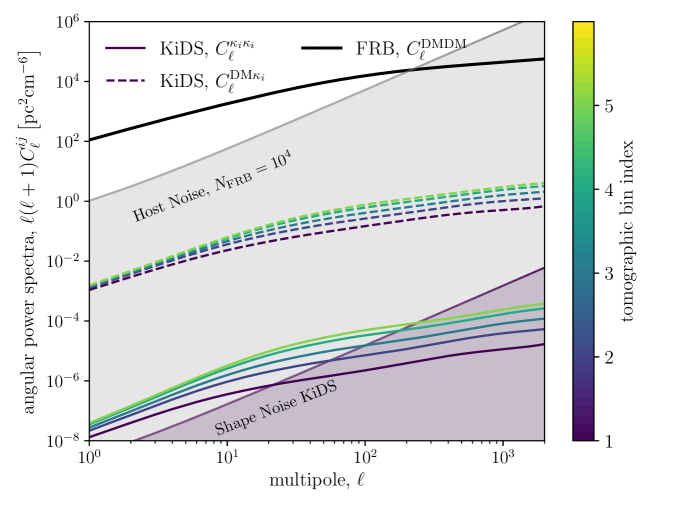
- 作者将FRBs的DM角功率谱与类欧几里得巡天的宇宙 shear 功率谱交叉相关,以打破参数空间中的退化关系。
- 采用无噪声数据向量的Fisher矩阵预测,并通过emcee进行MCMC采样,估计宇宙学与反馈参数的后验分布。
- 对宇宙学参数施加先验,以避免超出模拟校准范围的外推,确保参数估计的稳健性。
- 分析比较了仅使用宇宙 shear 与结合FRB DM相关性的约束结果,重点关注反馈强度、哈勃常数、重子密度和中微子质量。
实验结果
研究问题
- RQ1FRB色散量能否在弱透镜巡天中打破宇宙学参数与重子反馈参数之间的退化关系?
- RQ2与仅使用宇宙 shear 相比,加入FRB DM 数据后对反馈强度约束的改善程度如何?
- RQ3基于FRB的DM相关性在多大程度上能增强对中微子质量总和的约束?
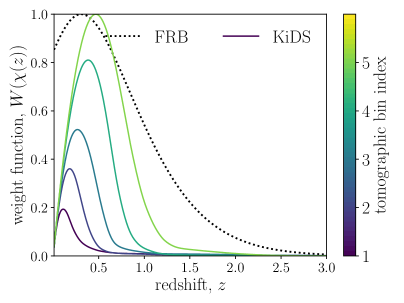
- RQ4FRB DM相关性的红移加权函数与tSZ效应有何不同?这对系统误差和互补性有何含义?
- RQ5FRBs能否作为不依赖CMB先验的独立、低红移重子结构探针?
主要发现
- 在约10⁴个FRBs的情况下,与仅使用宇宙 shear 相比,重子反馈强度的约束改善了一个数量级。
- 加入FRB数据后,中微子质量总和的不确定性降低了50–100 %,显著收紧了这一关键宇宙学参数的约束。
- FRB DM相关性打破了反馈参数与宇宙学参数(如哈勃常数和重子密度)之间的退化关系。
- 该方法为tSZ效应提供了互补探针,具有不同的红移敏感性和系统误差,增强了宇宙学推断的稳健性。
- 即使采用保守先验和简化反馈模型,引入FRB数据仍带来显著改进,尤其体现在反馈和中微子质量参数上。
- 预测中使用的信噪比在接下来十年内可实现,得益于当前和计划中的FRB巡天(如CHIME、ASKAP和SKA)。
更好的研究,从现在开始
从阅读论文到最终审阅,大幅缩短您的研究时间。
无需绑定信用卡
本解读由 AI 生成,并经人工编辑审核。