
[论文解读] Calorimeter shower superresolution
SuperCalo 提出了一种基于流的超分辨率模型,能够高效地将粗粒度量能器簇射上采样为高分辨率、细粒度的簇射,显著降低计算成本和生成时间,同时保持高保真度与多样性。该方法通过在 CaloChallenge 2022 数据集 2 上学习给定粗粒度体素输入的细粒度体素条件密度,实现了卓越的性能,具备更高的可扩展性与保真度。
Calorimeter shower simulation is a major bottleneck in the Large Hadron Collider computational pipeline. There have been recent efforts to employ deep-generative surrogate models to overcome this challenge. However, many of best performing models have training and generation times that do not scale well to high-dimensional calorimeter showers. In this work, we introduce SuperCalo, a flow-based superresolution model, and demonstrate that high-dimensional fine-grained calorimeter showers can be quickly upsampled from coarse-grained showers. This novel approach presents a way to reduce computational cost, memory requirements and generation time associated with fast calorimeter simulation models. Additionally, we show that the showers upsampled by SuperCalo possess a high degree of variation. This allows a large number of high-dimensional calorimeter showers to be upsampled from much fewer coarse showers with high-fidelity, which results in additional reduction in generation time.
研究动机与目标
- 通过加速量能器簇射生成,解决高能物理模拟中的计算瓶颈问题。
- 开发一种可扩展、可微分的超分辨率框架,无需在高维数据上端到端训练,即可将粗粒度簇射上采样至细粒度分辨率。
- 通过从较少的粗粒度簇射中学习条件超分辨率函数,在保持高保真度的同时减少内存占用和生成时间。
- 通过概率建模,从有限数量的粗粒度输入中实现多样化、高保真度的细粒度簇射生成。
- 证明在高维量能器簇射模拟中,超分辨率相较于直接生成建模的可行性与优越性。
提出的方法
- SuperCalo 使用归一化流来建模条件概率 $ p(\vec{E}_{\text{fine}}|\vec{E}_{\text{coarse}}) $,学习从简单先验到复杂细粒度簇射能量分布的双射变换。
- 模型以粗粒度体素能量、其空间位置及邻近粗粒度能量为条件,实现每个粗粒度体素的局部化、独立上采样。
- 关键创新在于使用粗粒度表示作为输入,通过基于流的模型以粗粒度特征为条件生成细粒度输出,避免了对高维数据的直接建模。
- 预处理包括逻辑斯蒂变换和噪声注入,以稳定在稀疏、零值主导的能量分布上的训练。
- 模型使用独热编码的粗粒度层和 r-bin 标签作为条件输入,以提升空间泛化能力。
- 推理阶段,模型通过从学习到的条件分布中采样,从单个粗粒度输入生成多个多样化细粒度簇射。
实验结果
研究问题
- RQ1基于归一化流的超分辨率技术能否有效将粗粒度量能器簇射上采样为高分辨率、细粒度簇射,且保持高保真度?
- RQ2与直接对高维簇射进行端到端生成建模相比,所提出的 SuperCalo 框架是否能显著降低计算成本和生成时间?
- RQ3在概率上采样下,少量粗粒度簇射在多大程度上可用于生成大量高保真度的细粒度簇射?
- RQ4粗粒度体素化方案的选择如何影响超分辨率模型的性能与泛化能力?
- RQ5该模型能否在实现快速、可扩展推理的同时,保持真实的簇射形态与能量沉积模式?
主要发现
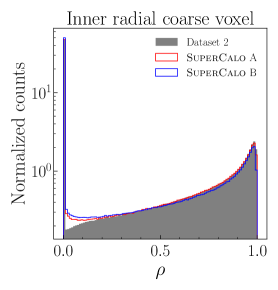
- SuperCalo 能够从粗粒度输入中实现对细粒度量能器簇射的高保真度重建,分类器评估指标显示其与参考 GEANT4 模拟结果在分布上高度相似。
- 该模型可从单个粗粒度输入生成多样化、高保真的细粒度簇射,显著减少了对大规模粗粒度训练数据的需求。
- 与直接的高维生成模型相比,生成时间显著缩短,其推理速度提升得益于粗到细的范式。
- 基于流的建模确保了精确的似然计算与稳定训练,即使在稀疏、零值泛滥的能量分布上亦表现稳健。
- 在不同粗粒度体素化方案下性能均表现稳健,模型对未见过的入射能量和簇射拓扑结构展现出强大的泛化能力。
- 分类器评估表明,生成的簇射在低级与高级特征上与参考簇射在统计上无法区分,证实了输出的高保真度。
更好的研究,从现在开始
从阅读论文到最终审阅,大幅缩短您的研究时间。
无需绑定信用卡
本解读由 AI 生成,并经人工编辑审核。