
[论文解读] CaloShowerGAN, a Generative Adversarial Networks model for fast calorimeter shower simulation
CaloShowerGAN 是一种基于生成对抗网络(GAN)的模型,用于在粒子物理中实现快速、高保真度的 calorimeter 暴发模拟。通过优化 GAN 架构、超参数和数据预处理(尤其是层能量归一化),该模型在性能上超越了现有的 ATLAS GAN 基础方法(如 FastCaloGAN),同时可直接集成到 ATLAS 软件框架中。
In particle physics, the demand for rapid and precise simulations is rising. The shift from traditional methods to machine learning-based approaches has led to significant advancements in simulating complex detector responses. CaloShowerGAN is a new approach for fast calorimeter simulation based on Generative Adversarial Network (GAN). We use Dataset 1 of the Fast Calorimeter Simulation Challenge 2022 to demonstrate the efficacy of the model to simulate calorimeter showers produced by photons and pions. The dataset is originated from the ATLAS experiment, and we anticipate that this approach can be seamlessly integrated into the ATLAS system. This development brings a significant improvement compared to the deployed GANs by ATLAS and could offer great enhancement to the current ATLAS fast simulations.
研究动机与目标
- 应对高亮度 LHC 实验中对快速、高精度蒙特卡洛模拟日益增长的计算需求。
- 克服基于 Geant4 的 calorimeter 暴发模拟带来的瓶颈,该模拟在 ATLAS 中占总模拟时间的约 80%。
- 开发一种 GAN 基础模型,其性能可与当前最先进的生成模型相匹配或超越,同时保持与 ATLAS 软件堆栈的兼容性。
- 通过领域感知的数据预处理和架构调优优化 GAN 训练,以提升保真度和稳定性。
- 在 Fast Calorimeter Simulation Challenge 2022 数据集上展示卓越性能,尤其在能量分辨率和暴发形状重建方面。
提出的方法
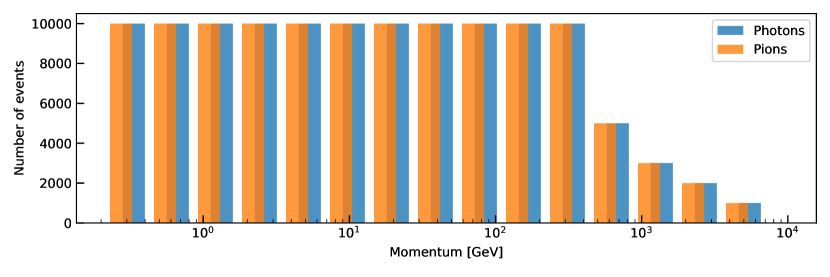
- 在 ATLAS 生成的 Geant4 模拟数据(数据集 1)上训练条件 GAN,覆盖从 256 MeV 到 4 TeV 动量的光子和 pion。
- 应用层能量归一化,按纵向层缩放能量沉积,以提升 GAN 训练的稳定性和性能。
- 对光子实施动量拆分训练,以改善在不同动量值之间的插值能力。
- 采用类似 U-Net 的生成器和基于 PatchGAN 的判别器,结合谱归一化和 Leaky ReLU 激活函数。
- 通过网格搜索和早停法优化超参数,使用自定义指标替代传统的 χ²/NDF 作为 GAN 训练的损失函数。
- 通过移除能量低于 1 keV 的低能体素并按层进行能量归一化对数据进行预处理,以增强模型泛化能力。
实验结果
研究问题
- RQ1GAN 基础模型是否能在 calorimeter 暴发模拟中实现比现有 ATLAS 快速模拟方法更高的保真度?
- RQ2层能量归一化对 GAN 训练稳定性和暴发模拟重建精度有何影响?
- RQ3通过训练策略和数据划分,动量插值能力可提升到何种程度?
- RQ4噪声注入或体素掩码是否能提升 GAN 在 calorimeter 暴发数据上的性能?
- RQ5GAN 基础模型是否能在该任务上超越或匹配更复杂生成模型(如归一化流或扩散模型)的性能?
主要发现
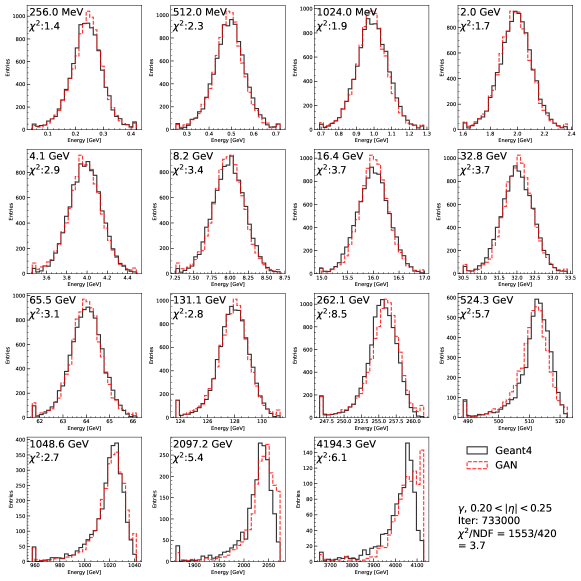
- 与 FastCaloGAN 相比,CaloShowerGAN 在能量分辨率和形状重建方面表现更优,能量偏差更小,且稳定性更高。
- 层能量归一化显著提升了训练收敛速度并减少了模式崩溃,使暴发轮廓更加逼真。
- 对光子实施动量拆分训练可实现更优的动量值间插值,提升对未见动量的泛化能力。
- 噪声注入和体素掩码策略未提升性能,反而常导致结果下降,表明 GAN 对低能噪声具有鲁棒性。
- 该模型在 GPU 上每事件生成时间低于 10 ms,支持大规模分析的实时模拟。
- 内存需求保持较低水平,推理过程仅需不到 1 GB 的 GPU 内存,确保与现有 ATLAS 工作流的兼容性。
更好的研究,从现在开始
从阅读论文到最终审阅,大幅缩短您的研究时间。
无需绑定信用卡
本解读由 AI 生成,并经人工编辑审核。