
[论文解读] Can supercooled phase transitions explain the gravitational wave background observed by pulsar timing arrays?
本文研究了超冷一阶相变(FOPT)是否能解释脉冲星时标阵列探测到的nHz频段随机引力波背景(SGWB)。研究揭示了两个关键障碍:超冷过程中真空主导会阻碍气泡蔓延和相变完成,而相变能标尺度的再加热会使SGWB谱计算变得不可行,从而排除了简单超冷FOPT对观测信号的解释。
Several pulsar timing array collaborations recently reported evidence of a stochastic gravitational wave background (SGWB) at nHz frequencies. Whilst the SGWB could originate from the merger of supermassive black holes, it could be a signature of new physics near the 100 MeV scale. Supercooled first-order phase transitions (FOPTs) that end at the 100 MeV scale are intriguing explanations, because they could connect the nHz signal to new physics at the electroweak scale or beyond. Here, however, we provide a clear demonstration that it is not simple to create a nHz signal from a supercooled phase transition, due to two crucial issues that could rule out many proposed supercooled explanations and should be checked. As an example, we use a model based on non-linearly realized electroweak symmetry that has been cited as evidence for a supercooled explanation. First, we show that a FOPT cannot complete for the required transition temperature of around 100 MeV. Such supercooling implies a period of vacuum domination that hinders bubble percolation and transition completion. Second, we show that even if completion is not required or if this constraint is evaded, the Universe typically reheats to the scale of any physics driving the FOPT. The hierarchy between the transition and reheating temperature makes it challenging to compute the spectrum of the SGWB.
研究动机与目标
- 评估超冷一阶相变(FOPT)是否能产生脉冲星时标阵列在nHz频段观测到的随机引力波背景(SGWB)。
- 在宇宙学与粒子物理学约束下,研究以100 MeV为终点的FOPT作为nHz信号来源的可行性。
- 识别并分析两个根本障碍——真空主导与再加热——如何削弱超冷FOPT解释的可行性。
- 检验一种具有非线性实现电弱对称性的特定模型作为超冷FOPT候选者的鲁棒性。
提出的方法
- 作者利用宇宙学与引力波(GW)辐射模型分析超冷FOPT的动力学,重点关注气泡成核、蔓延与相变完成过程。
- 采用红移后GW振幅与谱形拟合方法,分别针对碰撞、声波与湍流源,使用近期文献更新的参数。
- 从宇宙学演化推导出红移因子 $ \mathcal{R}_{\text{f}} $ 与 $ \mathcal{R}_{\text{\Omega}} $,以正确考虑频率与振幅的红移效应。
- 模型采用Hindmarsh等人提出的声波源拟合,参数为 $ \tilde{\Omega}_{\text{gw}} = 0.01 $,$ b = 1 $,$ z_p = 10 $,并采用湍流拟合参数 $ \kappa_{\text{turb}} = 0.05 $。
- 反向应用标准映射关系(如 $ R_* \propto v_w/\beta $),以超越原始假设,实现更广泛的参数探索。
- 分析表明,100 MeV的相变温度是否可在不违反宇宙学约束(尤其是真空主导与再加热动力学)的前提下实现。
实验结果
研究问题
- RQ1在约100 MeV的温度下,超冷一阶相变能否产生脉冲星时标阵列在nHz频段可探测的随机引力波背景?
- RQ2在超冷过程中,真空主导是否会阻止一阶相变的完成,从而破坏气泡蔓延与引力波辐射?
- RQ3相变能标尺度的再加热在多大程度上使超冷FOPT情景下的引力波谱计算变得不可行?
- RQ4此前被引用为可行超冷FOPT解释的非线性实现电弱对称性模型,是否与相变完成及再加热的宇宙学约束一致?
主要发现
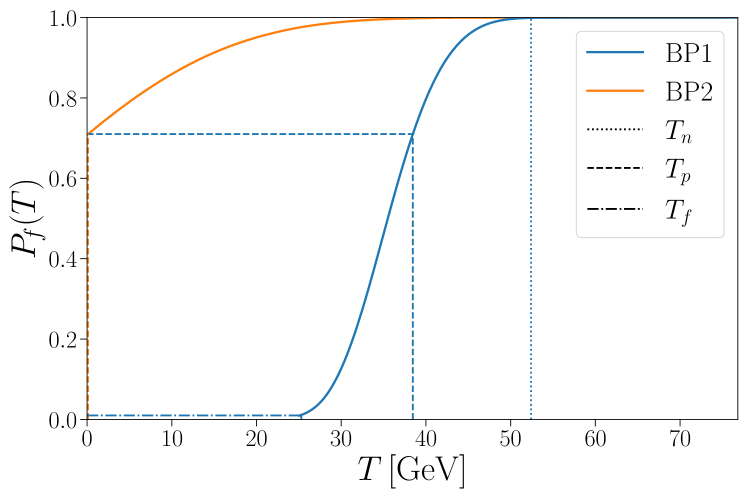
- 在约100 MeV的温度下,由于真空主导抑制了气泡蔓延,超冷一阶相变无法完成,从而无法形成持续的引力波信号。
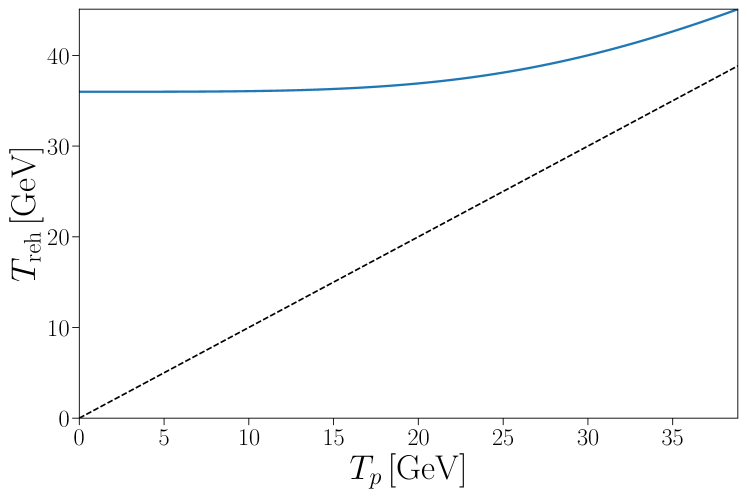
- 即使避开了相变完成的问题,相变能标尺度的再加热也会在相变与再加热温度之间引入一个层级关系,使引力波谱计算在计算上变得不可行。
- 此前被提出为可行解释的非线性实现电弱对称性模型,在相同宇宙学约束下也失败,尤其由于真空主导的影响。
- 红移后引力波振幅与谱形计算表明,在现实的超冷FOPT动力学下,无法产生所需的nHz信号。
- 本研究结论认为,简单超冷FOPT对nHz SGWB的解释已被基本宇宙学动力学所排除。
- 作者强调,任何可行的解释都必须避免真空主导与再加热层级关系,而这两者正是超冷FOPT的固有特征。
更好的研究,从现在开始
从阅读论文到最终审阅,大幅缩短您的研究时间。
无需绑定信用卡
本解读由 AI 生成,并经人工编辑审核。