
[论文解读] CANOS: A Fast and Scalable Neural AC-OPF Solver Robust To N-1 Perturbations
CANOS 是一种基于图神经网络的神经求解器,用于交流最优潮流(AC-OPF),在 33–65 毫秒内实现接近最优的解,与真实 AC-OPF 成本相差不到 1%,即使在 N-1 拓扑扰动下也表现良好。它可扩展至最多 10,000 个母线的电网,并在拓扑变化下保持可行性与准确性,适用于实时和安全约束的电力系统运行。
Optimal Power Flow (OPF) refers to a wide range of related optimization problems with the goal of operating power systems efficiently and securely. In the simplest setting, OPF determines how much power to generate in order to minimize costs while meeting demand for power and satisfying physical and operational constraints. In even the simplest case, power grid operators use approximations of the AC-OPF problem because solving the exact problem is prohibitively slow with state-of-the-art solvers. These approximations sacrifice accuracy and operational feasibility in favor of speed. This trade-off leads to costly "uplift payments" and increased carbon emissions, especially for large power grids. In the present work, we train a deep learning system (CANOS) to predict near-optimal solutions (within 1% of the true AC-OPF cost) without compromising speed (running in as little as 33--65 ms). Importantly, CANOS scales to realistic grid sizes with promising empirical results on grids containing as many as 10,000 buses. Finally, because CANOS is a Graph Neural Network, it is robust to changes in topology. We show that CANOS is accurate across N-1 topological perturbations of a base grid typically used in security-constrained analysis. This paves the way for more efficient optimization of more complex OPF problems which alter grid connectivity such as unit commitment, topology optimization and security-constrained OPF.
研究动机与目标
- 为解决在大规模电力系统中实时求解精确 AC-OPF 的计算不可行性。
- 克服传统近似方法(如 DC-OPF)在速度与精度之间权衡的问题,后者会导致高昂的补偿支付和更高的排放。
- 开发一种机器学习模型,在拓扑扰动(如线路停运,即 N-1 情况)下仍能保持可行性与精度。
- 实现在真实电网规模(最多 10,000 个母线)下的神经求解器可扩展部署,同时保持约束满足。
- 为求解更复杂的 OPF 变体(包括安全约束 OPF、机组组合和最优输电切换)提供基础。
提出的方法
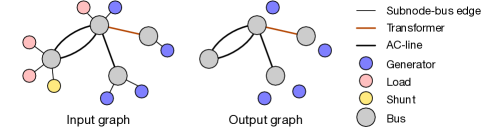
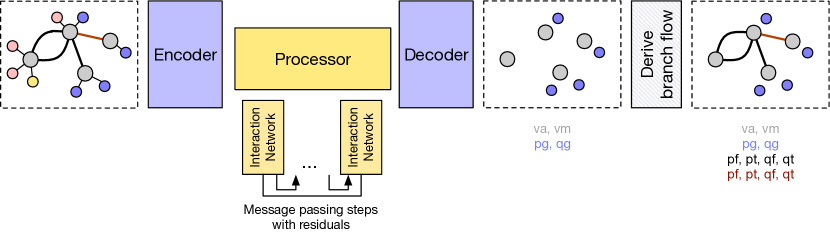
- CANOS 采用具有编码-处理-解码架构的深层图神经网络(GNN),通过 36–60 步消息传递来建模电网拓扑和潮流。
- 模型在通过扰动不同电网配置中的负荷值生成的合成数据上进行端到端训练,包括 N-1 线路停运场景。
- 直接从电网参数预测最优发电出力和电压分布,避免迭代优化过程。
- 通过可微分的后处理步骤强制约束满足,该步骤应用潮流方程以验证和优化预测结果。
- 损失函数包含约束违反的惩罚项,可通过拉格朗日或零梯度技术进一步改进。
- 由于 GNN 天然具备在图结构上的泛化能力,模型对拓扑变化具有鲁棒性,可在无需微调的情况下对修改后的电网进行推理。
实验结果
研究问题
- RQ1深度学习模型是否能在大规模电力系统上实现低于 65ms 推理时间的近似最优 AC-OPF 解?
- RQ2基于 GNN 的求解器在如线路停运等 N-1 拓扑扰动下,能否保持良好的可行性与精度?
- RQ3神经 AC-OPF 求解器在保持解质量的前提下,可扩展至多大规模的真实电网(如 10,000 个母线)?
- RQ4神经求解器是否可在不牺牲运行可行性的前提下,替代传统求解器用于实时和安全约束的 OPF 应用?
- RQ5模型在未见过的拓扑变化(如新增线路或新故障情况)下,是否无需微调即可良好泛化?
主要发现
- CANOS 在测试案例中实现的解与真实 AC-OPF 成本相差不到 1%,表明其作为神经求解器具有极高的最优性。
- 模型每次推理耗时 33–65 毫秒,支持在动态电力系统运行中实现实时部署。
- 在 10,000 母线系统中,CANOS 在 N-1 扰动下仍保持高达 99.8% 的平均约束满足率,显示出对拓扑变化的强大鲁棒性。
- 模型对未见的 N-1 故障具有良好的泛化能力,性能无显著下降,表明其泛化能力超越了训练阶段的扰动范围。
- 随着消息传递步数的增加,性能持续提升,表明更深的 GNN 能够提升解的质量。
- 由于其对拓扑变化的鲁棒性,CANOS 可支持在复杂 OPF 变体(如 SC-OPF、机组组合和最优输电切换)中的实际部署。
更好的研究,从现在开始
从阅读论文到最终审阅,大幅缩短您的研究时间。
无需绑定信用卡
本解读由 AI 生成,并经人工编辑审核。