
[论文解读] Cavity-Induced Strong Magnon-Magnon Coupling in Altermagnets
该论文提出通过虚光子交换在反铁磁体中实现腔体介导的长程强自旋波-自旋波耦合,利用垂直磁场诱导的手性自旋波劈裂。关键结果是在高度色散区域,RuO₂中实现高达0.49 meV的强各向异性有效自旋波-自旋波耦合强度,从而实现非局域量子自旋波相互作用。
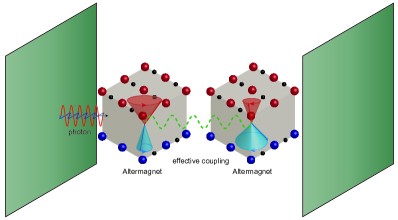
Long-distance strong coupling between short-wavelength magnons remains an outstanding challenge in quantum magnonics, an emerging interdiscipline between magnonics and quantum information science. Recently, altermagnets are identified as the third elementary class of magnets that break the time-reversal symmetry without magnetization and thus combine characteristics of conventional collinear ferromagnets and antiferromagnets. In this work, we show that cavity photons can mediate the long-distance strong coupling of exchange magnons with opposite chiralities in altermagnets, manifesting as an anticrossing of the magnon-polariton spectrum in the extremely dispersive regime. The predicted effective magnon-magnon coupling strongly depends on the magnon propagation direction, and is thus highly anisotropic. Our findings are intimately connected to the intrinsic nature of altermagnetic magnons, i.e., chirality-splitting-induced crossing of exchange magnons, which has no counterpart in conventional ferromagnets or antiferromagnets, and may open a new path way for magnon-based quantum information processing in altermagnets.
研究动机与目标
- 解决量子自旋波学中短波长自旋波之间长距离强耦合的挑战。
- 探索反铁磁体——打破时间反演对称性但无净磁矩——作为非局域自旋波耦合平台的独特性质。
- 证明腔体光子可介导反铁磁体中具有相反手性的交换自旋波之间的强非局域耦合。
- 推导并验证在色散区域由虚光子介导的有效自旋波-自旋波耦合的解析公式。
- 揭示由于反铁磁体中交换相互作用的本征各向异性导致的耦合各向异性特性。
提出的方法
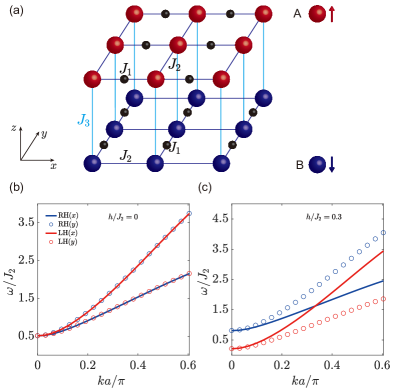
- 对具有各向异性层内交换相互作用的双亚晶格反铁磁体建模,并施加垂直磁场,将手性自旋波简并点从k=0移动至有限k值。
- 使用二阶微扰理论,从色散自旋波-光子耦合速率λₖ推导有效自旋波-自旋波耦合强度。
- 求解涉及波矢k_c和传播角φ的超越方程,以确定自旋波-极化子谱中的避平均点。
- 采用数值模拟验证有效耦合强度g_eff随磁场h、交换比J₁/J₂和传播方向φ的解析预测。
- 分析各向异性常数K和偶极-偶极相互作用的作用,表明由于频率失配大和1/d³衰减,其对g_eff影响可忽略不计。
- 计算协同度以确认在RuO₂中真实参数下强耦合区域(最高达100),其中α = 1.0×10⁻³。
实验结果
研究问题
- RQ1腔体光子能否在反铁磁体中介导短波长交换自旋波之间的长距离强耦合?
- RQ2施加垂直磁场如何影响自旋波简并点并实现非局域耦合?
- RQ3在色散区域中,由虚光子交换介导的有效自旋波-自旋波耦合的解析形式是什么?
- RQ4有效耦合强度如何依赖于自旋波传播方向,其各向异性的成因是什么?
- RQ5与腔体介导的虚过程相比,偶极-偶极相互作用或磁各向异性对有效耦合的影响程度如何?
主要发现
- 垂直磁场将自旋波简并点从k=0移动至非零波矢k_c ≠ 0,使交换区域能实现强耦合。
- 尽管光子频率比自旋波频率高出多个数量级,腔体诱导的自旋波-自旋波耦合仍表现为自旋波-极化子谱中的避平均现象。
- 在真实条件下(N/V ~ 10²³ cm⁻³,h = 0.6 meV),RuO₂中的有效耦合强度g_eff最高可达0.49 meV,表明在高度色散区域实现强耦合。
- 耦合强度g_eff具有高度各向异性,且对磁场h和交换比J₁/J₂呈非线性依赖,当φ = 0或π时达到最大值,原因在于群速度差最大。
- 由于自旋波与腔体光子之间频率失配大,有效耦合对各向异性常数K不敏感。
- g_eff随传播角φ变化的数值结果与基于二阶微扰理论推导的解析公式高度一致。
更好的研究,从现在开始
从阅读论文到最终审阅,大幅缩短您的研究时间。
无需绑定信用卡
本解读由 AI 生成,并经人工编辑审核。