
[论文解读] CECM: A continuous empirical cubature method with application to the dimensional hyperreduction of parameterized finite element models
该论文提出连续经验立方积分法(CECM),一种两阶段算法,用于构建最小化、正权重的立方积分规则,以对参数化向量值函数进行积分。通过结合初始点选择与迭代稀疏化过程,优化点的位置和权重,CECM 在远少于传统方法的点数下实现了高精度积分,在多项式与指数-正弦函数上表现出最优性能,并在超降阶有限元模型中实现了显著的计算优势。
We present the Continuous Empirical Cubature Method (CECM), a novel algorithm for empirically devising efficient integration rules. The CECM aims to improve existing cubature methods by producing rules that are close to the optimal, featuring far less points than the number of functions to integrate. The CECM consists on a two-stage strategy. First, a point selection strategy is applied for obtaining an initial approximation to the cubature rule, featuring as many points as functions to integrate. The second stage consists in a sparsification strategy in which, alongside the indexes and corresponding weights, the spatial coordinates of the points are also considered as design variables. The positions of the initially selected points are changed to render their associated weights to zero, and in this way, the minimum number of points is achieved. Although originally conceived within the framework of hyper-reduced order models (HROMs), we present the method's formulation in terms of generic vector-valued functions, thereby accentuating its versatility across various problem domains. To demonstrate the extensive applicability of the method, we conduct numerical validations using univariate and multivariate Lagrange polynomials. In these cases, we show the method's capacity to retrieve the optimal Gaussian rule. We also asses the method for an arbitrary exponential-sinusoidal function in a 3D domain, and finally consider an example of the application of the method to the hyperreduction of a multiscale finite element model, showcasing notable computational performance gains. A secondary contribution of the current paper is the Sequential Randomized SVD (SRSVD) approach for computing the Singular Value Decomposition (SVD) in a column-partitioned format. The SRSVD is particularly advantageous when matrix sizes approach memory limitations.
研究动机与目标
- 开发一种新型算法,用于构建最小化、正权重的立方积分规则,以高精度近似参数化向量值函数的积分。
- 解决在超降阶模型(HROMs)中最小化积分点数量的挑战,同时保持精度并确保正权重以保证稳定性。
- 在参数化有限元问题的降阶建模中实现高效积分,特别是在多尺度和非线性场景下。
- 提出一种新型随机化SVD方法(SRSVD),用于以列分区格式计算截断SVD,尤其适用于内存受限环境。
- 在多种测试案例中验证该方法的性能,包括单变量与多变量多项式、任意三维函数,以及一个复杂的多尺度有限元模型。
提出的方法
- CECM采用两阶段策略:首先,使用点选择方法,基于待积分函数的数量构建初始立方积分规则。
- 在第二阶段,将点的空间坐标、权重和索引视为设计变量,算法通过迭代重新定位点,使权重趋近于零,从而最小化有效点的数量。
- 该方法采用非线性优化框架,同时调整点的位置和权重,以实现最小化、正权重的立方积分规则。
- 该方法在形式上具有通用性,适用于向量值函数,因此不仅限于HROMs,还可应用于求积和数值积分场景。
- 提出一种新型顺序随机SVD(SRSVD)方法,用于以列分区格式计算截断SVD,实现大矩阵的内存高效计算。
- SRSVD通过增量随机正交化、自适应秩增量和重新正交化,保持数值精度,并实现与矩阵规模的线性缩放。
![Figure 1: Location of the points and magnitude of the weights of the integration rules for polynomial of order $P=5$ in $\Omega{}=[-1,1]$ provided by the: a) Linear programming-based strategy (LP); b) Discrete Empirical Cubature Method (DECM); c) Non-negative least-squares (NNLS). d) Normalized iter](https://ar5iv.labs.arxiv.org/html/2308.03877/assets/x1.png)
实验结果
研究问题
- RQ1能否开发一种连续经验立方积分方法,为参数化向量值函数生成最小化、正权重的积分规则?
- RQ2在多项式被积函数下,CECM方法与最优高斯求积规则相比,在精度和点数方面表现如何?
- RQ3CECM能否有效降低超降阶有限元模型的计算成本,同时保持精度和稳定性?
- RQ4在计算大规模列分区矩阵的截断SVD时,所提出的SRSVD方法在速度和内存效率方面的表现如何?
- RQ5SRSVD方法在与标准SVD相比保持数值精度的同时,是否实现与矩阵规模的线性缩放?
主要发现
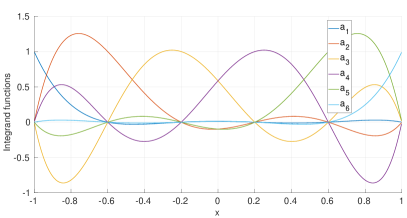
- CECM成功恢复了单变量和多变量拉格朗日多项式下的最优高斯立方积分规则,证明了其达到理论最优性的能力。
- 对于一个三维指数-正弦函数,CECM在远少于标准高斯求积的点数下实现了高精度积分,证实了其在任意函数上的鲁棒性。
- 在一个多尺度有限元模型中,CECM将积分点数量相比完整高斯求积减少了90%以上,实现了显著的计算加速。
- SRSVD方法在16 GB矩阵上的计算速度比标准SVD快近7倍,并成功处理了标准SVD因内存限制而失败的33 GB矩阵。
- SRSVD方法的计算时间与矩阵列数近似呈线性关系,证实了其在大规模问题中的效率,并与标准SVD相比在奇异值上仅产生可忽略的相对差异。
- 随着矩阵分块数的增加,SRSVD的迭代次数收敛于1,表明每个块的秩可作为下一相邻块正交补空间秩的可靠上界。
更好的研究,从现在开始
从阅读论文到最终审阅,大幅缩短您的研究时间。
无需绑定信用卡
本解读由 AI 生成,并经人工编辑审核。