
[论文解读] Cellular Network Radio Propagation Modeling with Deep Convolutional Neural Networks
本论文提出 PLNet,一个基于深度卷积神经网络的模型,通过将 GIS 地图和天线参数转换为输入图像张量来预测路径损耗,在精度和速度上优于经验和射线追迹模型。
Radio propagation modeling and prediction is fundamental for modern cellular network planning and optimization. Conventional radio propagation models fall into two categories. Empirical models, based on coarse statistics, are simple and computationally efficient, but are inaccurate due to oversimplification. Deterministic models, such as ray tracing based on physical laws of wave propagation, are more accurate and site specific. But they have higher computational complexity and are inflexible to utilize site information other than traditional global information system (GIS) maps. In this article we present a novel method to model radio propagation using deep convolutional neural networks and report significantly improved performance compared to conventional models. We also lay down the framework for data-driven modeling of radio propagation and enable future research to utilize rich and unconventional information of the site, e.g. satellite photos, to provide more accurate and flexible models.
研究动机与目标
- 将无线传播建模重新表述为使用深度卷积网络的图像回归问题。
- 设计将 GIS 地图层和天线参数整合作为图像通道的输入张量。
- 开发一个面向路径损耗预测的 U-Net 风格架构(PLNet)。
- 展示在使用模拟数据与真实现场数据的情况下,相对于传统经验和确定性模型具有更高的精度和速度。
提出的方法
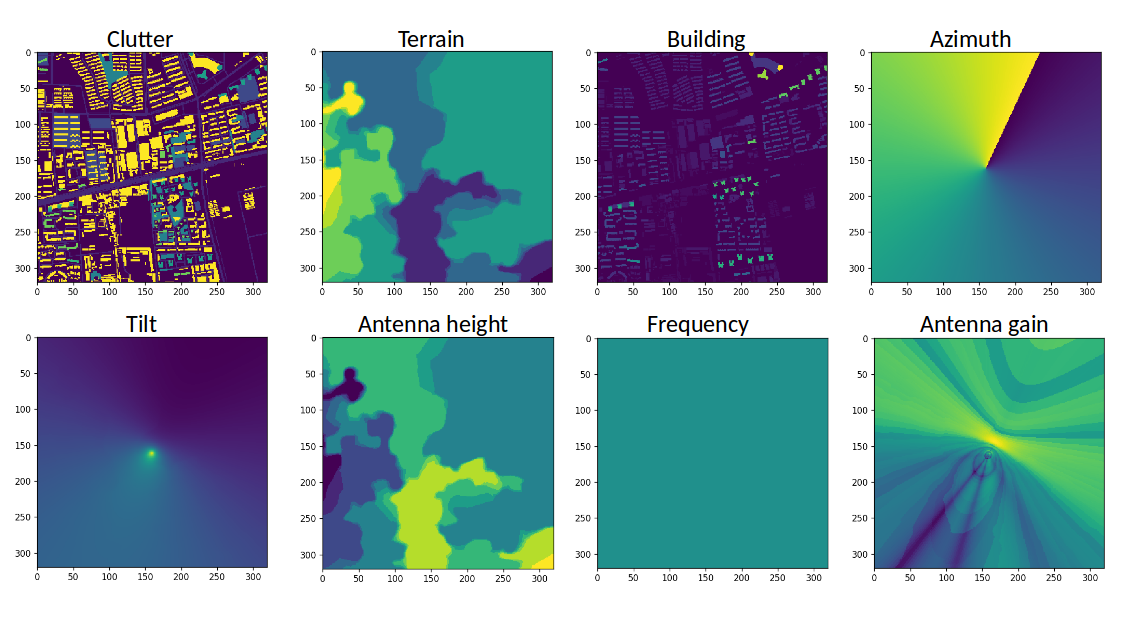
- 将 GIS 地图层和天线参数转换为每个区域块的 8 通道输入张量。
- 使用带跳跃连接的 U-Net 编码-解码器将输入张量映射到路径损耗图像。
- 使用带有标注路径损耗矩阵的 MAE/MSE 损失进行监督学习训练 PLNet。
- 使用模拟射线追踪数据进行预训练,使用真实现场数据进行微调和评估。
- 将 PLNet 与经验模型(如 SPM)及射线追踪基线进行比较。
- 展示基于 GPU 的推断加速(例如在 Titan Xp 上对 320x320 补丁的推断时间为 0.33 秒),与射线追踪的 30 秒相比。
实验结果
研究问题
- RQ1 能否利用丰富的站点信息(GIS 图层、天线参数)的基于 CNN 的模型,比传统经验模型或确定性模型更准确地预测路径损耗?
- RQ2 以数据驱动、基于图像的表述是否通过加入卫星影像等非传统输入或输入张量的额外通道而受益?
- RQ3 PLNet 在模拟数据与真实现场数据上的表现如何,是否可以在规划任务中作为射线追踪的快速代理?
主要发现
- PLNet 在实际场地数据的 RMSE 上优于传统模型,覆盖测试城市(如 City A–D)。
- 在经标定的数据下,PLNet 的 RMSE 低于 SPM,甚至在报道的案例中优于经标定的射线追踪。
- PLNet 展示出显著的速度优势,在 GPU 上对 320×320 路径损耗图预测仅需 0.33 秒,而 Volcano 射线追踪模拟器需要 30 秒。
- 对第一层滤波器的可视化显示出与建筑物和地形输入相对应的学习模式,表明网络捕捉到站点特定的传播特征。
- 对模拟射线追踪数据的预训练有助于 PLNet 学习适用于真实数据的表示,在真实数据有限时提升性能。
更好的研究,从现在开始
从论文设计到论文写作,大幅缩短您的研究时间。
无需绑定信用卡
本解读由 AI 生成,并经人工编辑审核。