
QUICK REVIEW
[论文解读] Challenges and Applications of Large Language Models
Jean Kaddour, Joshua Harris|arXiv (Cornell University)|Jul 19, 2023
Topic Modeling被引用 172
一句话总结
tldr: 一项系统性概述的综述,梳理在设计、行为、科学等方面的开放问题,以及在跨领域应用大型语言模型的当前成功,突出约束与权衡。
ABSTRACT
Large Language Models (LLMs) went from non-existent to ubiquitous in the machine learning discourse within a few years. Due to the fast pace of the field, it is difficult to identify the remaining challenges and already fruitful application areas. In this paper, we aim to establish a systematic set of open problems and application successes so that ML researchers can comprehend the field's current state more quickly and become productive.
研究动机与目标
- Identify unresolved challenges in LLM design, behavior, and scientific progress.
- Catalog successful application domains and how challenges constrain them.
- Provide guidance for ML researchers to accelerate progress in LLM research and deployment.
提出的方法
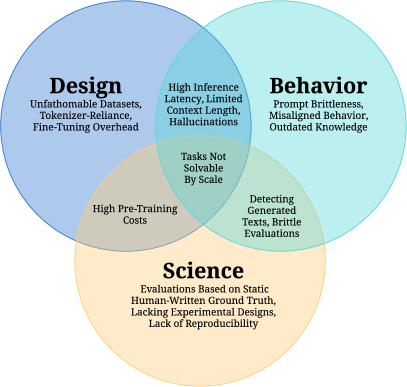
- Classify challenges into three broad categories: design, behavior, and science.
- Review literature and reported techniques addressing each challenge.
- Summarize application areas and associated constraints to guide future work.
实验结果
研究问题
- RQ1What challenges remain unresolved for large language models across design, behavior, and science?
- RQ2Where are LLMs currently applied, and what limitations do these challenges impose on these applications?
- RQ3What data, tokenization, training, fine-tuning, and evaluation practices influence LLM performance and trustworthiness?
主要发现
- Datasets for pre-training are vast and often unfathmanable, with near-duplicates and benchmark contamination impacting model behavior and evaluation.
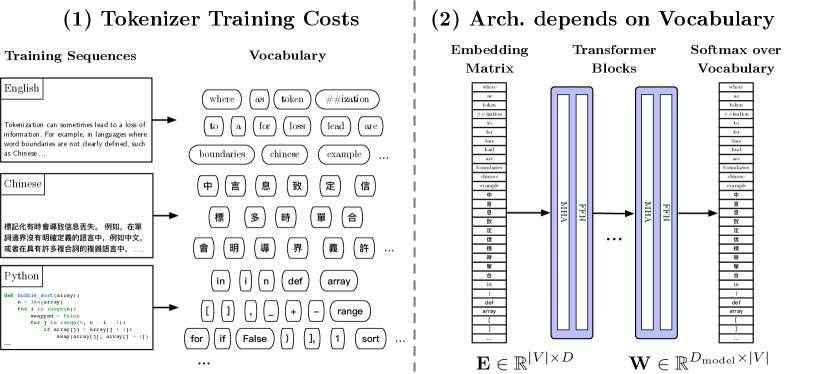
- Tokenization and tokenizer–model coupling introduce language and resource inequities, especially for multilingual and low-resource languages.
- Pre-training costs are extremely high, driving interest in scaling laws, compute-optimal strategies, and alternative training objectives to improve data efficiency.
- Fine-tuning LLMs faces practical barriers due to memory and storage requirements, prompting exploration of parameter-efficient fine-tuning methods like adapters, prefix-tuning, and prompt-tuning.
- A variety of pre-training objectives (MLM, prefix LM, span denoising, MoD) and data construction strategies impact data efficiency and downstream transfer, with ongoing research into their trade-offs.
- The paper also surveys a wide range of applications including chatbots, computational biology, programming, creative work, knowledge work, law, medicine, reasoning, robotics, social sciences, and synthetic data generation.
更好的研究,从现在开始
从阅读论文到最终审阅,大幅缩短您的研究时间。
无需绑定信用卡
本解读由 AI 生成,并经人工编辑审核。