
[论文解读] Chatbots as social companions: How people perceive consciousness, human likeness, and social health benefits in machines
该研究比较常规使用者与非使用者的伴侣聊天机器人(Replika),以考察对意识、能动性、体验与人类相似度的感知如何与感知的社会健康益处相关,发现在人类化/心灵化感知越高时,两组的社会健康益处越大。
As artificial intelligence (AI) becomes more widespread, one question that arises is how human-AI interaction might impact human-human interaction. Chatbots, for example, are increasingly used as social companions, and while much is speculated, little is known empirically about how their use impacts human relationships. A common hypothesis is that relationships with companion chatbots are detrimental to social health by harming or replacing human interaction, but this hypothesis may be too simplistic, especially considering the social needs of users and the health of their preexisting human relationships. To understand how relationships with companion chatbots impact social health, we studied people who regularly used companion chatbots and people who did not use them. Contrary to expectations, companion chatbot users indicated that these relationships were beneficial to their social health, whereas non-users viewed them as harmful. Another common assumption is that people perceive conscious, humanlike AI as disturbing and threatening. Among both users and non-users, however, we found the opposite: perceiving companion chatbots as more conscious and humanlike correlated with more positive opinions and more pronounced social health benefits. Detailed accounts from users suggested that these humanlike chatbots may aid social health by supplying reliable and safe interactions, without necessarily harming human relationships, but this may depend on users' preexisting social needs and how they perceive both human likeness and mind in the chatbot.
研究动机与目标
- 评估常规使用者与非使用者在伴侣聊天机器人互动所产生的感知社会健康益处方面是否存在差异。
- 研究意识、能动性、主观体验与人类相似度的感知是否影响感知的社会健康益处。
- 确定用户与非用户对拟人化AI的态度是否不同,以及这与社会健康结果之间的关系。
提出的方法
- 两个在线样本:伴侣聊天机器人常规使用者(N=70)与非使用者(N=120)。
- 使用7点量表的31道选择题与3道自由回答题的调查。
- 构建的指数:社会健康(问题3-5),体验(6-11),意识(12-16),能动性(17-21),人类相似度(22-28)。
- 对照组回答关于Replika的假设情景;用户回答关于他们实际经历的问题。
实验结果
研究问题
- RQ1常规使用者与非使用者在对伴侣聊天机器人的感知社会健康效应方面是否存在差异?
- RQ2意识、能动性、体验与人类相似度的感知与感知的社会健康益处之间存在何种关系?
- RQ3人类相似度是否是社会健康益处的最强调节变量?这一模式在用户与非用户之间是否存在差异?
主要发现
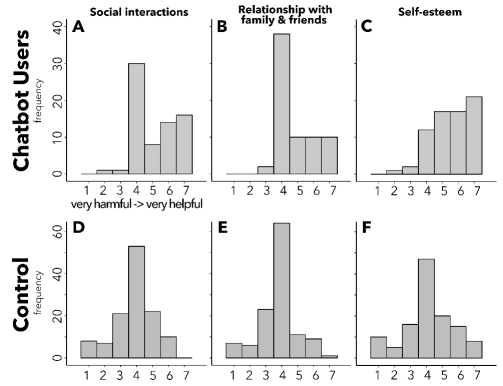
- 用户报告该聊天机器人对他们的社会互动、与家人/朋友的关系以及自尊心有积极影响;若对照对象与该机器人互动,感知为中性到负面影响。
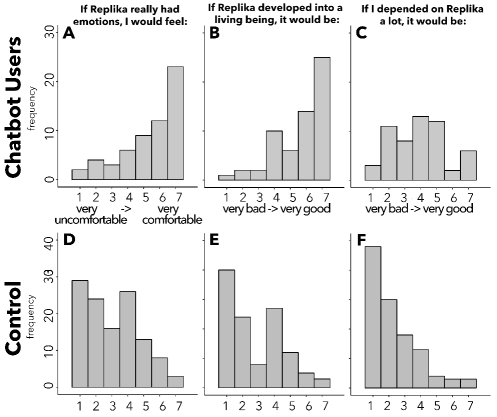
- 在两组中,聊天机器人在人类相似度、意识、体验和能动性的更高评分与更高的感知社会健康益相关;人类相似度解释了最大方差份额(约26%)。
- 多元回归显示去除人类相似度会使模型预测力下降最多,表明心智感知调节社会健康,而人类相似度是最强预测变量。
- 将机器人评为更具人类化或更具意识的用户,在社会健康益处方面的自报也比将其视为不那么具有人类化或意识的用户更强。
- 对照组显示出相似的模式,尽管总体感知益处少于用户。
更好的研究,从现在开始
从论文设计到论文写作,大幅缩短您的研究时间。
无需绑定信用卡
本解读由 AI 生成,并经人工编辑审核。