
[论文解读] Chemically Transferable Generative Backmapping of Coarse-Grained Proteins
本文提出 GenZProt,一种可迁移、具化学意识的回映模型,利用内部坐标的 SE(3)-等变 VAE 及物理信息损失,从 α-碳粗粒化表示重建蛋白质的全原子结构。
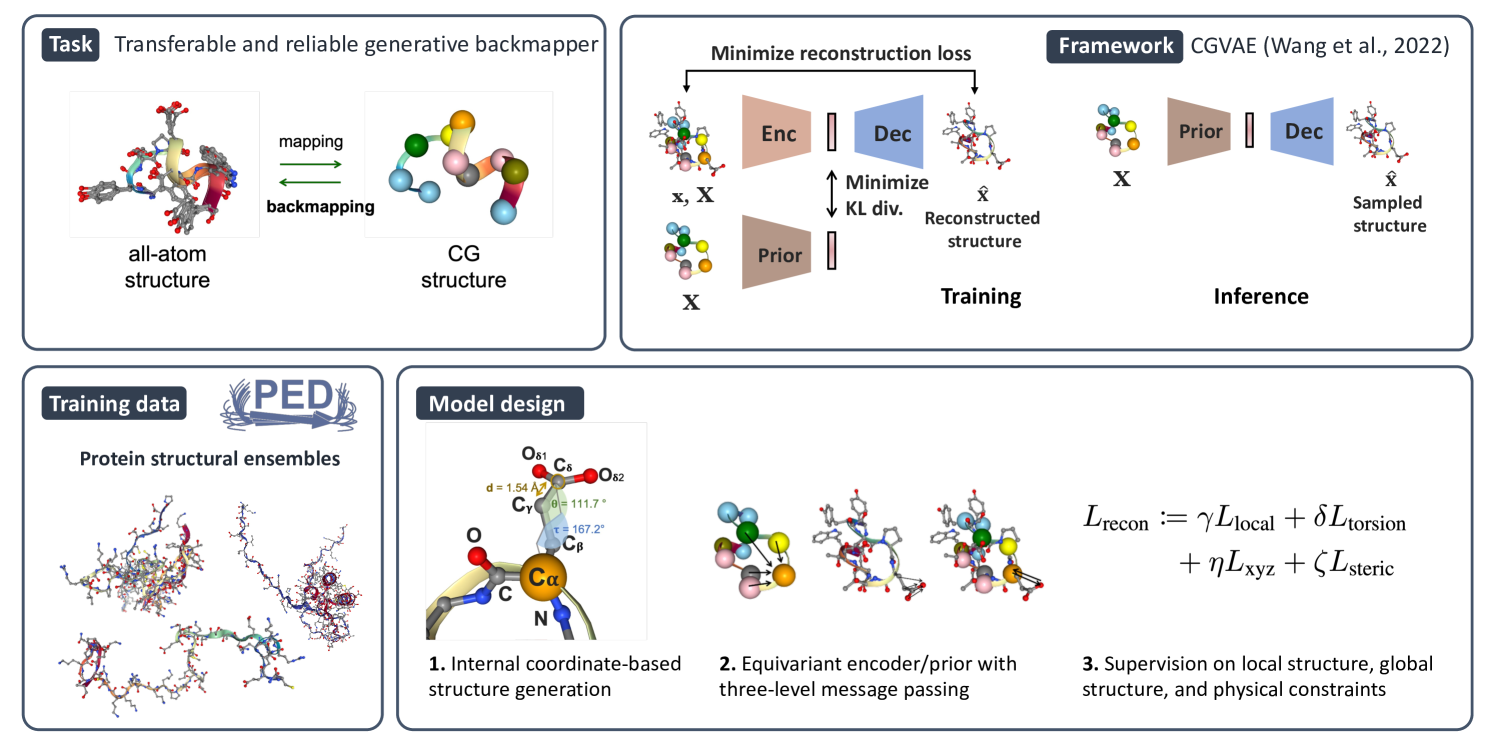
Coarse-graining (CG) accelerates molecular simulations of protein dynamics by simulating sets of atoms as singular beads. Backmapping is the opposite operation of bringing lost atomistic details back from the CG representation. While machine learning (ML) has produced accurate and efficient CG simulations of proteins, fast and reliable backmapping remains a challenge. Rule-based methods produce poor all-atom geometries, needing computationally costly refinement through additional simulations. Recently proposed ML approaches outperform traditional baselines but are not transferable between proteins and sometimes generate unphysical atom placements with steric clashes and implausible torsion angles. This work addresses both issues to build a fast, transferable, and reliable generative backmapping tool for CG protein representations. We achieve generalization and reliability through a combined set of innovations: representation based on internal coordinates; an equivariant encoder/prior; a custom loss function that helps ensure local structure, global structure, and physical constraints; and expert curation of high-quality out-of-equilibrium protein data for training. Our results pave the way for out-of-the-box backmapping of coarse-grained simulations for arbitrary proteins.
研究动机与目标
- 推动对粗粒化蛋白质模拟进行快速、可靠的回映,以恢复原子级细节。
- 通过在来自 PED 的多样化实验集合上训练,实现化学迁移性(可转移性)。
- 通过内部坐标生成和物理信息损失,保持拓扑结构和物理合理性。
- 展示对任意蛋白质和复杂蛋白–IDP 系统的开箱即用适用性。
提出的方法
- 使用变分自编码器框架建模 p(x|X),其中 X 是粗粒化结构,x 是全原子结构。
- 将结构表示为内部坐标(Z 矩阵),以保持拓扑并实现基于规则的笛卡尔坐标重构。
- 采用 SE(3)-等变编码器/先验,具多层图消息传递(原子-原子、原子-残基、残基-残基)。
- 以基于 Z 矩阵、具有不变性的解码器进行解码,约束局部几何(键长/角度),并允许扭转自由度。
- 融入物理启发的损失:L_bond、L_angle、L_torsion、L_xyz 和 L_steric,组合为 L_recon = γL_local + δL_torsion + ηL_xyz + ζL_steric;使用 ELBO 优化进行训练。
实验结果
研究问题
- RQ1生成式回映模型是否能够学习原子级重建,并在跨越多样蛋白质化学成分时具有泛化性?
- RQ2与笛卡尔解码器相比,带等变编码器的内部坐标解码是否提高拓扑保持并减少空间排斥?
- RQ3物理信息损失项对重建质量与有效性(空间排斥、键、角、扭转)的影响是什么?
- RQ4在 PED 集合上训练的可迁移模型是否能够对未见蛋白质及蛋白质–IDP 复合体进行准确回映?
主要发现
- GenZProt (m1) 相较于去除某些组件的变体,在测试蛋白上的 RMSD、GED 和空间排斥指标始终表现最佳。
- 具内部坐标 Z 矩阵解码器的等变编码器/先验在大型蛋白质上优于不变对端和笛卡尔解码器。
- 在多样化的 PED 集合上训练得到的可迁移模型,能够超越单一化学数据(仅 PED00151)的泛化。
- 物理信息损失,尤其中的 xyz 和 steric 项,对高质量重建和减少空间排斥至关重要。
- 定性分析表明,重建和采样的结构在拓扑与长程相互作用方面得到保持,空间排斥问题有限;氢键接触得到较合理的恢复。

更好的研究,从现在开始
从阅读论文到最终审阅,大幅缩短您的研究时间。
无需绑定信用卡
本解读由 AI 生成,并经人工编辑审核。