
[论文解读] CHGNet: Pretrained universal neural network potential for charge-informed atomistic modeling
CHGNet 是一个图神经网络互原子势在 Materials Project Trajectory Dataset 上预训练,以把磁矩作为原子电荷的代理,从而实现含电荷信息的分子动力学和异质、价态可变系统的相图计算。
The simulation of large-scale systems with complex electron interactions remains one of the greatest challenges for the atomistic modeling of materials. Although classical force fields often fail to describe the coupling between electronic states and ionic rearrangements, the more accurate extit{ab-initio} molecular dynamics suffers from computational complexity that prevents long-time and large-scale simulations, which are essential to study many technologically relevant phenomena, such as reactions, ion migrations, phase transformations, and degradation. In this work, we present the Crystal Hamiltonian Graph neural Network (CHGNet) as a novel machine-learning interatomic potential (MLIP), using a graph-neural-network-based force field to model a universal potential energy surface. CHGNet is pretrained on the energies, forces, stresses, and magnetic moments from the Materials Project Trajectory Dataset, which consists of over 10 years of density functional theory static and relaxation trajectories of $\sim 1.5$ million inorganic structures. The explicit inclusion of magnetic moments enables CHGNet to learn and accurately represent the orbital occupancy of electrons, enhancing its capability to describe both atomic and electronic degrees of freedom. We demonstrate several applications of CHGNet in solid-state materials, including charge-informed molecular dynamics in Li$_x$MnO$_2$, the finite temperature phase diagram for Li$_x$FePO$_4$ and Li diffusion in garnet conductors. We critically analyze the significance of including charge information for capturing appropriate chemistry, and we provide new insights into ionic systems with additional electronic degrees of freedom that can not be observed by previous MLIPs.
研究动机与目标
- 动机:需要准确的大规模原子建模,既捕捉离子自由度又捕捉电子自由度。
- 开发一个通用机器学习原子势(MLIP),通过磁矩整合电荷信息以规范化潜在空间。
- 在固态材料的电荷转移现象、相图和离子扩散方面演示 CHGNet。
- 评估包含电荷信息对捕捉真实化学和相行为的影响。
提出的方法
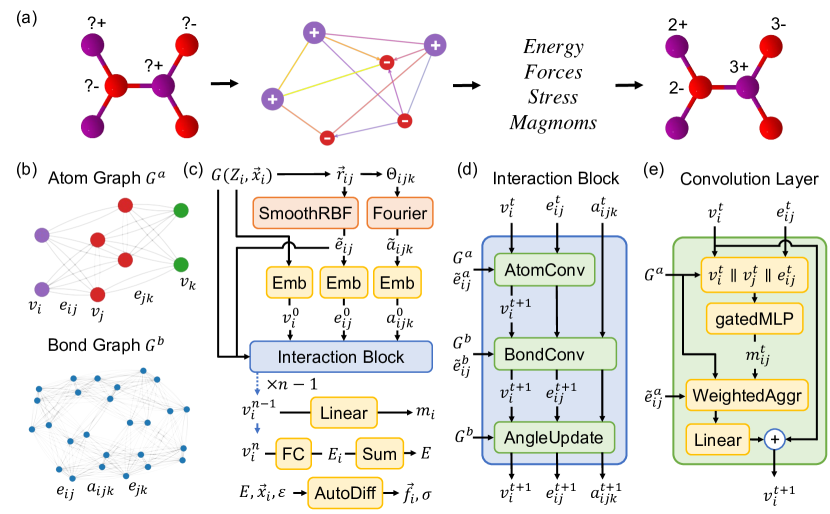
- 使用将晶体结构处理为原子图的图神经网络(GNN)架构,具备原子、键和角特征。
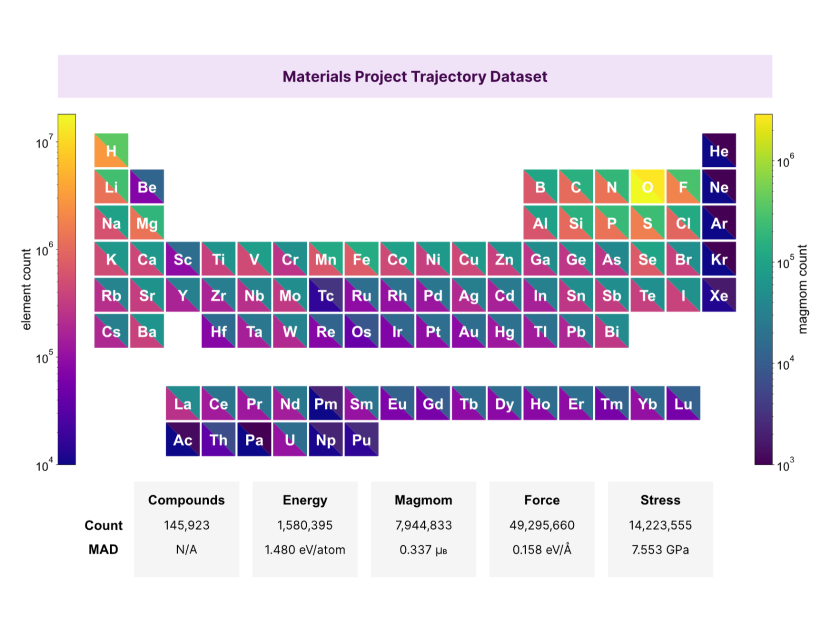
- 在 Materials Project Trajectory Dataset (MPtrj) 的能量、力、应力和磁矩上对 CHGNet 进行预训练,以学习通用势能面。
- 将磁矩作为电荷态约束纳入,以规范潜在空间并约束能量/力预测。
- 通过成对距离 (r_ij) 和角度 (theta_ijk) 构建输入特征,使用 SmoothRBF 和傅立叶基展开来处理长程相互作用。
- 采用基于相互作用块的消息传递方案,更新原子、键和角的特征,产出带电荷信息的输出(能量、力、应力、磁矩)。
- 在分子动力学模拟和高通量稳定性基准测试中验证 CHGNet,并与 DFT/AIMD 参考结果进行比较。
实验结果
研究问题
- RQ1基于 GNN 的 MLIP(用磁矩预训练)能否推断原子电荷态并提高电荷转移现象的准确性?
- RQ2通过磁矩包含电荷信息,是否能够在异质离子体系中实现可靠的带电荷信息的分子动力学、相图计算和扩散预测?
- RQ3CHGNet 在分布外材料稳定性任务中的表现以及在再现 DFT/AIMD 派生属性方面如何?
- RQ4在势中明确纳入电荷信息时,对具有电子自由度的离子系统会涌现出哪些见解?
- RQ5通过磁矩进行潜在空间正则化对捕捉价态依赖的化学是否至关重要?
主要发现
- 在 MPtrj 测试集上,若使用磁矩进行训练,CHGNet 的 MAE 与使用与不使用磁矩相比相当或更好(例如能量 30 meV/原子 vs 33 meV/原子,带磁矩时)。
- 该模型在 Matbench Discovery 的稳定无机晶体发现任务中,在八个对手模型中达到最先进的性能。
- 使用 CHGNet 的 MD 模拟在 Li 超离子导体中再现室温电导率和活化能,在 AIMD 的误差范围内,并区分快导体与慢导体。
- 通过磁矩的电荷约束使 CHGNet 能区分价态(例如 Li_xFePO4 中的 Fe2+ 与 Fe3+,Na4V2(PO4)3 中的 V3+/V4+),并揭示与磁矩相关的潜在空间聚类。
- CHGNet 捕捉到 LiMnO2 中由电荷失配驱动的相变,将结构演化(XRD)与电子态变化相关联,并与 DFT 磁矩一致。
- 在 Li_xFePO4 相图中通过带电荷装饰引入电子熵,定性地匹配实验相行为,与未带电荷装饰的模型不同。
更好的研究,从现在开始
从阅读论文到最终审阅,大幅缩短您的研究时间。
无需绑定信用卡
本解读由 AI 生成,并经人工编辑审核。