
[论文解读] Chiral limit of N = 4 SYM and ABJM and integrable Feynman graphs
本文提出N=4 SYM与ABJM理论的新型双重标度极限,得到在4D与3D中非幺正、手征的量子场论,尽管共形对称性被破坏,其在平面极限下仍保持可积性。关键贡献在于构建一个框架,使所有局部算符关联函数的平面费曼图均简化为单一可积的鱼网图,从而可通过渐近贝特 ansatz(ABA)与量子谱曲线(QSC)精确计算高圈幅值,文中并给出了明确的五圈预测。
We consider a special double scaling limit, recently introduced by two of the authors, combining weak coupling and large imaginary twist, for the $γ$-twisted $\mathcal{N}=4$ SYM theory. We also establish the analogous limit for ABJM theory. The resulting non-gauge chiral 4D and 3D theories of interacting scalars and fermions are integrable in the planar limit. In spite of the breakdown of conformality by double-trace interactions, most of the correlators for local operators of these theories are conformal, with non-trivial anomalous dimensions defined by specific, integrable Feynman diagrams. We discuss the details of this diagrammatics. We construct the doubly-scaled asymptotic Bethe ansatz (ABA) equations for multi-magnon states in these theories. Each entry of the mixing matrix of local conformal operators in the simplest of these theories - the bi-scalar model in 4D and tri-scalar model in 3D - is given by a single Feynman diagram at any given loop order. The related diagrams are in principle computable, up to a few scheme dependent constants, by integrability methods (quantum spectral curve or ABA). These constants should be fixed from direct computations of a few simplest graphs. This integrability-based method is advocated to be able to provide information about some high loop order graphs which are hardly computable by other known methods. We exemplify our approach with specific five-loop graphs.
研究动机与目标
- 建立γ-扭曲N=4 SYM与ABJM理论的新型双重标度极限,得到在4D与3D中非规范、手征的量子场论。
- 证明尽管由于双迹项导致共形对称性破缺,这些手征场论在平面极限下仍保持可积性。
- 发展一种图式框架,使得任意圈数下每个关联函数均由单一可积费曼图计算。
- 为这些理论中多子激发态谱构建双重标度渐近贝特 ansatz(ABA)方程。
- 通过可积性方法实现关联函数的高圈计算,绕过传统费曼图方法的困难。
提出的方法
- 结合弱耦合与大虚扭角的双重标度极限应用于γ-扭曲N=4 SYM与ABJM,得到具有定向相互作用的非幺正手征场论。
- 识别所得理论为4D中的双标量与3D中的三标量手征模型,仅含标量与费米子场,规范与胶粒子自由度解耦。
- 将平面费曼图构造为定向鱼网图,每种关联函数在任意圈数下仅存在一个主导图。
- 利用扭曲杨-巴克斯特代数与量子谱曲线(QSC)形式,推导多子激发态谱的渐近贝特 ansatz(ABA)方程。
- 利用ABA与QSC计算标定算符与异常维数,结果以有理数与zeta值表示。
- 通过低圈图的直接计算(如四圈与五圈)固定方案依赖常数,从而实现对更高圈幅值的预测。
实验结果
研究问题
- RQ1能否定义N=4 SYM与ABJM的非幺正、手征极限,使其在共形对称性破缺下仍保持平面可积性?
- RQ2在此手征极限下,局部算符关联函数的平面费曼图如何简化?能否在高圈阶下精确计算?
- RQ3所得手征场论中多子激发态谱的结构为何?能否由渐近贝特 ansatz 描述?
- RQ4可积性方法(如量子谱曲线或ABA)在多大程度上可计算传统费曼图方法难以处理的高圈幅值?
- RQ5如何通过少数低圈图的直接计算,固定ABA框架中的方案依赖常数?
主要发现
- γ-扭曲N=4 SYM与ABJM的手征极限产生4D与3D中非幺正、平面可积的场论,仅含标量与费米子,规范与超对称自由度解耦。
- 在双标量4D与三标量3D模型中,任意圈数下局部单迹算符的每个关联函数恰好对应一个平面费曼图,极大简化微扰论。
- 已构建多子激发态谱的ABA方程,并证明其能正确重现局部算符的异常维数,包括四圈与五圈结果。
- 通过ABA计算标定算符与两点函数,结果以有理系数与zeta值表示,如ζ₂、ζ₃、ζ₄与ζ₅。
- 利用ABA预测了两子激发态的五圈异常维数,结果依赖于通过低圈计算固定的有限个方案依赖常数。
- 在维度正则化下计算了鱼网图的主积分,给出ε至O(ε²)的显式展开,包括如I[;1] = -2/ε - 2 + ζ₂ε + ... 与 I[;4] = 2/(3ε⁴) + ... + O(ε⁰) 等表达式。
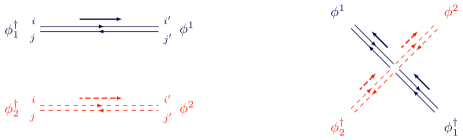
![Figure 3 : Non-planar diagrams that generate couplings of the form ${\rm Tr}(\phi^{1}\phi_{2}^{\dagger})\,{\rm Tr}(\phi^{2}\phi_{1}^{\dagger})$ and $\bigl{[}{\rm Tr}(\phi^{1}\phi_{1}^{\dagger})\bigr{]}^{2}$ .](https://ar5iv.labs.arxiv.org/html/1612.05895/assets/x6.png)
更好的研究,从现在开始
从阅读论文到最终审阅,大幅缩短您的研究时间。
无需绑定信用卡
本解读由 AI 生成,并经人工编辑审核。