
[论文解读] Circuit-Depth Reduction of Unitary-Coupled-Cluster Ansatz by Energy Sorting
该论文提出了一种能量排序(ES)算法,通过基于能量贡献预先排序激发算符,以减少变分量子本征求解器(VQE)中单重耦合簇(UCC)ansatz的电路深度。通过迭代添加最具影响力的算符,该方法在保持化学精度的前提下,将算符数量减少了高达98%,显著提升了含噪声中等规模量子(NISQ)设备的资源效率。
Quantum computation represents a revolutionary approach for solving problems in quantum chemistry. However, due to the limited quantum resources in the current noisy intermediate-scale quantum (NISQ) devices, quantum algorithms for large chemical systems remains a major task. In this work, we demonstrate that the circuit depth of the unitary coupled cluster (UCC) and UCC-based ansatzes in the algorithm of variational quantum eigensolver can be significantly reduced by an energy-sorting strategy. Specifically, subsets of excitation operators are first pre-screened from the operator pool according to its contribution to the total energy. The quantum circuit ansatz is then iteratively constructed until the convergence of the final energy to a typical accuracy. For demonstration, this method has been successfully applied to molecular and periodic systems. Particularly, a reduction of 50\%$\sim$98\% in the number of operators is observed while retaining the accuracy of the origin UCCSD operator pools. This method can be straightforwardly extended to general parametric variational ansatzes.
研究动机与目标
- 解决基于UCC的ansatz在变分量子本征求解器(VQE)中电路深度过高的问题,该问题限制了其在当前含噪声中等规模量子(NISQ)设备上的可行性。
- 在不牺牲能量精度的前提下,减少UCC和UCCGSD ansatz中的激发算符数量,以提高量子电路效率。
- 开发一种可扩展、参数高效的算法,最大限度减少迭代ansatz构建过程中的重复测量。
- 通过在近场量子硬件上使用压缩ansatz,实现对分子和周期性系统的精确基态能量计算。
提出的方法
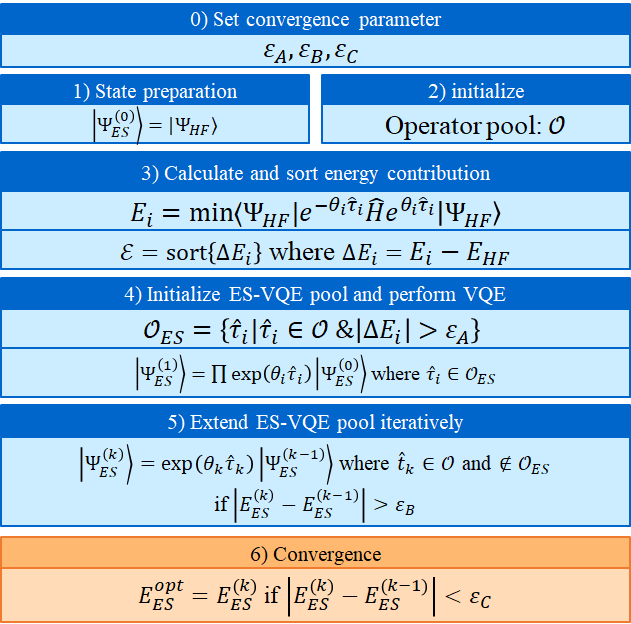
- 通过单次测量评估所有来自UCC库的激发算符相对于HF参考态的能量贡献,预先筛选算符。
- 按能量降低潜力从高到低对算符进行排序,优先选择最具影响力的项。
- 通过按预排序序列逐个添加算符,迭代构建ansatz,直至能量收敛。
- 仅通过一次初始评估对所有算符进行评分,避免在迭代ansatz增长过程中重复测量带来的开销。
- 将能量排序策略应用于UCCSD和UCCGSD ansatz,使其可应用于强关联体系。
- 通过使用排序后的算符库生成压缩但精确的参数化量子电路,将该方法与VQE集成。
实验结果
研究问题
- RQ1基于UCC的ansatz的电路深度能否在保持化学精度的前提下显著降低?
- RQ2通过能量贡献对激发算符进行预排序,是否能实现更少算符下的更快收敛?
- RQ3能量排序策略在减少分子和周期性体系的CNOT门数量与电路深度方面有多高效?
- RQ4该方法能否扩展至UCC之外的一般参数化变分ansatz?
- RQ5在强关联体系(如H6)中,算符数量减少与能量精度之间的权衡如何?
主要发现
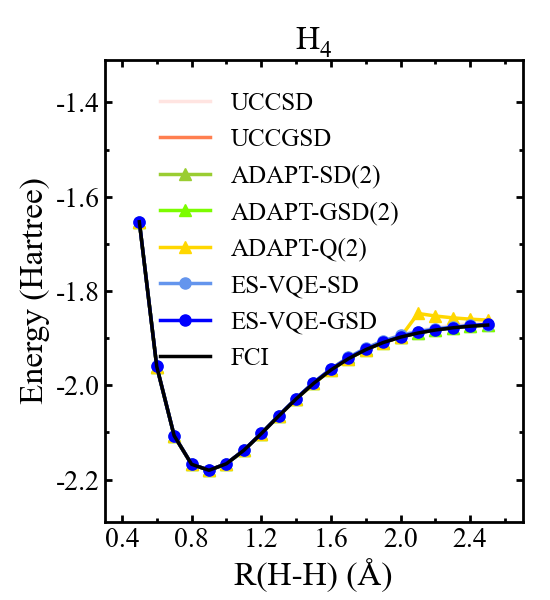
- 能量排序(ES-VQE)方法在保持化学精度的前提下,与原始UCCSD库相比,将激发算符数量减少了50%至98%。
- 对于LiH分子,该方法仅使用原始算符的一小部分即实现了化学精度,显著降低了电路深度。
- 在H6分子(强关联体系)中,使用UCCGSD ansatz的ES-VQE仅从初始240个算符中选取20个,即达到了化学精度。
- 单参数更新方案即使使用全部240个算符也无法实现化学精度,凸显了ES-VQE中迭代多算符更新的优势。
- 该方法保持了低测量开销,仅需一次初始评估即可对所有算符评分,避免了优化过程中重复的高成本测量。
- 该方法可推广至其他参数化ansatz,并已成功应用于分子和周期性体系,包括采用k点采样的1D氢链。
更好的研究,从现在开始
从阅读论文到最终审阅,大幅缩短您的研究时间。
无需绑定信用卡
本解读由 AI 生成,并经人工编辑审核。