
[论文解读] Classical benchmarking of zero noise extrapolation beyond the exactly-verifiable regime
本文将零噪声外推(ZNE)与踢激Ising电路的多种经典仿真进行基准比较,显示ZNE在可验证的范围之外仍然保持准确,并比较多种经典方法。
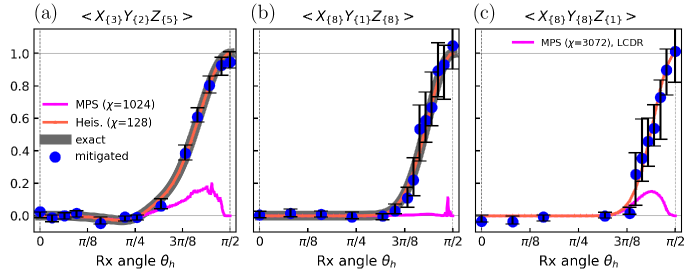
In a recent work a quantum error mitigation protocol was applied to the expectation values obtained from circuits on the IBM Eagle quantum processor with up $127$ - qubits with up to $60 \; - \; \mbox{CNOT}$ layers. To benchmark the efficacy of this quantum protocol a physically motivated quantum circuit family was considered that allowed access to exact solutions in different regimes. The family interpolated between Clifford circuits and was additionally evaluated at low depth where exact validation is practical. It was observed that for highly entangling parameter regimes the circuits are beyond the validation of matrix product state and isometric tensor network state approximation methods. Here we compare the experimental results to matrix product operator simulations of the Heisenberg evolution, find they provide a closer approximation than these pure-state methods by exploiting the closeness to Clifford circuits and limited operator growth. Recently other approximation methods have been used to simulate the full circuit up to its largest extent. We observe a discrepancy of up to $20\%$ among the different classical approaches so far, an uncertainty comparable to the bootstrapped error bars of the experiment. Based on the different approximation schemes we propose modifications to the original circuit family that challenge the particular classical methods discussed here.
研究动机与目标
- 促使在超出精确经典验证范围的电路上评估量子误差缓解(QEM)技术,如零噪声外推(ZNE)
- 将实验性的ZNE结果与近似海森堡演化或态态动力学的多种经典仿真方法进行比较。
- 评估哪些经典方法在可验证与超出可验证范围内最能再现ZNE校正后的观测量。
- 提出能够挑战经典方法并揭示其局限性的电路与建模扩展。
提出的方法
- 使用矩阵积算子(MPO)表示近似海森堡演化的观测量,以模拟 O(D) = (U†)D O U^D 的动力学。
- 将 2D heavy-hex 晶格映射为 1D 链,采用 snake 顺序,并在层之间进行变分MPO压缩的交错单位幺共轭。
- 使用固定键维度 χ 来控制截断误差,并在给定初始乘积态下在 D 步后计算期望值。
- 将 MPO-海森堡结果与精确计算、纯态 MPS 动力学、等距张量网络(isoTNS)、BP-TNS、CPT,以及更小设备的仿真进行比较。
- 通过算子纠缠熵(OEE)和 OTOC 来分析算子增长,以理解 MPO 的有效性和光锥动力学。
![Figure 1: Comparison of classical approximations for $\langle Z_{62}\rangle$ at Trotter depth $D=20$ against experimental ZNE results: (1) matrix-product-state (MPS) representation of the pure state within a lightcone-reduced volume [ 3 ] ; (2) extrapolation of the MPS results with respect to the es](https://ar5iv.labs.arxiv.org/html/2306.17839/assets/x1.png)
实验结果
研究问题
- RQ1在可以通过经典方法验证的范围内,ZNE 多准确地再现精确结果?
- RQ2替代的经典方法(MPS、MPO、BP-TNS、CPT)是否能够在可验证范围之外继续保持准确性,以及它们与ZNE的比较?
- RQ3基于MPO的海森堡演化在heavy-hex晶格上的大深度、高纠缠电路中的局限性与尺度分析?
- RQ4电路变体(非Clifford门、非交换门层)如何影响ZNE与经典仿真的性能和可比性?
- RQ5基于算子的经典仿真是否能为在近端设备上预测ZNE结果提供可靠的基准或改进?
主要发现
- ZNE 在可被经典方法验证的范围内,在自举误差带内再现精确结果。
- MPS 与二维 isoTNS 纯态方法在重参数范围内,尤其在远离 Clifford 点时,难以再现观测量。
- 海森堡 MPO 演化在超出精确验证范围的参数区间内,与 ZNE 结果一致,直到 20 次 Trotter 步骤(60 层 CNOT)。
- 在某些区域,不同经典方法的结果大致相差约 20%,与 ZNE 误差棒相当,指示仍存在经典不确定性。
- 算子增长比最坏情形慢,OEE 随深度呈二次增长,OTOC 指示光锥受限扩展,有助于提高MPO效率;BP-TNS 在大深度和环状纠缠下显示局限性。
更好的研究,从现在开始
从阅读论文到最终审阅,大幅缩短您的研究时间。
无需绑定信用卡
本解读由 AI 生成,并经人工编辑审核。