
[论文解读] Classification of 1+1D gapless symmetry protected phases via topological holography
本文通过量子双模型中的任意子凝结,建立了1+1D任意子非简并对称保护拓扑(gSPT)相与2+1D对称拓扑场理论(SymTFT)部分束缚边界之间的一一对应关系。关键贡献是通过拓扑全像法对gSPT进行全面分类,表明边界模式与涌现异常源于SymTFT结构通过保持对称性的任意子凝结而产生。
Symmetry topological field theory (SymTFT) gives a holographic correspondence between systems with a global symmetry and a higher-dimensional topological field theory. In this framework, classification of gapped phases of matter in spacetime dimension 1+1D correspond to classifications of mechanisms to confine the SymTFT by condensing anyons. In this work, we extend these results to characterize gapless symmetry-protected topological states: symmetry-enriched gapless phases or critical points that exhibit edge modes protected by symmetry and topology. We establish a one-to-one correspondence between 1+1D bosonic gSPTs, and partially-confined boundaries of 2+1D SymTFTs. From general physical considerations, we determine the set of data and consistency conditions required to define a 1+1D gSPT, and show that this data precisely matches that of symmetry-preserving partial confinement (or partially gapped boundaries) of 2+1D quantum double models. We illustrate this correspondence through a dimensional reduction (thin-slab) construction, which enables a physically-intuitive derivation of how properties of the gSPT such as edge modes, emergent anomalies, and stability to perturbations arise from the SymTFT perspective.ditions required to define a 1+1D gSPT and show that they fully determine the physics of the gSPT including edge modes and emergent anomaly.
研究动机与目标
- 将此前用于简并相的SymTFT框架扩展至1+1D系统中非简并对称保护拓扑(gSPT)相的分类。
- 识别出完整表征1+1D自旋玻色子gSPT的代数数据及其一致性条件,包括边界模式与涌现异常。
- 在gSPT与2+1D SymTFT部分束缚边界之间建立全像对偶关系,特别是量子双模型。
- 证明gSPT的拓扑特征(如边界模式与异常)源于SymTFT体相中任意子的凝结。
- 通过将1+1D gSPT与0+1D边界理论通过SymTFT的拓扑数据联系起来,将体-边对应关系推广至非简并相。
提出的方法
- 引入一组拓扑数据 $(\eta, \epsilon)$ 以对1+1D自旋玻色子gSPT进行分类,其中 $\eta$ 编码简并部分的SPT类,$\epsilon$ 控制对称性与非简并部分的相互作用。
- 通过SymTFT对偶性,将gSPT映射为2+1D量子双模型 $D(\Gamma)$ 的部分束缚边界,其中任意子凝结部分保持拓扑序。
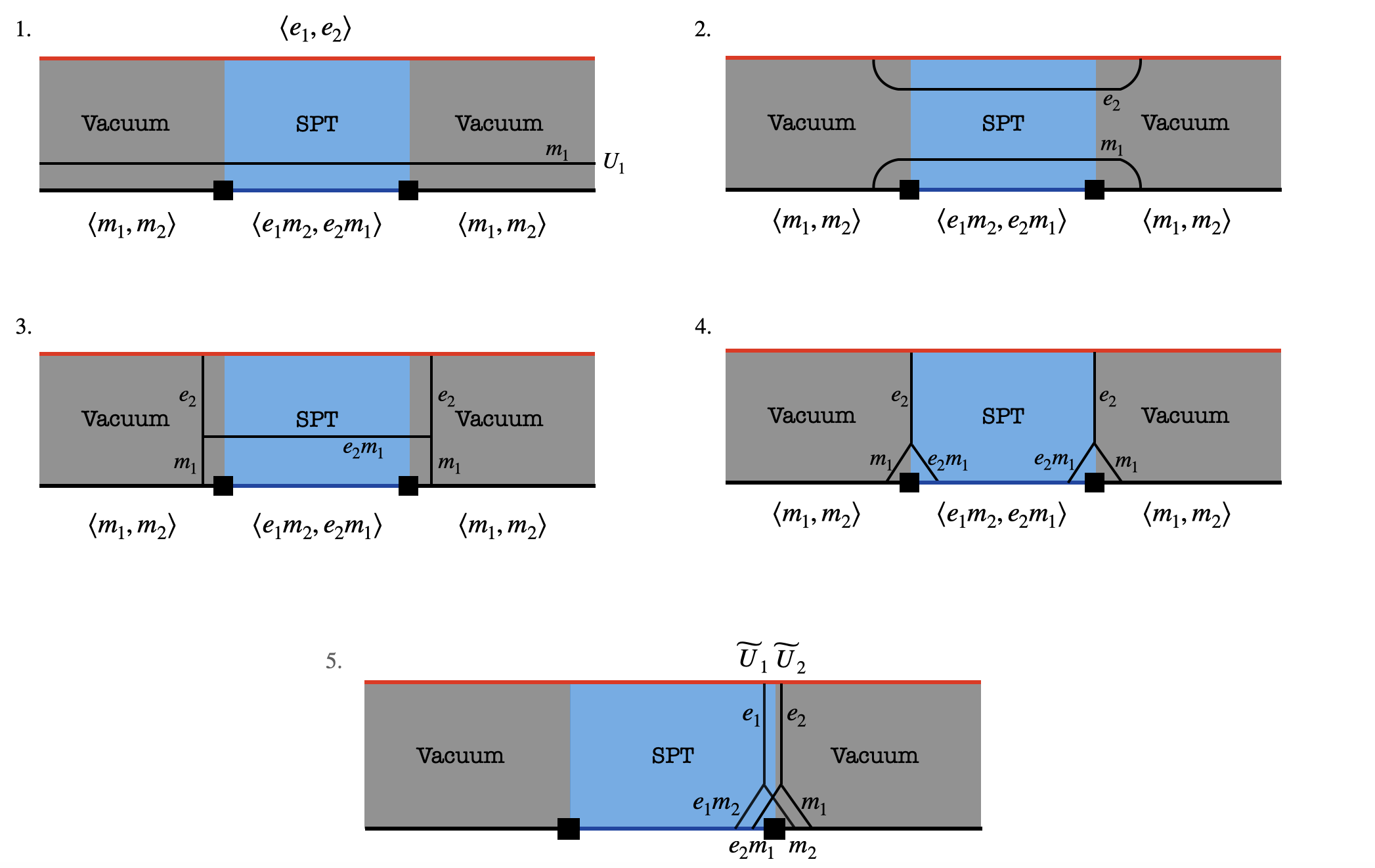
- 使用维度约化(细层构造)以获得物理直觉:简并部分与非简并部分分别源于SymTFT的边界与体相。
- 利用群上同调与拓扑场论约束推导 $(\eta, \epsilon)$ 的一致性条件,确保对称性实现无异常。
- 通过证明gSPT中涌现的异常与SymTFT中凝结后的扭结结构一致,建立体-边对应关系,将1+1D gSPT与0+1D边界异常联系起来。
- 证明将一个gSPT与一个平凡SPT(由 $\omega_2$ 分类)叠加,对应于通过拉回将 $\eta $ 因子平凡化,同时保持涌现异常。

实验结果
研究问题
- RQ1如何利用拓扑全像法对1+1D非简并对称保护拓扑相进行分类?
- RQ21+1D gSPT与2+1D SymTFT部分束缚边界之间的确切对应关系是什么?
- RQ3gSPT中的边界模式与涌现异常如何从SymTFT中任意子凝结机制中产生?
- RQ4哪些代数数据可完全表征一个1+1D自旋玻色子gSPT,其必须满足的一致性条件是什么?
- RQ5在SymTFT框架下,体-边对应关系如何从简并SPT推广至非简并SPT?
主要发现
- 在1+1D自旋玻色子gSPT与2+1D量子双模型中对称且部分束缚的任意子凝结之间建立了一一对应关系。
- gSPT的分类完全由两个相位因子 $(\eta, \epsilon)$ 捕获,其中 $\eta$ 决定简并部分的SPT类,$\epsilon$ 编码对称性与非简并部分的相互作用。
- gSPT中的边界模式源于SymTFT部分束缚边界处的任意子激发,其结构由凝结模式决定。
- gSPT中涌现的异常被证明等价于SymTFT中凝结后的扭结结构,确认了在非简并区域中存在体-边对应关系。
- 将一个gSPT与一个平凡SPT(由 $\omega_2$ 分类)叠加,对应于通过拉回将 $\eta$ 因子平凡化,同时保持涌现异常,从而证实了SPT叠加下异常的不变性。
- 该框架通过SymTFT对偶性与任意子凝结,成功重现了已知的gSPT家族,如 $\mathbb{Z}_4$-igSPT与SPT泵型相。
更好的研究,从现在开始
从阅读论文到最终审阅,大幅缩短您的研究时间。
无需绑定信用卡
本解读由 AI 生成,并经人工编辑审核。