
[论文解读] Cloud Atlas: Navigating the Multiphase Landscape of Tempestuous Galactic Winds
本文通过三维磁流体动力学模拟研究了超新星驱动的星系风,证明湍流辐射混合层理论能够成功模拟多相喷流中冷云的形成、形态及生长过程。关键结果表明,云体大小分布遵循幂律(dN/dm ∝ −2),湍流压力提供了显著的支持作用,与真实磁化湍流风中观测到的云体存活率和生长速率一致。
Galaxies comprise intricate networks of interdependent processes which together govern their evolution. Central among these are the multiplicity of feedback channels, which remain incompletely understood. One outstanding problem is the understanding and modeling of the multiphase nature of galactic winds, which play a crucial role in galaxy formation and evolution. We present the results of three dimensional magnetohydrodynamical tall box interstellar medium patch simulations with clustered supernova driven outflows. Fragmentation of the interstellar medium during superbubble breakout seeds the resulting hot outflow with a population of cool clouds. We focus on analyzing and modeling the origin and properties of these clouds. Their presence induces large scale turbulence, which in turn leads to complex cloud morphologies. Cloud sizes are well described by a power law distribution and mass growth rates can be modelled using turbulent radiative mixing layer theory. Turbulence provides significant pressure support in the clouds, while magnetic fields only play a minor role. We conclude that many of the physical insights and analytic scalings derived from idealized small scale simulations translate well to larger scale, more realistic turbulent magnetized winds, thus paving a path towards their necessary yet challenging inclusion in global-scale galaxy models.
研究动机与目标
- 理解由成簇超新星驱动的湍流磁化星系风中冷的多相云的起源与演化。
- 确定理想化小尺度湍流混合层模拟中的分析标度是否可适用于大尺度真实星系风环境。
- 为星系和宇宙学模拟中未解析的冷云开发基于物理解释的亚网格模型。
- 量化湍流、磁场和剪切在云体存活、形态和质量增长中的作用。
提出的方法
- 对包含成簇超新星反馈的高长宽比星际介质(ISM)区域进行了三维磁流体动力学(MHD)模拟。
- 将ISM在超级气泡破裂期间的动力学破碎裂视为热喷流中冷云种子形成的主要机制。
- 应用湍流辐射混合层理论来建模云体质量增长速率,采用表面积与体积的标度关系(A_cl ∝ V^{5/6})和流入速度(v_in)。
- 通过模拟输出的统计分析及与理论判据(如 r_crit,shear)的对比,量化云体形态、大小分布和存活率。
- 通过测量云体和热风中湍流马赫数,并评估非热压力支持,评估湍流的作用。
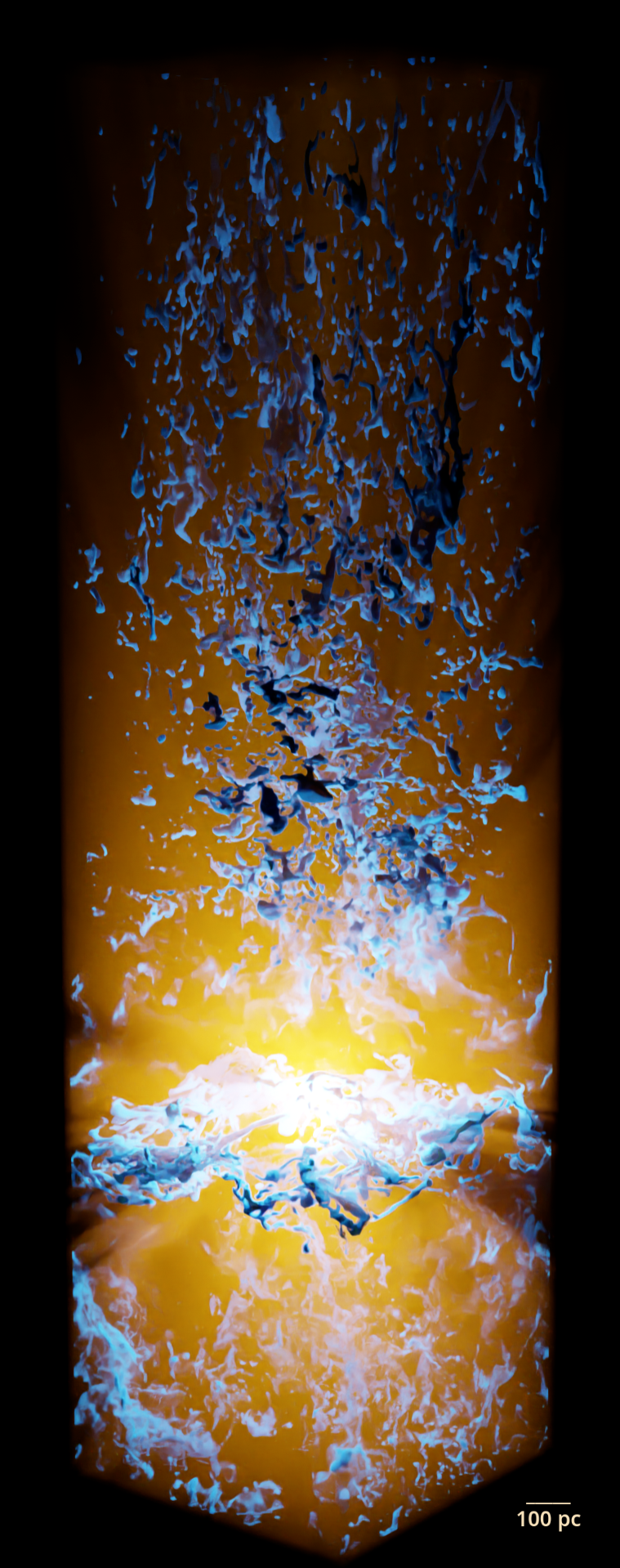
- 使用 yt、matplotlib 和 numpy 进行数据分析与可视化,使用 Blender 进行云体结构的三维渲染。
实验结果
研究问题
- RQ1由成簇超新星驱动的湍流磁化星系风中,冷云如何形成并演化?
- RQ2理想化混合层模型中的分析标度在大尺度真实多相喷流中适用程度如何?
- RQ3是什么决定了湍流星系风中冷云的大小分布与存活率?
- RQ4湍流、磁场和剪切如何共同影响云体形态复杂性与质量增长?
- RQ5热压力与湍流压力在抵抗引力与冲压压力作用下,对冷云的支持中相对重要性如何?
主要发现
- 冷云通过超级气泡破裂期间ISM的动力学破碎裂形成,从而在热喷流中播下了多相结构的种子。
- 云体尺寸遵循幂律分布,且 dN/dm ∝ −2,该结果在有无磁场的模拟中均一致,且与云体存活半径和盘面标高作为物理截断尺度的理论一致。
- 云体内湍流马赫数约为1,表明湍流压力与热压力支持作用相当,尽管初始ISM的 β ∼ 1。
- 云体存活由条件 t_cool,mix < t_shear 决定,临界半径 r_crit,shear 与观测到的存活阈值一致。
- 质量增长速率可被湍流辐射混合层理论良好预测,模型预测的标度关系与估算的 ṁ 与模拟输出高度一致。
- 云体进入喷流后,湍流由冷却或冷却诱发的振荡维持,而非剪切作用,且KHI并非混合过程的主要驱动力。
更好的研究,从现在开始
从阅读论文到最终审阅,大幅缩短您的研究时间。
无需绑定信用卡
本解读由 AI 生成,并经人工编辑审核。