
[论文解读] Clustering transformed compositional data using K-means, with applications in gene expression and bicycle sharing system data
本文提出一种基于数据变换的K均值聚类策略,用于成分数据,具体包括中心对数比(CLR)和一种新型的对数中心对数比(logCLR)变换,以提升基因表达和共享自行车数据中的聚类性能。该方法通过更好地处理零值或近零值,在未变换数据的基础上表现更优,并采用非渐近惩罚准则结合斜率启发式方法,选择最优聚类数。
Although there is no shortage of clustering algorithms proposed in the literature, the question of the most relevant strategy for clustering compositional data (i.e., data made up of profiles, whose rows belong to the simplex) remains largely unexplored in cases where the observed value of an observation is equal or close to zero for one or more samples. This work is motivated by the analysis of two sets of compositional data, both focused on the categorization of profiles but arising from considerably different applications: (1) identifying groups of co-expressed genes from high-throughput RNA sequencing data, in which a given gene may be completely silent in one or more experimental conditions; and (2) finding patterns in the usage of stations over the course of one week in the Velib' bicycle sharing system in Paris, France. For both of these applications, we focus on the use of appropriately chosen data transformations, including the Centered Log Ratio and a novel extension we propose called the Log Centered Log Ratio, in conjunction with the K-means algorithm. We use a nonasymptotic penalized criterion, whose penalty is calibrated with the slope heuristics, to select the number of clusters present in the data. Finally, we illustrate the performance of this clustering strategy, which is implemented in the Bioconductor package coseq, on both the gene expression and bicycle sharing system data.
研究动机与目标
- 解决缺乏系统性策略对成分数据聚类的问题,特别是当数值为零或接近零时。
- 研究数据变换对成分数据设定下K均值聚类性能的影响。
- 提出一种新型变换——对数中心对数比(logCLR),以增强对靠近单纯形顶点的异常情况观测的分离能力。
- 使用非渐近惩罚准则结合斜率启发式方法,选择最优聚类数。
- 在真实世界数据集(RNA-seq基因表达和Velib’共享自行车系统数据)上展示该方法的有效性。
提出的方法
- 在三种数据形式上应用基于欧氏距离的K均值聚类:未变换的成分数据、CLR变换数据和logCLR变换数据。
- 提出logCLR变换作为CLR的改进形式,以增强对具有近零成分的观测的分离能力。
- 使用非渐近惩罚准则(如BIC类似准则)结合斜率启发式方法选择聚类数,避免过拟合。
- 在Bioconductor软件包coseq中实现完整分析流程,以支持成分数据的可重复分析。
- 通过轮廓可视化与空间映射(如巴黎地铁站的地理聚类)评估聚类结果。
- 在不同变换之间比较结果,以确定哪种方法最能捕捉生物或行为上具有意义的分组。
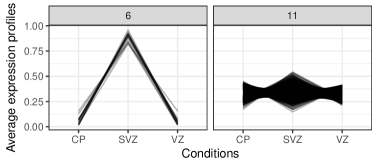
实验结果
研究问题
- RQ1不同的数据变换(未变换、CLR、logCLR)如何影响在含有零值或近零值的成分数据上的K均值聚类性能?
- RQ2所提出的logCLR变换是否能比标准CLR更好地捕捉高度特异或边缘情况的成分轮廓?
- RQ3当真实结构包含稀疏或位于顶点的轮廓时,成分数据中的最优聚类数是多少?
- RQ4基于斜率启发式的惩罚准则在真实世界成分数据集中能否可靠地选择聚类数?
- RQ5聚类结果在多大程度上可解释为现实世界模式,如基因共表达或城市出行行为?
主要发现
- 在RNA-seq和Velib’共享自行车数据集中,logCLR变换均取得了最令人满意的聚类结果,尤其在识别出具有明确行为一致性的用户或基因轮廓方面表现突出。
- Velib’数据的聚类轮廓与已知城市区域具有强空间一致性:例如,市中心的第3号聚类、居民区的第7号聚类,以及高海拔V+站点中具有夜间再分配需求的第11号聚类。
- 使用logCLR变换的K均值算法成功识别出RNA-seq数据中具有生物意义的共表达基因群,即使在某些条件下部分基因表达沉默。
- 非渐近惩罚准则结合斜率启发式方法提供了可靠的聚类数选择,避免了过拟合,并支持稳健的模型选择。
- 该方法的结果与使用原始计数的χ²距离相当,表明CLR/logCLR变换是成分数据聚类的有效替代方案。
- logCLR变换在分离具有近零成分的轮廓方面尤为有效,其在边缘情况检测中的表现优于未变换和标准CLR方法。

更好的研究,从现在开始
从阅读论文到最终审阅,大幅缩短您的研究时间。
无需绑定信用卡
本解读由 AI 生成,并经人工编辑审核。