
QUICK REVIEW
[论文解读] CODATA Recommended Values of the Fundamental Physical Constants: 2022
Peter J. Mohr, David B. Newell|arXiv (Cornell University)|Aug 30, 2024
Renal function and acid-base balance被引用 37
一句话总结
本文给出基于对截至2022年12月31日数据进行最小二乘调整得到的2022年自洽 CODATA 基本物理常数值,并讨论了主要改进与数据不一致。
ABSTRACT
We report the 2022 self-consistent values of constants and conversion factors of physics and chemistry recommended by the Committee on Data of the International Science Council (CODATA). The recommended values can also be found at physics.nist.gov/constants. The values are based on a least-squares adjustment that takes into account all theoretical and experimental data available through 31 December 2022. A discussion of the major improvements as well as inconsistencies within the data is given.
研究动机与目标
- 为物理学和化学提供自洽的基本物理常数及换算因子。
- 执行至2022年12月31日的理论与实验数据的最小二乘调整。
- 识别影响2022年推荐值的主要改进与数据不一致。
- 解释μ态与电子转变数据的处理及其对推导常数的影响。
- 将2022年的结果与2018年的调整进行比较,并讨论对计量学与理论的含义。
提出的方法
- 对133个输入数据和79个待调整常数(ν = 54)进行最小二乘调整(LSA)。
- 结合包括相对原子质量、离化/结合能、氢/氘跃迁能、μ子原子、电子磁矩异常,以及电弱量量在内的广泛输入数据。
- 对不确定度扩展因子以实现可接受的χ²和数据一致性(表11、12及D1–D6采用1.7×,并有2.5的因子)。
- 将AMDC、NIST ASD及其他来源的数据,结合更新的理论与相关性,作为输入进入调整。
- 讨论μ子兰姆位移数据在半径测定中的作用及质子半径之谜。
- 报告2022 CODATA数值及其与2018调整的比较,包括修订后的SI和理论改进的影响。
实验结果
研究问题
- RQ12022年自洽CODATA推荐的基本常数与换算因值是什么?
- RQ2截至2022年12月31日的新实验与理论数据如何影响相对于2018调整的调整常数?
- RQ3在2022调整中识别出的主要改进与不一致性有哪些,它们如何影响不确定度和中心值?
- RQ4在2022调整中,质子半径之谜和μ子磁矩异常等关键问题的现状如何?
主要发现
- 2022年调整使用133个输入数据和79个调整常数(ν = 54)。
- 最初的χ²为109.6,在应用扩展因子后降至44.2,给出ν = 54时χ²值偶然发生的概率为83%。
- 更新的电子磁矩异常输入及相关理论将来自多独立决定的精细结构常数α的不确定性降低。
- μ子磁矩异常显示实验与理论之间存在4.2σ的差异,最近的FNAL结果影响了该调整。
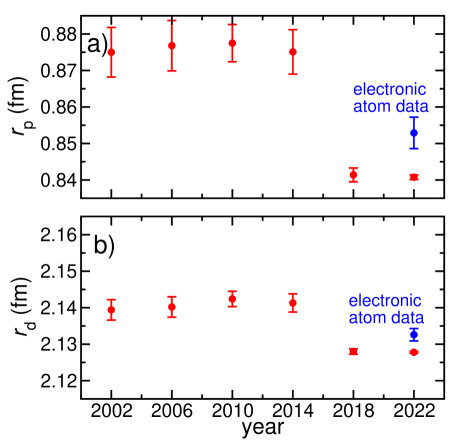
- 质子半径之谜依旧存在,因为μ子兰姆-位移半径与电子跃迁数据在不确定度范围内给出不同的中心值。
- 在这一时期,新数据未对G产生影响,万有引力常数G与2018调整保持不变。
更好的研究,从现在开始
从论文设计到论文写作,大幅缩短您的研究时间。
无需绑定信用卡
本解读由 AI 生成,并经人工编辑审核。