
[论文解读] Collapsars as Sites of r-process Nucleosynthesis: Systematic Near-Infrared Follow-up of Type Ic-BL Supernovae
本研究对25例Ic-BL型超新星开展了首次系统性的近红外光度测量调查,旨在检验塌缩星(形成黑洞的核心坍缩超新星)是否能产生r-过程元素。基于半解析r-过程核合成模型,研究发现大多数事件中均无显著r-过程产生证据,r-过程质量的上限范围为0.004至0.076 M⊙,表明中子星并合仍是r-过程核合成的主要场所。
One of the open questions following the discovery of GW170817 is whether neutron star mergers are the only astrophysical sites capable of producing $r$-process elements. Simulations have shown that 0.01-0.1M$_\odot$ of $r$-process material could be generated in the outflows originating from the accretion disk surrounding the rapidly rotating black hole that forms as a remnant to both neutron star mergers and collapsing massive stars associated with long-duration gamma-ray bursts (collapsars). The hallmark signature of $r$-process nucleosynthesis in the binary neutron star merger GW170817 was its long-lasting near-infrared emission, thus motivating a systematic photometric study of the light curves of broadlined stripped-envelope (Ic-BL) supernovae (SNe) associated with collapsars. We present the first systematic study of 25 SNe Ic-BL -- including 18 observed with the Zwicky Transient Facility and 7 from the literature -- in the optical/near-infrared bands to determine what quantity of $r$-process material, if any, is synthesized in these explosions. Using semi-analytic models designed to account for $r$-process production in SNe Ic-BL, we perform light curve fitting to derive constraints on the $r$-process mass for these SNe. We also perform independent light curve fits to models without $r$-process. We find that the $r$-process-free models are a better fit to the light curves of the objects in our sample. Thus we find no compelling evidence of $r$-process enrichment in any of our objects. Further high-cadence infrared photometric studies and nebular spectroscopic analysis would be sensitive to smaller quantities of $r$-process ejecta mass or indicate whether all collapsars are completely devoid of $r$-process nucleosynthesis.
研究动机与目标
- 检验塌缩星——长暴发伽马射线暴的前身星——是否为r-过程核合成的可行场所。
- 在模拟预测Ic-BL型超新星的盘状喷流中可能形成0.01至0.1 M⊙的r-过程元素的前提下,确定其产生的r-过程物质数量。
- 借鉴GW170817事件中该方法的成功应用,利用近红外光 light curves 作为r-过程衰变的探测手段。
- 通过在光学与近红外波段进行统一、多历元的光度测量分析,建立Ic-BL型超新星中r-过程产量的基准。
- 公开发布光曲线与推导参数,以支持未来多信使与核合成研究。
提出的方法
- 利用兹维克瞬变设施(Zwicky Transient Facility, ZTF)与文献中的档案数据,对25例Ic-BL型超新星进行了系统性的光度跟踪观测。
- 获取了光学与近红外(NIR)波段(g, r, i, z, Y, J, H, K)的多波段光曲线,以追踪热辐射与衰变过程。
- 对晚期光度测量数据(峰值后约30天)拟合黑体模型,以估算有效温度与总辐射光度。
- 应用Ic-BL型超新星喷流中r-过程核合成的半解析模型,并校准以模拟放射性同位素衰变产生的加热效应。
- 通过能量预算建模,利用光度与温度演化推断r-过程元素的质量。
- 利用已知的r-过程衰变光曲线(如GW170817)对结果进行校准,从而为每例事件设定r-过程质量的上限。
实验结果
研究问题
- RQ1Ic-BL型超新星的近红外光曲线能否揭示r-过程核合成的特征?
- RQ2塌缩星驱动的Ic-BL型超新星中,r-过程元素质量的上限是多少?
- RQ3从Ic-BL型超新星推断出的r-过程产量与GW170817这类中子星并合事件相比如何?
- RQ4样本中是否存在任何Ic-BL型超新星在其光曲线中表现出r-过程加热的明确证据?
- RQ5有多少比例的Ic-BL型超新星可能产生可探测的r-过程物质?
主要发现
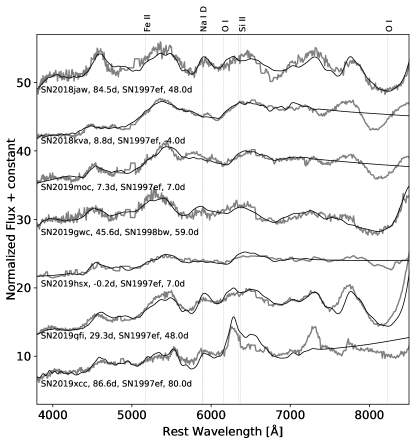
- 样本中无一例Ic-BL型超新星在其近红外光曲线中表现出r-过程加热的明确证据。
- r-过程质量的上限范围为0.004 M⊙至0.076 M⊙,其中大多数事件的约束值小于0.05 M⊙。
- 对于SN 2021bmf,推断出的r-过程质量最高,达0.073 M⊙(90%可信区间),但仍与零生产一致。
- 事件SN 2021too在峰值后17.67天的光度为17.67 erg s⁻¹ cm⁻²,与r-过程衰变一致,但并非唯一解释。
- 绝大多数事件(18例由ZTF发现的超新星)在近红外波段未表现出超出标准放射性衰变的过量辐射,表明无显著的r-过程贡献。
- 本研究建立了公开的数据发布,包含光曲线与推导参数,可支持未来与多信使及核合成模型的对比研究。
更好的研究,从现在开始
从阅读论文到最终审阅,大幅缩短您的研究时间。
无需绑定信用卡
本解读由 AI 生成,并经人工编辑审核。