
[论文解读] colorspace: A Toolbox for Manipulating and Assessing Colors and Palettes
The colorspace R package provides a flexible toolkit to select, manipulate, and evaluate colors and color palettes using the HCL color space, including qualitative, sequential, and diverging types, with visualization, interactive apps, and color-vision deficiency emulation.
The R package colorspace provides a flexible toolbox for selecting individual colors or color palettes, manipulating these colors, and employing them in statistical graphics and data visualizations. In particular, the package provides a broad range of color palettes based on the HCL (Hue-Chroma-Luminance) color space. The three HCL dimensions have been shown to match those of the human visual system very well, thus facilitating intuitive selection of color palettes through trajectories in this space. Using the HCL color model general strategies for three types of palettes are implemented: (1) Qualitative for coding categorical information, i.e., where no particular ordering of categories is available. (2) Sequential for coding ordered/numeric information, i.e., going from high to low (or vice versa). (3) Diverging for coding ordered/numeric information around a central neutral value, i.e., where colors diverge from neutral to two extremes. To aid selection and application of these palettes the package also contains scales for use with ggplot2, shiny (and tcltk) apps for interactive exploration, visualizations of palette properties, accompanying manipulation utilities (like desaturation and lighten/darken), and emulation of color vision deficiencies.
研究动机与目标
- 提供一个可访问、感知上映射的框架用于基于 HCL 色空间的调色板构建。
- 提供广泛的预定义定性、顺序和发散调色板及可自定义参数。
- 实现调色板的可视化、评估与操作(去饱和、变亮/变暗等)。
- 促进与图形系统如 ggplot2 及互动应用(Shiny、tcltk)之集成。
- 支持色觉缺陷仿真以评估调色板的可及性。
提出的方法
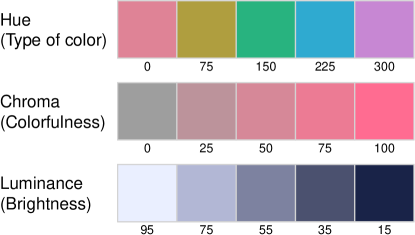
- 采用基于感知的 Hue–Chroma–Luminance (HCL) 色空间来构建三种调色板类型:定性、顺序和发散。
- 提供 S4 色空间类及用于在不同空间之间转换、提取坐标和十六进制编码的工具。
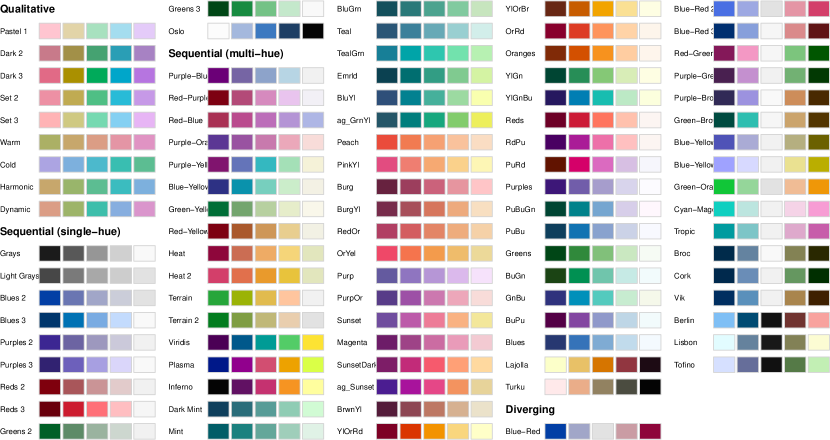
- 通过 hcl_palettes 构建调色板,并使用特定函数 qualitative_hcl()、sequential_hcl()、和 diverging_hcl(),具有 H、C、L 的固定和参数化轨迹。
- 包括通过色相、色度和亮度轨迹、以及幂变换轨迹和多色相变体来定制调色板的方法。
- 提供可视化工具(demoplot、hclplot、specplot)来评估调色板内的亮度、色度和色相分布。
- 提供 ggplot2 规模整合(scale_<aesthetic>_<datatype>_<colorscale>()) 和交互工具(choose_palette/hclwizard)用于探索。
实验结果
研究问题
- RQ1colorspace 如何利用 HCL 色空间生成感知上连贯的调色板?
- RQ2颜色空间中定义定性、顺序和发散调色板的构造与参数化(轨迹)是什么?
- RQ3用户如何可视化并评估基于 HCL 的调色板的属性(色相、色度、亮度)及其对不同绘图类型的适用性?
- RQ4colorspace 如何支持与基础 R 图形及 ggplot2 的互操作性,包括颜色尺度和应用程序基础探索?
- RQ5有哪些特征可用于色觉缺陷仿真以评估调色板的可及性?
主要发现
- Colorspace 提供基于 HCL 的三种主要调色板构造器:qualitative_hcl()、sequential_hcl(),和 diverging_hcl()。
- 该包附带大量预定义调色板,覆盖定性、顺序(单色相和多色相)和发散类型,近似流行的 Palette 家族。
- 调色板可视化工具(demoplot、hclplot、specplot)使评估调色板内的色相、色度和亮度轨迹成为可能。
- 与 ggplot2 规模和交互应用(hclwizard、Shiny、tcltk)的集成便于调色板的应用与探索。
- 该包支持调色板自定义并通过 register 参数注册用户定义的调色板,从而扩展调色板目录。
更好的研究,从现在开始
从论文设计到论文写作,大幅缩短您的研究时间。
无需绑定信用卡
本解读由 AI 生成,并经人工编辑审核。