
[论文解读] Colossal c-axis response and lack of rotational symmetry breaking within the kagome plane of the CsV$_3$Sb$_5$ superconductor
本研究揭示,CsV₃Sb₅中的电荷密度波(CDW)态对c轴应变表现出巨大的响应,且在kagome平面内未发现旋转对称性破缺的证据。CDW相表现出由电子-电子散射驱动的强烈增强的A₁g对称弹性电阻率,而超导性与CDW在c轴调制下存在强烈竞争,表明c轴是调控该kagome超导体电子不稳定性的主要参数。
The kagome materials AV4$_3$Sb$_5$ (A = K, Rb, Cs) host an intriguing interplay between unconventional superconductivity and charge-density-waves. Here, we investigate CsV$_3$Sb$_5$ by combining high-resolution thermal-expansion, heat-capacity and electrical resistance under strain measurements. We directly unveil that the superconducting and charge-ordered states strongly compete, and that this competition is dramatically influenced by tuning the crystallographic c-axis. In addition, we report the absence of additional bulk phase transitions within the charge-ordered state, notably associated with rotational symmetry-breaking within the kagome planes. This suggests that any breaking of the C$_6$ invariance occurs via different stacking of C$_6$-symmetric kagome patterns. Finally, we find that the charge-density-wave phase exhibits an enhanced A$_{1g}$-symmetric elastoresistance coefficient, whose large increase at low temperature is driven by electronic degrees of freedom.
研究动机与目标
- 研究应变下CsV₃Sb₅中超导性与电荷密度波(CDW)序之间的相互作用。
- 确定CDW态是否通过热力学与弹性电阻率测量在kagome平面内破缺六重旋转对称性(C₆)。
- 阐明CDW相中巨大弹性电阻率响应的起源及其对称性通道。
- 评估c轴调制在调制CDW与超导态之间竞争关系中的作用。
- 通过结合高分辨率热力学与输运测量,解决AV₃Sb₅中关于电子向列性与对称性破缺的相互矛盾报告。
提出的方法
- 对来自两个来源(上海与卡尔斯鲁厄)的CsV₃Sb₅单晶进行了高分辨率热膨胀与比热测量,以探测体积极热力学响应。
- 沿[100]方向施加单轴应变以测量弹性电阻率,并将对称性分解为A₁g与E₂g通道,以识别电子各向异性的本质。
- 采用Kadowaki-Woods关系(A ∝ γ²)将电阻率系数A与电子比热系数γ关联,从而推断电子-电子散射的贡献。
- 利用应变依赖的电阻率与热膨胀测量,分离电子-声子与电子-电子散射的贡献。
- 将弹性电阻率数据与未经校正的残余电阻率进行比较,表明先前报道的约T ≈ 35 K处的下降趋势很可能是由于未计入的残余电阻率所致。
- 交叉比对X射线衍射与先前的弹性电阻率数据,以评估其与报告的C₆对称性破缺及堆叠畸变的一致性。
![Figure 1: (a) Relative length changes, $\Delta L/L$ , along the hexagonal directions and corresponding volume change as a function of temperature. The black vertical dashed line indicates T CDW . (b) Comparison of $\Delta L_{i}/L_{i}$ measured along the orthogonal [100] and [210] hexagonal direction](https://ar5iv.labs.arxiv.org/html/2310.06102/assets/x1.png)
实验结果
研究问题
- RQ1CsV₃Sb₅中的电荷密度波态是否在kagome平面内破缺六重旋转对称性?
- RQ2CDW相中巨大弹性电阻率响应的起源是什么?其主导对称性通道为何?
- RQ3c轴调制如何影响超导性与电荷密度波序之间的竞争?
- RQ4是否存在热力学证据表明CDW态内存在额外的体相变,例如与c轴周期性或向列序相关的相变?
- RQ5在低温下,电子-电子散射对弹性电阻率的贡献在多大程度上占主导地位,特别是在CDW相中?
主要发现
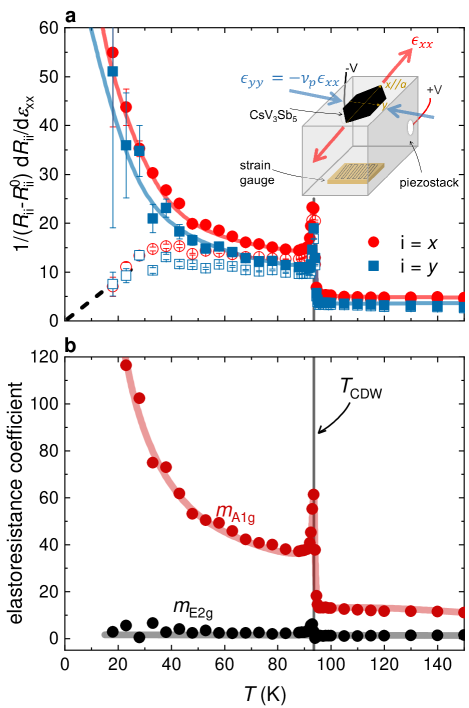
- CsV₃Sb₅中的CDW态对c轴应变表现出巨大响应,A₁g对称弹性电阻率系数在20 K时达到mₐ₁g ≈ 120。
- 在T_CDW以下未发现正交畸变或额外体相变的热力学证据,表明kagome平面内的六重旋转对称性得以保持。
- 在整个温度范围内,E₂g对称弹性电阻率响应可忽略不计,排除了面内向列性与各向异性应变的直接耦合。
- 巨大的A₁g弹性电阻率主要由电子贡献,其温度依赖性由低温下电子-电子散射的增强所驱动。
- 观测到的mₐ₁g增强与[100]单轴压力下电子比热系数γ的减小相关,符合Kadowaki-Woods关系。
- 先前报道的约T ≈ 35 K处弹性电阻率的下降被证明是未校正残余电阻率所致的伪影,而非真实的电子相变。
更好的研究,从现在开始
从阅读论文到最终审阅,大幅缩短您的研究时间。
无需绑定信用卡
本解读由 AI 生成,并经人工编辑审核。