
[论文解读] Companion Animal Disease Diagnostics based on Literal-aware Medical Knowledge Graph Representation Learning
该论文提出LiteralKG,一种知识图嵌入模型,通过门控融合与注意力消息传递机制,将异质性文字信息(如症状、文本描述、治疗方案)与图结构相结合,以提升伴侣动物疾病诊断性能。该模型在链接预测任务上达到最先进性能,通过在无标签的图结构上进行自监督预训练,显著优于基线模型。
Knowledge graph (KG) embedding has been used to benefit the diagnosis of animal diseases by analyzing electronic medical records (EMRs), such as notes and veterinary records. However, learning representations to capture entities and relations with literal information in KGs is challenging as the KGs show heterogeneous properties and various types of literal information. Meanwhile, the existing methods mostly aim to preserve graph structures surrounding target nodes without considering different types of literals, which could also carry significant information. In this paper, we propose a knowledge graph embedding model for the efficient diagnosis of animal diseases, which could learn various types of literal information and graph structure and fuse them into unified representations, namely LiteralKG. Specifically, we construct a knowledge graph that is built from EMRs along with literal information collected from various animal hospitals. We then fuse different types of entities and node feature information into unified vector representations through gate networks. Finally, we propose a self-supervised learning task to learn graph structure in pretext tasks and then towards various downstream tasks. Experimental results on link prediction tasks demonstrate that our model outperforms the baselines that consist of state-of-the-art models. The source code is available at https://github.com/NSLab-CUK/LiteralKG.
研究动机与目标
- 解决现有知识图嵌入模型在伴侣动物疾病诊断中忽略电子病历(EMRs)中多样化文字信息的局限性。
- 开发一种统一的表征学习框架,有效融合异质性实体属性(如数值型、文本型)与图结构。
- 通过在图结构上进行自监督预训练,学习有意义的表征而无需标注数据,从而提升诊断性能。
- 探究不同图神经网络聚合器及架构组件对异质性医学知识图中表征学习的影响。
提出的方法
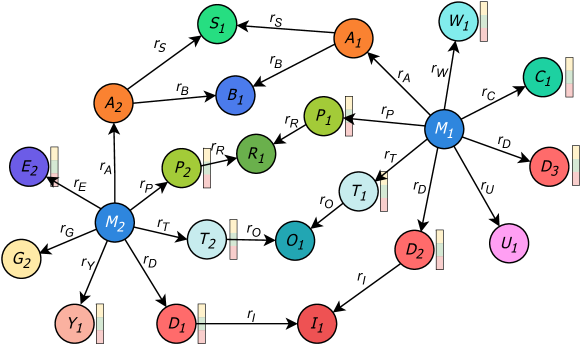
- 从31家伴侣动物医院收集的电子病历中构建医学知识图(MKG),整合临床记录、症状、治疗方案及人口统计学信息中的实体与关系。
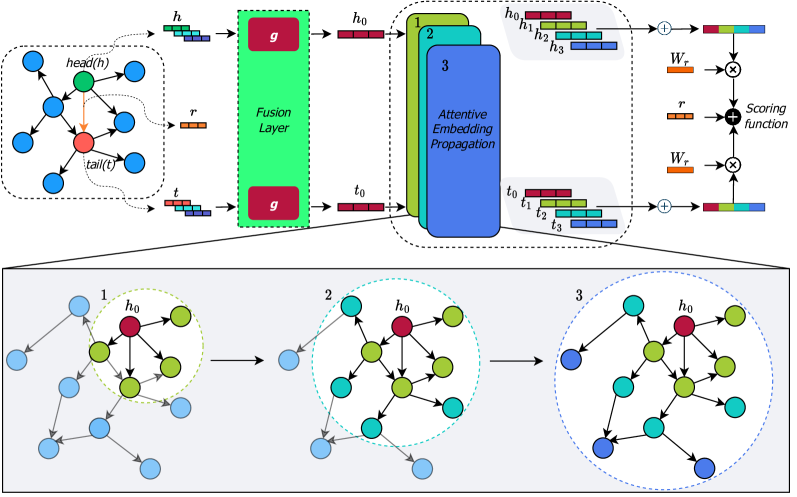
- 应用门控网络将多样化文字特征(如文本描述、数值型数据、分类属性)融合为统一的实体表征。
- 采用带有残差连接的注意力消息传递机制,以捕捉局部与全局图结构,增强特征传播效果。
- 设计基于三元组负采样的自监督预训练任务,以在无需标注数据的情况下学习知识图中的结构邻近性。
- 在下游链接预测任务上微调预训练模型,以评估诊断表征的质量。
- 采用多种图神经网络聚合器(GCN、GraphSAGE、Bi-Interaction、GIN)进行性能对比,并分析其对表征学习的影响。
实验结果
研究问题
- RQ1RQ1:融合不同类型的文字信息与图结构是否能提升医学知识图中复杂关系发现的表征学习效果?
- RQ2RQ2:哪些编码器架构(如GIN、Bi-Interaction)最能捕捉医学知识图中的异质性特征与结构复杂性?
- RQ3RQ3:自监督预训练任务能否生成有效表征,从而提升下游诊断任务(如链接预测)的性能?
主要发现
- 使用Bi-Interaction聚合器时,LiteralKG在链接预测任务上取得0.8712的F1分数,优于所有基线模型。
- 采用GIN聚合器并使用预训练权重后,F1分数从0.8021提升至0.8612,准确率从0.8013提升至0.8490。
- 1层的LiteralKG模型在Bi-Interaction聚合器上达到峰值性能,表明更深的堆叠可能导致该架构出现过平滑问题。
- GIN聚合器在深度上表现出更优的可扩展性,其1D-WL同构性能力可缓解过平滑问题,性能在8层内保持稳定。
- 残差连接使F1分数从0.8174提升至0.8378,表明其在消息传递过程中有效保持了特征完整性。
- 预训练阶段显著提升了下游任务性能,验证了自监督学习在医学知识图表征学习中的有效性。
更好的研究,从现在开始
从阅读论文到最终审阅,大幅缩短您的研究时间。
无需绑定信用卡
本解读由 AI 生成,并经人工编辑审核。