
[论文解读] Confirmation and refutation of very luminous galaxies in the early universe
JWST/NIRSpec 光谱确认两颗 z>11 星系并通过揭示 z=4.9 的混入体而否定一个 z~16 的候选对象;强调对光度法高红移候选对象进行光谱学验证的必要性,以及对早期星系形成的意义。
During the first 500 million years of cosmic history, the first stars and galaxies formed, seeding the Universe with heavy elements and eventually reionizing the intergalactic medium. Observations with JWST have uncovered a surprisingly high abundance of candidates for early star-forming galaxies, with distances (redshifts, $z$), estimated from multi-band photometry, as large as $z\approx 16$, far beyond pre-JWST limits. While generally robust, such photometric redshifts can suffer from degeneracies and occasionally catastrophic errors. Spectroscopic measurement is required to validate these sources and to reliably quantify physical properties that can constrain galaxy formation models and cosmology. Here we present JWST spectroscopy that confirms redshifts for two very luminous galaxies with $z > 11$, but also demonstrates that another candidate with suggested $z\approx 16$ instead has $z = 4.9$, with an unusual combination of nebular line emission and dust reddening that mimics the colors expected for much more distant objects. These results reinforce evidence for the early, rapid formation of remarkably luminous galaxies, while also highlighting the necessity of spectroscopic verification. The large abundance of bright, early galaxies may indicate shortcomings in current galaxy formation models, or deviation from physical properties (such as the stellar initial mass function) that are generally believed to hold at later times.
研究动机与目标
- 使用 JWST 光谱学验证光度法高红移星系候选者。
- 测量光谱红移与关键发射线,以确认或推翻所提早期宇宙源。
- 推断已确认的 z>11 星系的物理性质,并与理论预期进行比较。
提出的方法
- 使用 JWST NIRSpec 棱镜光谱学,低分辨率、宽波段覆盖(0.6–5.3 μm),以检测连续性断裂与发射线。
- 识别 Lyα 跃变和如 [O II] 之类的发射线以确定红移。
- 采用 NIRCam 光度计进行 photometry 的交叉对比,进行光度数据处理与光谱通量标定。
- 结合光谱和光度数据对恒星群体进行建模,以推导恒星质量、SFR、A_V 和 sSFR。
- 使用 NOEMA 1.1 mm 观测评估 CEERS-93316 位置的尘埃发射(目标位置未检出)。
- 将观测结果与以往文献相比,以将结果置于早期星系形成的背景中。
实验结果
研究问题
- RQ1经过光谱确认后,JWST 的 z>11 光度法高红移候选星系是否为真实星系?
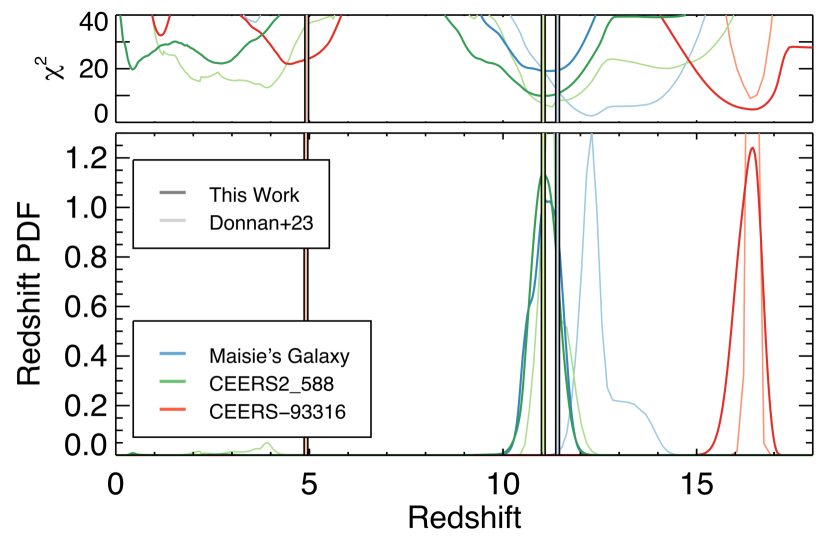
- RQ2亮星的 z>11 候选星系(Maisie’s Galaxy、CEERS2_588、CEERS-93316)的光谱红移是多少,它们与光度估计有何差异?
- RQ3经光谱确认的 z>11 星系的物理性质(恒星质量、SFR、尘埃衰减)为何,以及它们如何为早期星系形成模型提供信息?
- RQ4高于 z>9 的极端带宽光度颜色是否可被较低红shift 的尘埃星系或发射线星系模仿,光谱学如何区分它们?
- RQ5在 z>>10 突显的明亮星系盛行对星系形成理论和初始质量函数(IMF)的假设意味着什么?
主要发现
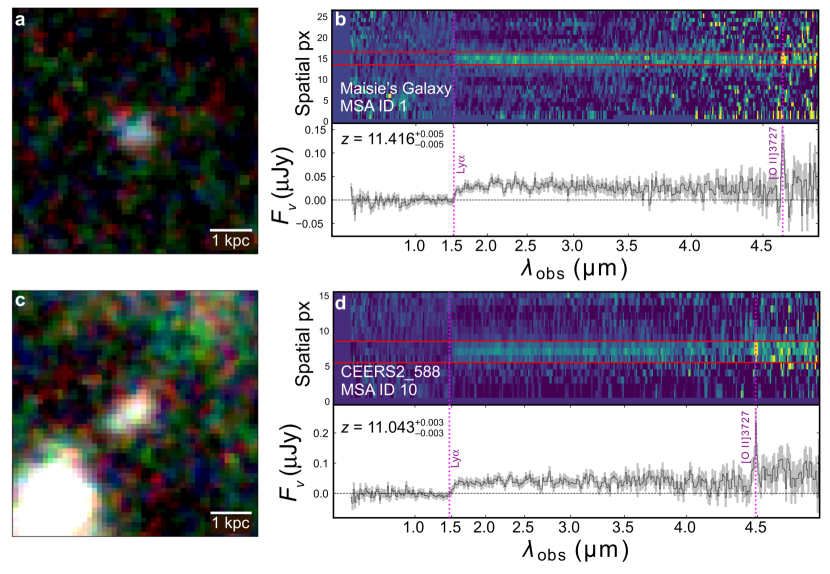
- 两颗星系的光谱红移已确认为 z=11.416±0.005 与 z=11.043±0.003(Maisie’s Galaxy 与 CEERS2_588)。
- 第三个候选 CEERS-93316,此前被认为在 z~16,实际光谱红移为 z=4.912±0.001,具有强的 nebular 发射线和尘埃红化,能模仿更高红移的颜色。
- Maisie’s Galaxy 与 CEERS2_588 是已知的 z>11 最 UV-明亮的星系,M_UV 分别为 −20.1 与 −20.3;两者都显示 Lyα 跀变和弱的 [O II] 探测。
- CEERS-93316 在 z=4.912 展现出强的 Hα、[NII]、[O III] 发射线,Balmer 衰减显著(Hα/Hβ=5.2±0.5),指示星际气体的红化(E(B−V)=0.60±0.10)。
- NOEMA 1.1 mm 观测未在 CEERS-93316 处检出 1.1 mm 连续辐射,但发现邻近的一个 z~4.9 星系可能是先前亚毫米探测的来源。
- 对已确认的 z>11 星系进行固定光谱红移的恒星群体建模,得到 M_star≈10^8.6–10^8.7 M_sun、低尘埃消减 A_V≈0.1–0.2 mag、SFR≈2–10 M_sun/yr、sSFR≈−8.3 to −7.7 yr^−1,与其他 z>11 星系一致。
更好的研究,从现在开始
从阅读论文到最终审阅,大幅缩短您的研究时间。
无需绑定信用卡
本解读由 AI 生成,并经人工编辑审核。