
[论文解读] Connecting the Hamiltonian structure to the QAOA energy and Fourier landscape structure
本文研究了哈密顿量的结构——特别是其项的顺序、系数和拓扑——如何影响QAOA代价景观及其傅里叶变换。通过引入粗糙度度量并使用orqviz可视化景观,作者表明,较大的系数差异和高阶项会增加景观的粗糙度,而结构对称性则会降低粗糙度,为优化器选择和问题特定设计提供了洞见。
In this paper, we aim to expand the understanding of the relationship between the composition of the Hamiltonian in the Quantum Approximate Optimization Algorithm (QAOA) and the corresponding cost landscape characteristics. QAOA is a prominent example of a Variational Quantum Algorithm (VQA), which is most commonly used for combinatorial optimization. The success of QAOA heavily relies on parameter optimization, which is a great challenge, especially on scarce noisy quantum hardware. Thus understanding the cost function landscape can aid in designing better optimization heuristics and therefore potentially provide eventual value. We consider the case of 1-layer QAOA for Hamiltonians with up to 5-local terms and up to 20 qubits. In addition to visualizing the cost landscapes, we calculate their Fourier transform to study the relationship with the structure of the Hamiltonians from a complementary perspective. Furthermore, we introduce metrics to quantify the roughness of the landscape, which provide valuable insights into the nature of high-dimensional parametrized landscapes. While these techniques allow us to elucidate the role of Hamiltonian structure, order of the terms and their coefficients on the roughness of the optimization landscape, we also find that predicting the intricate landscapes of VQAs from first principles is very challenging and unlikely to be feasible in general.
研究动机与目标
- 理解哈密顿量结构如何影响QAOA代价景观的形状与复杂度。
- 识别哪些哈密顿量属性——如项的阶数、系数大小和拓扑——对景观粗糙度的影响最为显著。
- 开发用于量化代价景观和傅里叶景观中粗糙度的定量度量,以指导优化器选择。
- 探索从第一性原理预测VQA中景观复杂度的可行性。
- 证明哈密顿量的结构对称性可导致更鲁棒且更平滑的优化景观。
提出的方法
- 使用orqviz库可视化最多20量子比特和5体局域哈密顿量的1层QAOA代价景观。
- 计算代价景观的傅里叶变换,以分析频谱成分并将其与哈密顿量结构关联。
- 为代价景观和傅里叶景观引入粗糙度度量,以量化景观复杂度。
- 通过改变系数、增删项以及调整项的顺序,系统性地修改哈密顿量,以评估其对粗糙度的影响。
- 使用谱分析,将傅里叶景观中的高频分量与高阶项和系数不平衡的存在相关联。
- 将结构化哈密顿量(如3-正则图)的景观与随机化版本进行比较,以评估鲁棒性和微扰效应。

实验结果
研究问题
- RQ1哈密顿量系数的相对大小在多大程度上影响QAOA代价景观的粗糙度?
- RQ2高阶项(如4体相互作用)在多大程度上增加了QAOA景观的复杂度和局部极小点的数量?
- RQ3哈密顿量的底层结构——如源自图问题的结构——在受到微扰时如何影响景观的鲁棒性?
- RQ4代价景观和傅里叶景观中的粗糙度度量能否用于预测QAOA中的优化难度?
- RQ5量子比特数量或哈密顿量中的总项数是否独立地影响景观粗糙度?
主要发现
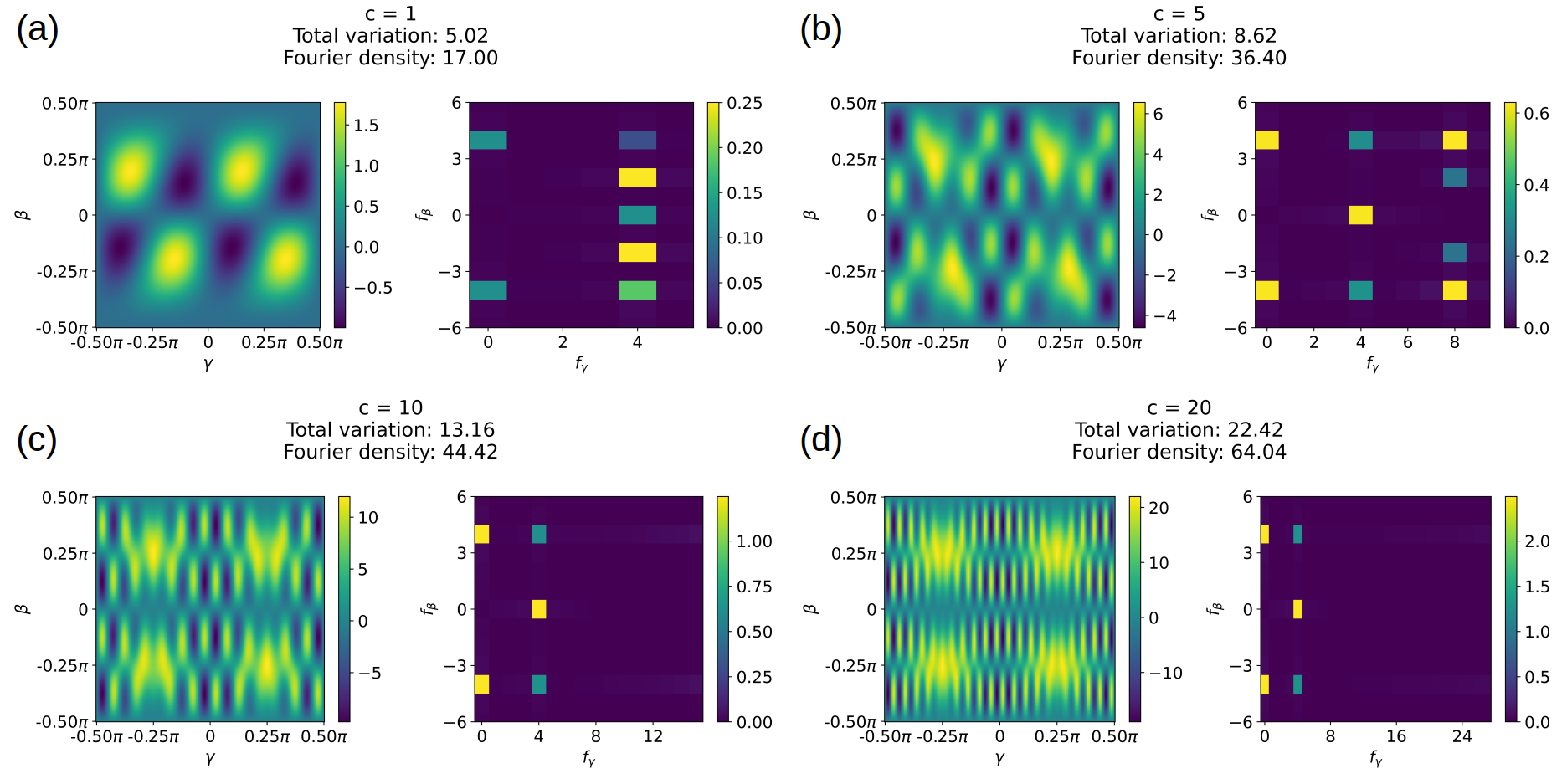
- 哈密顿量系数的较大相对大小,尤其是当某一单项占主导时,由于频率的过度强调,会显著增加景观的粗糙度。
- 高阶项的存在会提高傅里叶谱中的最大频率,从而导致更多鞍点和局部极小点。
- 具有底层结构对称性的哈密顿量——如源自3-正则图的哈密顿量——表现出更低的粗糙度,并对小扰动具有更高的鲁棒性。
- 量子比特数量和哈密顿量中的总项数并不会独立地增加粗糙度;相反,它们可能导致景观集中化并降低特征复杂度。
- 在结构化哈密顿量中观察到参数集中现象,表明可利用共享结构特性研究整个QAOA问题族。
- 本研究确认,即使引入了这些度量,从第一性原理预测VQA景观仍极具挑战性,原因在于系数、项顺序和拓扑之间复杂的相互作用。
更好的研究,从现在开始
从阅读论文到最终审阅,大幅缩短您的研究时间。
无需绑定信用卡
本解读由 AI 生成,并经人工编辑审核。