
[论文解读] Constraint on Early Dark Energy from Isotropic Cosmic Birefringence
本文利用宇宙微波背景(CMB)的 $EB$ 功率谱,约束了早期暗能量(EDE)模型中光子-轴子耦合常数,该谱由宇称破坏性相互作用产生。结果在 68% 可信水平下得到 $g = (0.04 \pm 0.16)\,M_{\text{Pl}}^{-1}$,排除了显著的EDE诱导宇宙双折射现象,并提供了对基础物理和弦理论嵌入具有重要意义的、与前景无关的稳健限制。
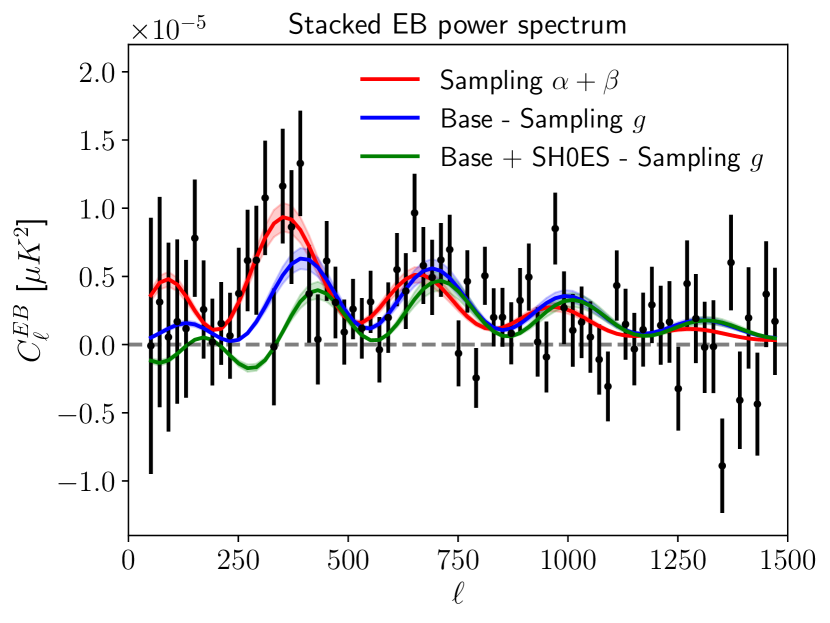
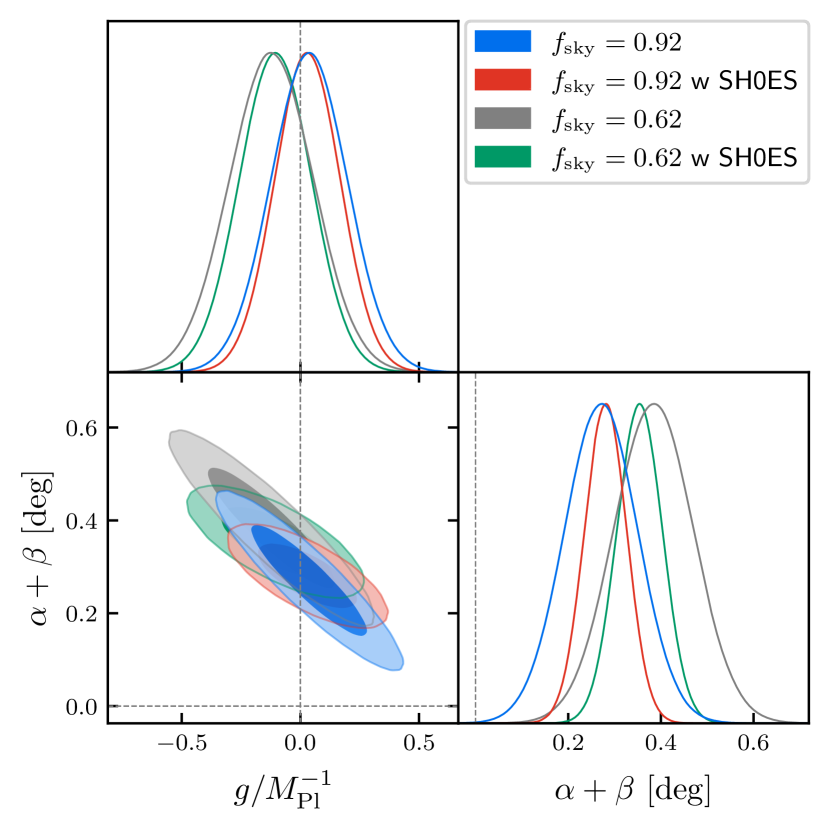
Polarization of the cosmic microwave background (CMB) is sensitive to new physics violating parity symmetry, such as the presence of a pseudoscalar "axionlike" field. Such a field may be responsible for early dark energy (EDE), which is active prior to recombination and provides a solution to the so-called Hubble tension. The EDE field coupled to photons in a parity-violating manner would rotate the plane of linear polarization of the CMB and produce a cross-correlation power spectrum of $E$- and $B$-mode polarization fields with opposite parities. In this paper, we fit the $EB$ power spectrum predicted by the photon-axion coupling of the EDE model with a potential $V(ϕ)\propto [1-\cos(ϕ/f)]^3$ to polarization data from Planck. We find that the unique shape of the predicted $EB$ power spectrum is not favored by the data and obtain a first constraint on the photon-axion coupling constant, $g=(0.04\pm 0.16)M_{ ext{Pl}}^{-1}$ (68% CL), for the EDE model that best fits the CMB and galaxy clustering data. This constraint is independent of the miscalibration of polarization angles of the instrument or the polarized Galactic foreground emission. Our limit on $g$ may have important implications for embedding EDE in fundamental physics, such as string theory.
研究动机与目标
- 测试具有赝标量轴子样场与光子耦合的早期暗能量(EDE)模型是否能在宇宙微波背景(CMB)中产生可观测的宇宙双折射效应。
- 利用宇称破坏性相互作用所预测的 $EB$ 功率谱的独特形状,约束光子-轴子耦合常数 $g$。
- 确定普朗克数据中观测到的 $EB$ 谱是否更倾向于由EDE诱导的双折射效应,还是更可能由再复合后效应或仪器校准误差解释。
- 评估所得到的 $g$-约束与弱引力猜想及弦理论等基础物理原理的相容性。
提出的方法
- 将EDE势建模为 $V(\phi) \propto [1 - \cos(\phi/f)]^3$,使该场能在再组合之前驱动一个瞬态暗能量相。
- 在拉格朗日量中引入陈-西蒙斯相互作用项 $\mathcal{L} \propto g\phi F_{\mu\nu}\tilde{F}^{\mu\nu}$,该作用导致宇称破坏并旋转CMB偏振面。
- 计算由光子-轴子耦合产生的预测 $EB$ 功率谱,其形状对 $g$ 敏感且与 $\ell$-模混合无关。
- 使用联合似然分析将预测的 $EB$ 谱拟合至普朗克2018年极化数据,对 $\alpha$(校准误差)和 $\beta$(再复合后双折射)进行边缘化处理。
- 利用 $EB$ 谱的奇宇称特性,将信号与宇称破坏性物理过程分离,避免来自标准 $E$-和 $B$-模源的污染。
- 采用贝叶斯分析方法,使用GetDist软件包,并通过改变势中的 $f_{\text{EDE}}$ 和 $n$ 验证结果的稳健性,确认约束主要依赖于 $\alpha + \beta$。
实验结果
研究问题
- RQ1普朗克数据观测到的 $EB$ 功率谱是否显示出通过光子-轴子耦合由早期暗能量诱导的宇宙双折射的证据?
- RQ2由EDE诱导的双折射所产生的 $EB$ 功率谱的独特谱形是否可与其它 $EB$ 相关来源区分开来?
- RQ3对光子-轴子耦合常数 $g$ 的约束是否对仪器校准误差或银河系前景发射的不确定性具有鲁棒性?
- RQ4所得到的 $g$-约束对将EDE嵌入弦理论或量子引力等基础理论有何启示?
- RQ5观测到的 $g$-极限是否与弱引力猜想相冲突,该猜想认为 $|g| \gtrsim M_{\text{Pl}}^{-1}$?
主要发现
- 普朗克数据不支持通过光子-轴子耦合由早期暗能量诱导的宇宙双折射,$EB$ 谱未显示出与零有显著偏离。
- 在 68% 可信水平下,光子-轴子耦合常数被约束为 $g = (0.04 \pm 0.16)\,M_{\text{Pl}}^{-1}$,表明耦合非常微弱。
- 该约束对校准角 $\alpha$ 和再复合后双折射 $\beta$ 具有鲁棒性,因为 $EB$ 谱的形状主要取决于 $\alpha + \beta$。
- 所得到的 $g$-值远小于引力耦合尺度,表明 $|g| \ll M_{\text{Pl}}^{-1}$,若要求 $|g| \gtrsim M_{\text{Pl}}^{-1}$,则可能与弱引力猜想相冲突。
- 对于 $f = 0.15\,M_{\text{Pl}}$ 的EDE模型,异常系数被约束为 $c_{\phi\gamma} = 5.2 \pm 21$(68% C.L.),若弱引力猜想要求 $|c_{\phi\gamma}| \gtrsim 130$,则该值与自然值不一致。
- 该方法可推广至其他EDE模型(如 $n=2$ 势),并可应用于未来灵敏度更高的CMB实验。
更好的研究,从现在开始
从阅读论文到最终审阅,大幅缩短您的研究时间。
无需绑定信用卡
本解读由 AI 生成,并经人工编辑审核。