
[论文解读] Constraints on the Faint End of the Galaxy Stellar Mass Function at z ~ 4-8 from Deep JWST Data
本研究利用詹姆斯·韦布空间望远镜(JWST)在HUDF和UKIDSS UDS场的深度数据,首次对红移 $z \simeq 4$--$8$ 的高红移星系实现了稳健的个体恒星质量估计,质量下限达 $\sim10^8\,\mathrm{M_\odot}$。研究揭示了星系恒星质量函数(GSMF)的明亮端斜率随红移显著变陡,$z \simeq 7$ 时 $\alpha = -1.98 \pm 0.14$,且归一化因子随时间显著演化,从 $z \simeq 7$ 到 $z \simeq 4$ 密度增加了130倍,采用了一种新颖的爱丁顿偏差校正方法,该方法考虑了质量与红移相关的误差偏度。
We analyze a sample of 3300 galaxies between redshifts z~3.5 and z~8.5 selected from JWST images in the Hubble Ultra Deep Field (HUDF) and UKIDSS Ultra Deep Survey field, including objects with stellar masses as low as ~ 10^8 Msun up to z~8. The depth and wavelength coverage of the JWST data allow us, for the first time, to derive robust stellar masses for such high-z, low stellar-mass galaxies on an individual basis. We compute the galaxy stellar mass function (GSMF), after complementing our sample with ancillary data from CANDELS to constrain the GMSF at high stellar masses (M > M*). Our results show a steepening of the low stellar-mass end slope (a) with redshift, with a = -1.61 (+/-0.05) at z~4 and a = -1.98 (+/-0.14) at z~7. We also observe an evolution of the normalization phi* from z~7 to z~4, with phi*(z~4)/phi*(z~7)= 130 (+210/-50). Our study incorporates a novel method for the estimation of the Eddington bias that takes into account its possible dependence both on stellar mass and redshift, while allowing for skewness in the error distribution. We finally compute the resulting cosmic stellar mass density and find a flatter evolution with redshift than previous studies.
研究动机与目标
- 在高红移($z \simeq 4$--$8$)精确测量星系恒星质量函数(GSMF),实现对低质量星系前所未有的深度与精度。
- 通过利用JWST提供的深度中红外覆盖,克服以往巡天的局限,为红移 $z \simeq 8$ 时星等约为 $\sim10^8\,\mathrm{M_\odot}$ 的星系提供个体恒星质量估计。
- 开发并应用一种新颖的爱丁顿偏差校正方法,该方法考虑了光度误差分布中的恒星质量与红移依赖性,包括偏度。
- 约束GSMF的明亮端斜率($\alpha$)与归一化因子($\phi^*$)在宇宙时空中演化规律,为星系形成模型提供关键检验。
- 计算从 $z \simeq 4$ 到 $z \simeq 8$ 的宇宙恒星质量密度演化,解决先前研究中的矛盾之处。
提出的方法
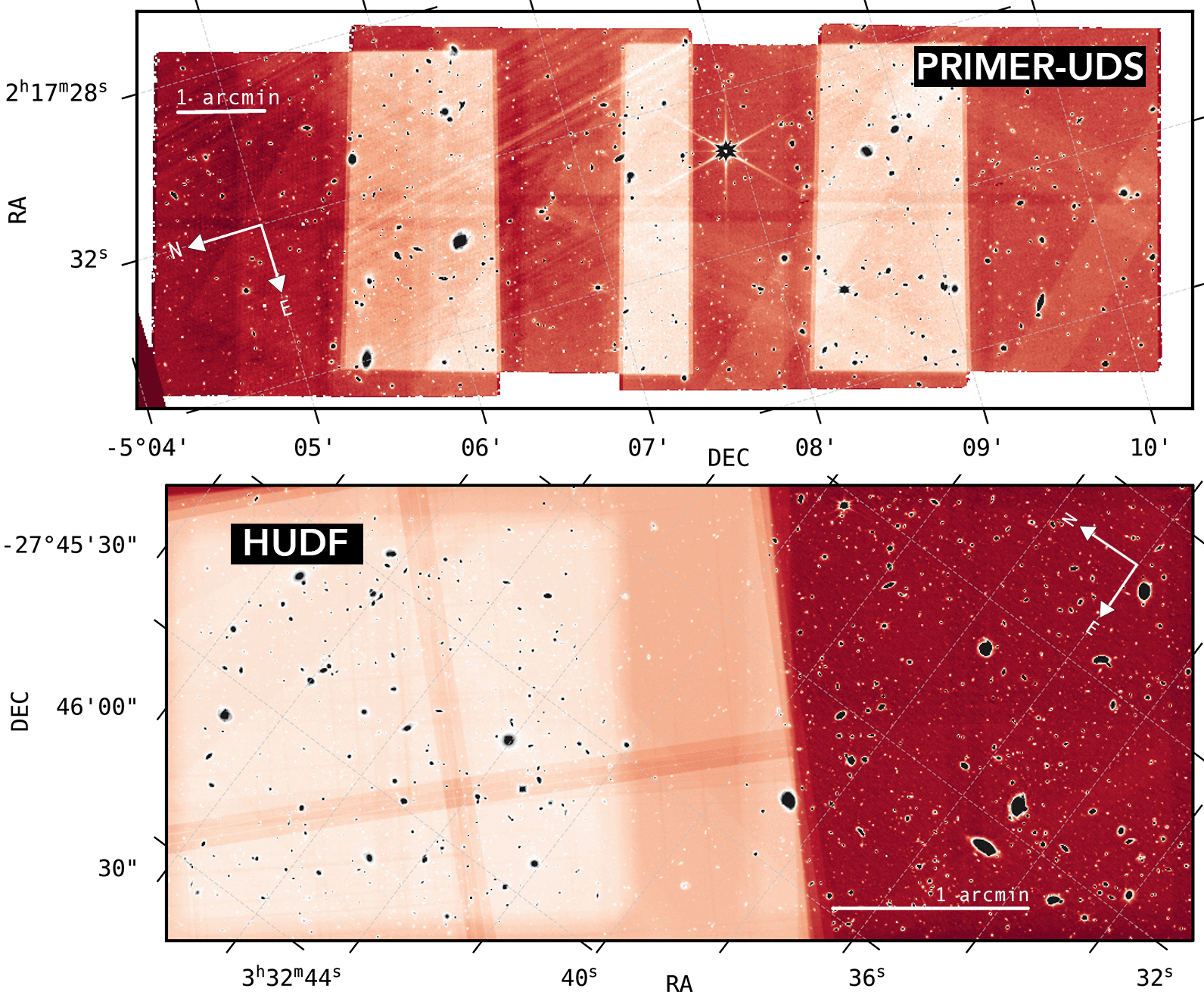
- 作者分析了来自HUDF和UKIDSS UDS场JWST成像的3,300个星系样本,覆盖红移范围 $3.5 \leq z \leq 8.5$,恒星质量下限达 $\sim10^8\,\mathrm{M_\odot}$。
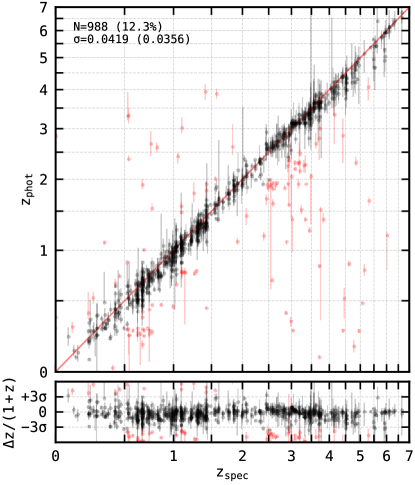
- 通过使用LePHARE进行光谱能量分布(SED)拟合,结合JWST提供的从近红外到中红外波段的测光数据,推导出恒星质量。
- 采用一种新颖的爱丁顿偏差校正方法,其卷积核由正态分布与学生t分布的乘积构成,能够处理非对称、依赖质量与红移的误差分布。
- 该核函数通过拟合30次光度测量随机化不确定性的实现结果所获得的误差分布,准确捕捉了误差偏度及随质量与红移的演化特征。
- GSMF建模为Schechter函数,经爱丁顿偏差校正后,确定 $\alpha$、$M^*$ 和 $\phi^*$,并结合CANDELS数据以增强对大质量星系的约束。
- 基于校正后的GSMF计算宇宙恒星质量密度,实现与先前研究的对比,并评估红移演化特性。
实验结果
研究问题
- RQ1在 $z \simeq 4$--$8$ 红移下,星系恒星质量函数(GSMF)的明亮端形状如何,特别是对 $M \lesssim 10^8\,\mathrm{M_\odot}$ 的星系?
- RQ2从 $z \simeq 7$ 到 $z \simeq 4$,GSMF的明亮端斜率($\alpha$)如何演化,这对早期星系形成意味着什么?
- RQ3GSMF的归一化因子($\phi^*$)如何随红移演化,其对宇宙恒星质量密度演化有何暗示?
- RQ4光度误差及其非对称性(偏度)在多大程度上影响观测到的GSMF?如何实现稳健的校正?
- RQ5与标准方法相比,包含质量与红移依赖的误差分布是否能显著提升爱丁顿偏差校正的准确性?
主要发现
- GSMF的明亮端斜率随红移显著变陡,$z \simeq 4$ 时 $\alpha = -1.61 \pm 0.05$,$z \simeq 7$ 时 $\alpha = -1.98 \pm 0.14$。
- 归一化因子 $\phi^*$ 从 $z \simeq 7$ 到 $z \simeq 4$ 增加了 $130^{+210}_{-50}$ 倍,表明早期宇宙中低质量星系的数量密度显著上升。
- 本研究开发的爱丁顿偏差校正方法能够有效处理非对称、依赖质量与红移的误差分布,其精度优于传统的对称近似方法。
- 恒星质量的误差分布整体向较低质量方向偏斜,尤其在较浅的PRIMER-UDS场中更为明显,而在更深的HUDF场中偏度减小。
- 宇宙恒星质量密度的红移演化比以往研究报道的更平缓,表明若未正确校正偏差,先前研究可能高估了演化程度。
- HUDF与PRIMER-UDS场的联合使用使误差分布的偏度低于任一独立场,凸显了结合深度数据的优势。
更好的研究,从现在开始
从阅读论文到最终审阅,大幅缩短您的研究时间。
无需绑定信用卡
本解读由 AI 生成,并经人工编辑审核。