
[论文解读] Constraints on the velocity of gravitational waves from NANOGrav 15-year data set
本文利用 NANOGrav 15 年脉冲星时标阵列数据,通过分析随机引力波背景(SGWB)重叠相关函数(ORF)的偏差,对引力波传播速度施加约束。研究发现引力波速度存在稳健的下限 $ v \gtrsim 0.87c $,表明与广义相对论预测的光速传播高度一致;而对于超光速情形,后验分布趋于平坦,导致该区域约束能力有限。
General relativity predicts that gravitational waves propagate at the speed of light. Although ground-based gravitational-wave detectors have successfully constrained the velocity of gravitational waves in the high-frequency range, extending this constraint to the lower frequency range remains a challenge. In this work, we utilize the deviations in the overlap reduction function for a gravitational-wave background within pulsar timing arrays to investigate the velocity of gravitational waves in the nanohertz frequency band. By analyzing the NANOGrav 15-year data set, we obtain a well-constrained lower bound for the velocity of gravitational waves that $v \gtrsim 0.87\,c$, where $c$ is the speed of light.
研究动机与目标
- 测试在纳赫兹频段引力波的传播速度,广义相对论预测其以光速传播。
- 探究随机引力波背景(SGWB)的重叠相关函数(ORF)偏离是否可超越广义相对论对引力波速度施加约束。
- 解决先前研究中在拟合空间相关性时忽略 SGWB 能量密度谱的局限性。
- 提供一种通用的引力波速度约束,不局限于大质量引力模型或特定色散关系。
提出的方法
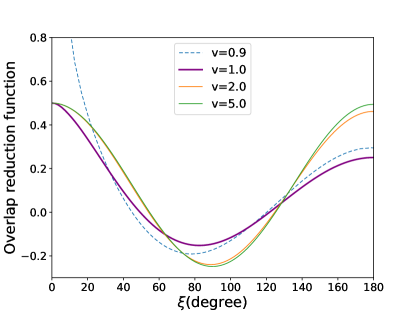
- 将重叠相关函数(ORF)建模为引力波传播速度 $ v $ 的函数,采用参数化色散关系 $ \omega = vk $,其中相速度与群速度相等。
- 在联合似然分析中同时纳入空间相关性(通过 ORF)和 SGWB 的能量密度谱,使用 Enterprise 软件包进行分析。
- 采用使用 PTMCMCSampler 的马尔可夫链蒙特卡洛(MCMC)采样方法,对速度 $ v $ 进行约束,同时对定时模型参数和噪声参数进行边缘化。
- 分析使用 NANOGrav 15 年数据集,包含 67 颗毫秒脉冲星,白噪声(EFAC、EQUAD、ECORR)、红噪声及共同谱过程均被建模。
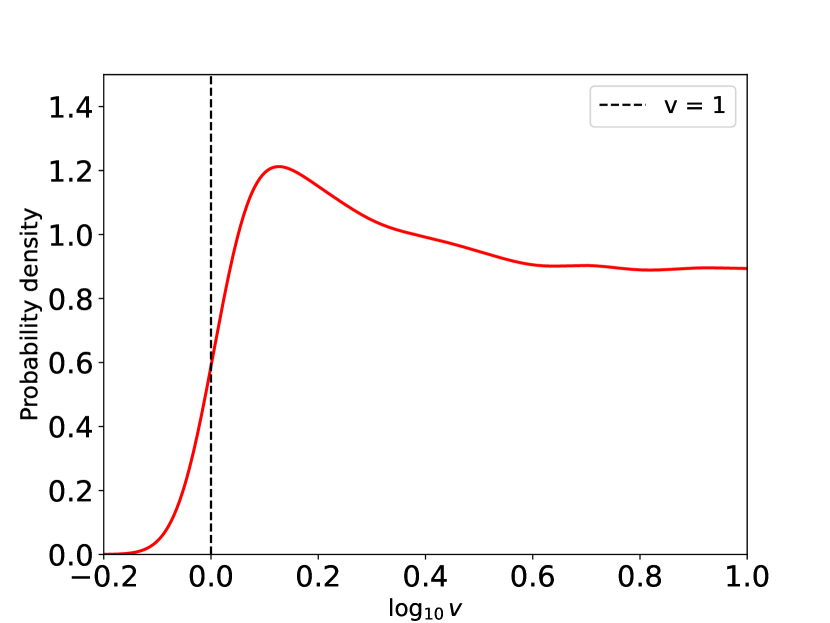
- 对 $ v $ 的后验分布应用带宽为 0.09 且采用镜像边界校正的核密度估计(KDE),以评估置信区间。
- 通过后验峰左侧的 $ 1/e^2 $ 宽度估算置信水平,假设峰左侧呈高斯分布。
实验结果
研究问题
- RQ1利用 NANOGrav 15 年数据集,可在纳赫兹频段对引力波传播速度施加何种约束?
- RQ2非光速引力波速度引起的重叠相关函数(ORF)偏差如何影响随机引力波背景(SGWB)的探测?
- RQ3SGWB 的能量密度谱能否在仅依赖空间相关性分析的基础上进一步改善对引力波速度的约束?
- RQ4数据在多大程度上能够区分亚光速与超光速的引力波传播速度?
- RQ5观测到的 $ v $ 后验分布是否支持一个下限,还是允许超光速传播?
主要发现
- 引力波速度 $ v $ 的后验分布表现出在亚光速区域的急剧截断,表明存在强烈的下限。
- 分析得出下限 $ v \gtrsim 0.87c $,对应 $ \log_{10}v \gtrsim -0.059 $,该结果基于后验峰的 $ 1/e^2 $ 宽度。
- 对于大于 $ c $ 的速度,后验分布保持相对平坦,表明当前数据尚无法排除超光速传播。
- 该约束对亚光速情形稳健,但对超光速情形显著减弱,原因在于 ORF 响应中的退化现象。
- 该方法具有通用性,不局限于大质量引力模型,可拓展用于研究具有不同引力波色散关系的更广泛修正引力理论。
- 结果与广义相对论预测的 $ v = c $ 一致,且观测到的 ORF 变化与不同 $ v $ 值的理论预期相符。
更好的研究,从现在开始
从阅读论文到最终审阅,大幅缩短您的研究时间。
无需绑定信用卡
本解读由 AI 生成,并经人工编辑审核。