
[论文解读] Context, Composition, Automation, and Communication -- The C2AC Roadmap for Modeling and Simulation
本文提出了C2AC路线图——上下文、组合、自动化与沟通——通过增强上下文捕获、模型组合与重用、仿真工作流的自动化以及结果的有效沟通,推动建模与仿真的发展。该框架强调对所有仿真成果采用明确且机器可处理的表示方式,以提升研究与决策情境下的可重现性、可信度与可用性。
Simulation has become, in many application areas, a sine-qua-non. Most recently, COVID-19 has underlined the importance of simulation studies and limitations in current practices and methods. We identify four goals of methodological work for addressing these limitations. The first is to provide better support for capturing, representing, and evaluating the context of simulation studies, including research questions, assumptions, requirements, and activities contributing to a simulation study. In addition, the composition of simulation models and other simulation studies' products must be supported beyond syntactical coherence, including aspects of semantics and purpose, enabling their effective reuse. A higher degree of automating simulation studies will contribute to more systematic, standardized simulation studies and their efficiency. Finally, it is essential to invest increased effort into effectively communicating results and the processes involved in simulation studies to enable their use in research and decision-making. These goals are not pursued independently of each other, but they will benefit from and sometimes even rely on advances in other subfields. In the present paper, we explore the basis and interdependencies evident in current research and practice and delineate future research directions based on these considerations.
研究动机与目标
- 解决新冠疫情暴露出的当前仿真实践中的局限性,特别是模型开发速度、结果解释以及与非专家沟通方面的问题。
- 通过将研究问题、假设、需求和仿真实验视为第一类、形式化表示的成果,提升仿真研究的方法论基础。
- 通过整合语义与目标驱动机制,超越语法兼容性,实现仿真模型的更高程度重用与可组合性。
- 通过提高仿真工作流的自动化程度,减少人为错误,提升一致性,并支持更广泛地应用高级分析技术。
- 通过结构化、可访问且交互式的仿真结果与过程表示,增强建模者、领域专家与决策者之间的沟通。
提出的方法
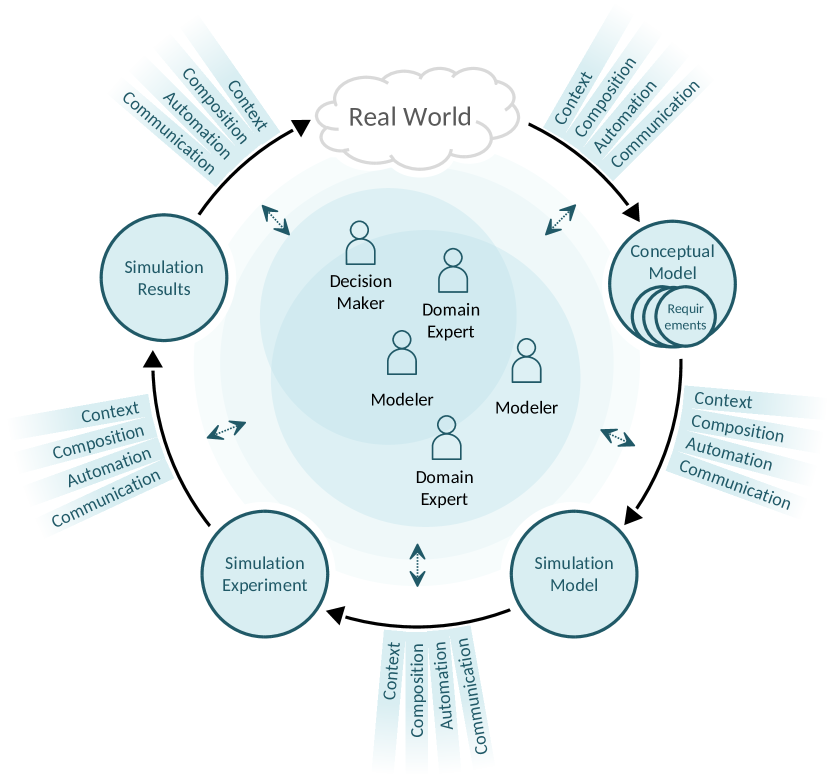
- 提出一种统一的建模与仿真生命周期,明确将上下文、组合、自动化与沟通作为相互关联的维度。
- 提出对仿真成果(包括研究问题、假设、需求、仿真实验与结果)进行明确且机器可处理表示的需求。
- 利用领域特定语言(DSLs)、本体论与注释,支持在语义层面进行模型与组件的组合与重用。
- 整合基于知识的系统与人工智能技术,包括演绎推理与机器学习,以实现模型生成、实验配置与结果解释的自动化。
- 应用软件工程与人机交互原则,设计在仿真生命周期全程保持建模者与用户参与度的工具。
- 开发基于效率、有效性与准确性的评估框架,以衡量仿真研究,重点关注可信度与理解度指标。
实验结果
研究问题
- RQ1如何通过包含研究问题、假设与决策过程等丰富上下文,系统化地记录仿真研究,以确保可重现性与可信度?
- RQ2何种形式化机制可实现超越语法兼容性的语义层面模型组合与重用?
- RQ3在仿真生命周期中,系统性地应用自动化可采取哪些方式,以提升一致性、减少错误并扩展分析能力?
- RQ4如何有效向非专家利益相关者(包括领域专家与决策者)传达仿真结果与过程?
- RQ5何种评估指标与方法可可靠地衡量仿真研究在理解度、可信度与可用性方面的改进?
主要发现
- C2AC路线图识别出四个相互关联的支柱——上下文、组合、自动化与沟通——是推动仿真研究与实践发展的关键要素。
- 对所有仿真成果(包括假设与研究问题)进行形式化、机器可处理的表示,是实现可重现性与互操作性的基础。
- 通过领域特定语言、本体论与结构化注释,实现语义层面的模型组合与重用,超越语法兼容性。
- 仿真工作流的自动化可减少人为错误,提升效率,并支持更广泛地应用高级分析方法。
- 有效传达仿真结果需要采用针对不同用户类型(如决策者与领域专家)量身定制的交互式、可视化与抽象化技术。
- 仿真研究的评估必须超越技术正确性,纳入可信度、理解度与可用性指标,这需要在人机交互与指标设计领域开展新的研究。
![Figure 3: To move forward, the context of simulation studies needs to be explicitly and unambiguously represented. Different artifacts play a role (here depicted with their individual life cycle), inspired by [ 164 ] . Methods are needed to interrelate those with provenance retrospectively as well a](https://ar5iv.labs.arxiv.org/html/2310.05649/assets/x2.png)
更好的研究,从现在开始
从阅读论文到最终审阅,大幅缩短您的研究时间。
无需绑定信用卡
本解读由 AI 生成,并经人工编辑审核。