
[论文解读] Contrastive Video-Language Learning with Fine-grained Frame Sampling
FineCo 提出了一种细粒度对比学习方法,通过使用帧选择器采样语义相关的视频帧,然后在帧-文本对上应用对比损失,从而提升视频-语言表征。该方法在 YouCookII 上达到最先进性能,在 MSR-VTT 上也取得具有竞争力的结果,尤其在视频-文本对应关系较弱的长视频中表现更优。
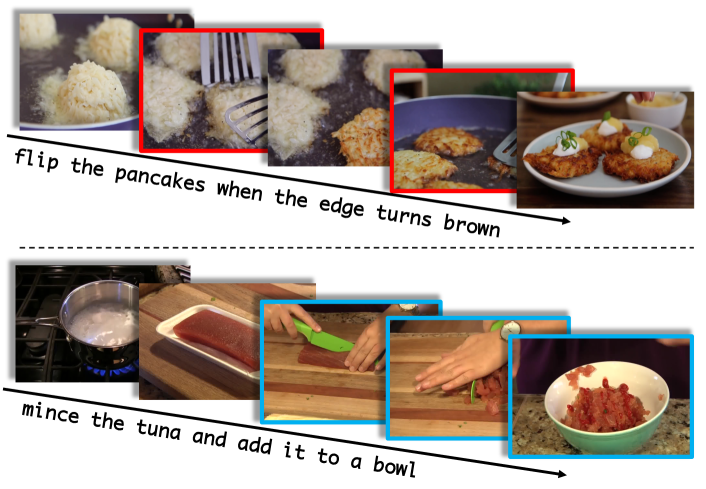
Despite recent progress in video and language representation learning, the weak or sparse correspondence between the two modalities remains a bottleneck in the area. Most video-language models are trained via pair-level loss to predict whether a pair of video and text is aligned. However, even in paired video-text segments, only a subset of the frames are semantically relevant to the corresponding text, with the remainder representing noise; where the ratio of noisy frames is higher for longer videos. We propose FineCo (Fine-grained Contrastive Loss for Frame Sampling), an approach to better learn video and language representations with a fine-grained contrastive objective operating on video frames. It helps distil a video by selecting the frames that are semantically equivalent to the text, improving cross-modal correspondence. Building on the well established VideoCLIP model as a starting point, FineCo achieves state-of-the-art performance on YouCookII, a text-video retrieval benchmark with long videos. FineCo also achieves competitive results on text-video retrieval (MSR-VTT), and video question answering datasets (MSR-VTT QA and MSR-VTT MC) with shorter videos.
研究动机与目标
- 解决视频-语言表征学习中视频与文本之间对应关系微弱或稀疏的问题。
- 通过聚焦语义相关的帧而非将整个视频片段视为统一单元,提升跨模态对齐。
- 缓解长视频中无关帧带来的负面影响,这些帧会稀释标准成对对比学习中的学习信号。
- 开发一种帧级对比目标,以增强视频表征,且无需帧级标注。
- 证明细粒度帧采样能提升性能,尤其在 YouCookII 等长视频数据集上。
提出的方法
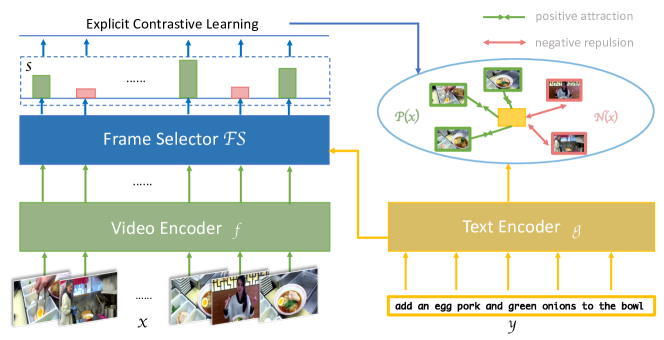
- 训练一个帧选择器,基于帧-文本相似度得分,识别并采样与文本语义相似度高的帧。
- 在选定的正样本帧与未选中的负样本帧之间应用细粒度对比损失,以促进相关视觉内容与文本的对齐。
- 将该方法集成到 VideoCLIP 框架中,使用其视频和文本编码器,并通过成对对比目标与帧级对比目标进行端到端训练。
- 正样本帧数量(k)作为在开发集上调优的超参数,采用固定-k策略,选择与文本相似度最高的 k 个帧。
- 该方法无需时间标注,因此适用于视频-文本对松散对齐的数据集。
- 帧采样在对比损失之前执行,从而实现最具信息量帧的提炼,以改善视频表征。
实验结果
研究问题
- RQ1当仅存在视频-文本对级标注时,帧级对比学习是否能提升视频-语言表征?
- RQ2仅从视频中采样最语义相关的帧,是否比使用所有帧能带来更好的跨模态对齐?
- RQ3帧级对比学习在不同长度的视频数据集上(尤其是对应关系稀疏的长视频)性能如何变化?
- RQ4与词级采样相比,细粒度帧采样是否更有效地提升视频-语言检索性能?
- RQ5所提出的方法是否能在基于对比学习的不同视频-语言框架之间实现泛化?
主要发现
- FineCo 在 YouCookII 文本-视频检索基准上达到最先进性能,尤其在长视频上表现优于先前方法。
- 在 YouCookII 上,FineCo 实现 R@1 为 32.1,R@5 为 62.6,R@10 为 75.5,显著优于基础 VideoCLIP 模型。
- 在 MSR-VTT MC(多项选择)任务中,当 k=25 时,FineCo 取得最佳性能,表明其在短视频上也有效。
- 消融实验表明,在 MSR-VTT QA 上使用 k=20 的固定-k 采样,以及在 MSR-VTT MC 上使用 k=25,可获得最优结果,证实了选择合适正样本帧数量的重要性。
- 帧级采样优于词级采样,因为移除词语会破坏句子语义,而帧更具冗余性,更适合过滤。
- 定性分析显示,FineCo 通过聚焦关键帧能正确检索视频,但在短或动态较弱的视频中,帧选择效果较差,导致失败。
更好的研究,从现在开始
从阅读论文到最终审阅,大幅缩短您的研究时间。
无需绑定信用卡
本解读由 AI 生成,并经人工编辑审核。