
[论文解读] Controlling the Photon Number Coherence of Solid-state Quantum Light Sources for Quantum Cryptography
本论文通过采用具有激励脉冲的定制化双光子激发方案,在半导体量子点中实现了按需生成高保真度单光子,实现了对光子数相干性(PNC)的完全控制,同时保持了高纯度和高不可区分性。该方法可调节PNC水平,适用于多种量子密码学协议,包括需要零PNC或特定非零PNC以增强安全性和性能的协议。
Quantum communication networks rely on quantum cryptographic protocols including quantum key distribution (QKD) using single photons. A critical element regarding the security of QKD protocols is the photon number coherence (PNC), i.e. the phase relation between the zero and one-photon Fock state, which critically depends on the excitation scheme. Thus, to obtain flying qubits with the desired properties, optimal pumping schemes for quantum emitters need to be selected. Semiconductor quantum dots generate on-demand single photons with high purity and indistinguishability. Exploiting two-photon excitation of a quantum dot combined with a stimulation pulse, we demonstrate the generation of high-quality single photons with a controllable degree of PNC. Our approach provides a viable route toward secure communication in quantum networks.
研究动机与目标
- 解决固态单光子源在量子密码学中光子数相干性(PNC)的关键挑战。
- 开发一种激发方案,实现在不降低单光子纯度或不可区分性的情况下,对PNC进行按需控制。
- 通过根据特定协议需求调节PNC水平,实现与广泛量子密码学协议的兼容性。
- 实验演示在InAs/GaAs量子点中,利用双光子激发协议结合激励脉冲,可精确控制PNC。
提出的方法
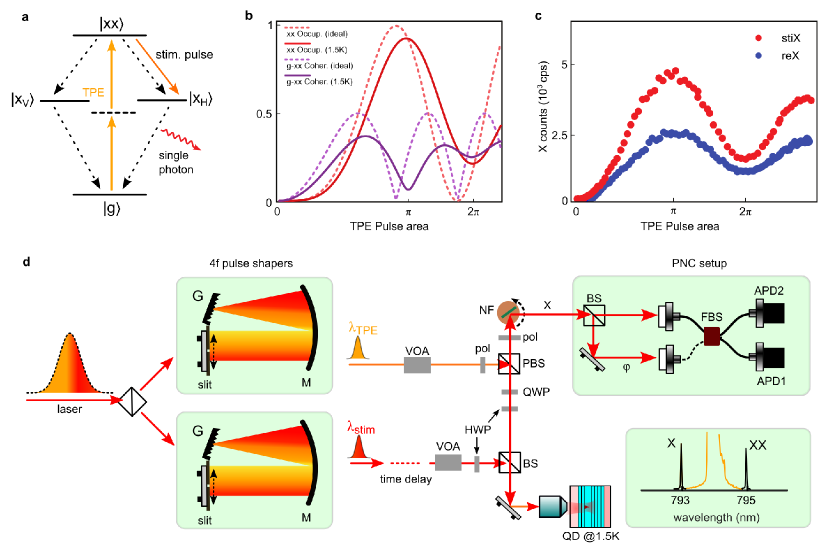
- 采用带有激励脉冲的双光子激发方案,相干制备量子点处于基态与单激子态的叠加态。
- 使用四分之一波片和半波片的序列作为可变相位延迟器,实现对一个干涉光路的连续相位调制。
- 采用基于光纤的Hanbury Brown and Twiss(HBT)装置,利用50:50光纤分束器测量光子不可区分性和可见度。
- 应用理论模型将密度矩阵分解为纯态与混合态成分,通过可见度和光子占据概率提取PNC。
- 通过将激发激光自身进行干涉对干涉仪进行校准,以最大化条纹对比度,实现98%的可见度。
- 利用基态布居数作为函数的可见度,提取相干性参数λ,以量化PNC的程度。
实验结果
研究问题
- RQ1是否能在不损害单光子质量的前提下,实验控制固态单光子源中的光子数相干性(PNC)?
- RQ2带有激励脉冲的双光子激发方案如何影响半导体量子点中PNC的程度?
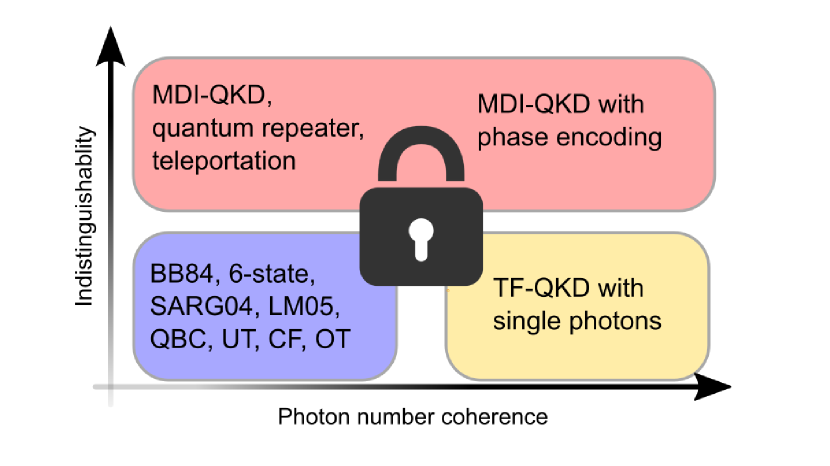
- RQ3PNC在多大程度上可被调节以匹配不同量子密码学协议(如BB84、MDI-QKD或双场QKD)的需求?
- RQ4在受控激发方案中,光子不可区分性、可见度与提取的PNC之间存在何种关系?
- RQ5是否能通过改进的HBT装置与密度矩阵分解方法,准确测量并量化PNC?
主要发现
- HBT干涉仪中实现了98%的可见度,表明光子具有高不可区分性且干涉仪对准稳定。
- 实验上实现了对光子数相干性(PNC)的控制与测量,其值可在零至最大相干性之间连续调节。
- 该方法使光子输出速率最高达到传统共振激发的两倍,显著提升了光源亮度。
- 通过基于模型的可见度与布居数分析提取PNC,得到PNC^exp = λ√(ρ₁,₁(1−ρ₁,₁)),其中λ量化了相干性强度。
- 该方法在保持高单光子纯度与不可区分性的同时,实现了精确的PNC控制,适用于先进量子密码学协议。
- 结果表明,利用半导体量子点作为按需单光子源,为构建安全、高性能的量子网络提供了可行路径。
更好的研究,从现在开始
从阅读论文到最终审阅,大幅缩短您的研究时间。
无需绑定信用卡
本解读由 AI 生成,并经人工编辑审核。