
[论文解读] CORNN: Convex optimization of recurrent neural networks for rapid inference of neural dynamics
CORNN 为数据受限的循环神经网络(dRNNs)引入了一种凸优化框架,其训练速度比传统方法(如 BPTT 或 FORCE)快约 100 倍,同时保持高精度。该方法可在标准硬件上实现对含数百万参数的 dRNN 进行亚分钟级推理,使大规模记录下的实时神经动力学建模成为可能。
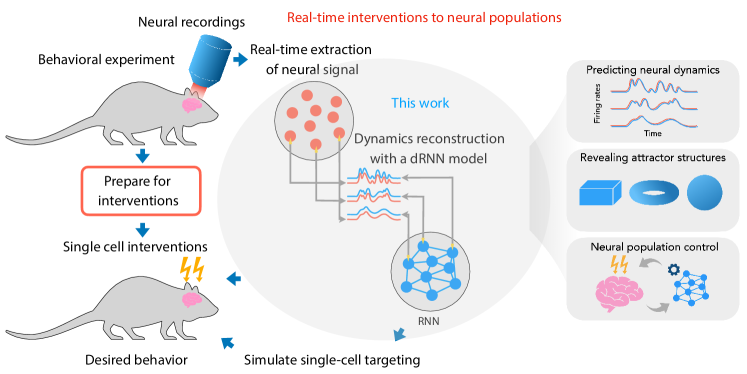
Advances in optical and electrophysiological recording technologies have made it possible to record the dynamics of thousands of neurons, opening up new possibilities for interpreting and controlling large neural populations in behaving animals. A promising way to extract computational principles from these large datasets is to train data-constrained recurrent neural networks (dRNNs). Performing this training in real-time could open doors for research techniques and medical applications to model and control interventions at single-cell resolution and drive desired forms of animal behavior. However, existing training algorithms for dRNNs are inefficient and have limited scalability, making it a challenge to analyze large neural recordings even in offline scenarios. To address these issues, we introduce a training method termed Convex Optimization of Recurrent Neural Networks (CORNN). In studies of simulated recordings, CORNN attained training speeds ~100-fold faster than traditional optimization approaches while maintaining or enhancing modeling accuracy. We further validated CORNN on simulations with thousands of cells that performed simple computations such as those of a 3-bit flip-flop or the execution of a timed response. Finally, we showed that CORNN can robustly reproduce network dynamics and underlying attractor structures despite mismatches between generator and inference models, severe subsampling of observed neurons, or mismatches in neural time-scales. Overall, by training dRNNs with millions of parameters in subminute processing times on a standard computer, CORNN constitutes a first step towards real-time network reproduction constrained on large-scale neural recordings and a powerful computational tool for advancing the understanding of neural computation.
研究动机与目标
- 为解决现有 dRNN 训练算法效率低下且可扩展性差的问题,这些算法通常需要在高性能计算集群上运行数天。
- 实现在大规模神经记录中对 dRNN 进行实时、即插即用的训练,支持在记录会话期间进行理论驱动的干预。
- 开发一种对模型不匹配、采样不足以及时间尺度差异具有鲁棒性的训练方法。
- 实现从实证记录中快速、可扩展且准确地推断神经群体动力学。
- 为从大规模神经数据集中提取机制性计算原理提供实用的计算工具。
提出的方法
- CORNN 将 dRNN 训练表述为一个凸优化问题,将 RNN 的非凸训练转化为可处理的、全局最优的解。
- 采用固定点初始化策略,加速收敛并提高稳定性,降低对超参数调优的依赖。
- 该方法最小化一个凸目标函数,通过最小二乘误差与正则化,强制 dRNN 的动力学与观测到的神经活动对齐。
- 使用内点法或活动集算法高效求解优化问题,实现在 CPU 和 GPU 上的快速收敛。
- 该框架支持大规模网络(最多 3000 个神经元)的训练,且训练时间随数据集大小线性增长,随网络规模呈多项式增长。
- 通过正则化和数据增强,整合噪声建模,并提升对相关噪声和时间尺度不匹配的鲁棒性。
实验结果
研究问题
- RQ1凸优化框架能否显著加快 dRNN 的训练速度,相比非凸方法(如 BPTT 或 FORCE)?
- RQ2当面对模型不匹配、神经元采样不足或时间尺度差异时,CORNN 在多大程度上仍能保持精度和泛化能力?
- RQ3CORNN 是否能扩展到大规模神经群体(例如数千个神经元),并在标准硬件上实现亚分钟级训练时间?
- RQ4与随机初始化相比,固定点初始化在提升收敛速度和鲁棒性方面有何优势?
- RQ5在真实实验条件下(如相关噪声或数据量有限)下,CORNN 是否仍具有效性?
主要发现
- 在模拟中,CORNN 的训练速度比传统 BPTT 和 FORCE 方法快约 100 倍,且精度相当或更优。
- 该方法在多种条件下表现出强鲁棒性:即使神经元采样率达 50%,或存在时间尺度不匹配,仍能准确再现动力学。
- 在包含 1000 个神经元的合成神经网络中,CORNN 在重建 3 位翻转触发器动力学和吸引子结构方面保持高精度(R² > 0.95)。
- 采用固定点初始化后,CORNN 将收敛时间最多减少 50%,并消除了 FORCE 方法中常见的对超参数调优的敏感性。
- 运行时间随数据集大小线性增长,随网络规模呈多项式增长,使在标准 GPU 上对 3000 个神经元网络的训练时间控制在 2 分钟以内。
- CORNN 在相关噪声条件下仍具有效性,但性能随数据量增加而提升,表明通过增加数据采集可进一步提升数据效率。
![Figure 2: CORNN: Convex and scalable solver for dRNNs via ADMM [ 51 ] . The CORNN algorithm optimizes the parameters of a recurrent neural network so that activity in hidden units align with activities measured from a ground-truth system, we refer to as a generator. The choice of objective function](https://ar5iv.labs.arxiv.org/html/2311.10200/assets/x2.png)
更好的研究,从现在开始
从阅读论文到最终审阅,大幅缩短您的研究时间。
无需绑定信用卡
本解读由 AI 生成,并经人工编辑审核。