
[论文解读] Cosmic chronometers to calibrate the ladders and measure the curvature of the Universe. A model-independent study
本研究利用宇宙时钟(CCH)和Pantheon+ Ia型超新星数据,结合高斯过程,对Ia型超新星绝对星等 $M(z)$、曲率参数 $Ω_k(z)$ 和声学尺度 $r_d(z)$ 进行模型无关重建,发现其结果与恒定值一致。该研究排除SH0ES宿主星系Ia型超新星后得出 $H_0 = 71.5 \pm 3.1$ km/s/Mpc,包含造父变星校准的Ia型超新星后得出 $H_0 = 74.0 \pm 1.0$ km/s/Mpc,提供了一项不依赖校准的Hubble张力检验。
We use the state-of-the-art data on cosmic chronometers (CCH) and the Pantheon+ compilation of supernovae of Type Ia (SNIa) to test the constancy of the SNIa absolute magnitude, $M$, and the robustness of the cosmological principle (CP) at $z\lesssim 2$ with a model-agnostic approach. We do so by reconstructing $M(z)$ and the curvature parameter $Ω_{k}(z)$ using Gaussian Processes. Moreover, we use CCH in combination with data on baryon acoustic oscillations (BAO) from various galaxy surveys (6dFGS, BOSS, eBOSS, WiggleZ, DES Y3) to measure the sound horizon at the baryon-drag epoch, $r_d$, from each BAO data point and check their consistency. Given the precision allowed by the CCH, we find that $M(z)$, $Ω_k(z)$ and $r_d(z)$ are fully compatible (at $<68\%$ C.L.) with constant values. This justifies our final analyses, in which we put constraints on these constant parameters under the validity of the CP, the metric description of gravity and standard physics in the vicinity of the stellar objects, but otherwise in a model-independent way. If we exclude the SNIa contained in the host galaxies employed by SH0ES, our results read $M=(-19.314^{+0.086}_{-0.108})$ mag, $r_d=(142.3\pm 5.3)$ Mpc and $Ω_k=-0.07^{+0.12}_{-0.15}$, with $H_0=(71.5\pm 3.1)$ km/s/Mpc ($68\%$ C.L.). These values are independent from the main data sets involved in the $H_0$ tension, namely, the cosmic microwave background and the first two rungs of the cosmic distance ladder. If, instead, we also consider the SNIa in the host galaxies, calibrated with Cepheids, we measure $M=(-19.252^{+0.024}_{-0.036})$ mag, $r_d=(141.9^{+5.6}_{-4.9})$ Mpc, $Ω_k=-0.10^{+0.12}_{-0.15}$ and $H_0=(74.0^{+0.9}_{-1.0})$ km/s/Mpc.
研究动机与目标
- 使用无模型假设的方法,检验 $z \lesssim 2$ 范围内Ia型超新星绝对星等 $M$ 和宇宙学原理(CP)的恒定性。
- 在不假设特定宇宙学模型的前提下,利用CCH和BAO数据重建曲率参数 $\Omega_k(z)$ 和声学尺度 $r_d(z)$。
- 利用CCH数据独立校准宇宙距离梯子,避免依赖CMB和第一级(造父变星为基础)校准,从而消除模型依赖性。
- 提供一项稳健且独立的 $H_0$ 约束,避免标准测距梯子和CMB估计中出现的张力。
- 利用非参数高斯过程重建方法,评估 $M(z)$、$\Omega_k(z)$ 和 $r_d(z)$ 与恒定值的一致性。
提出的方法
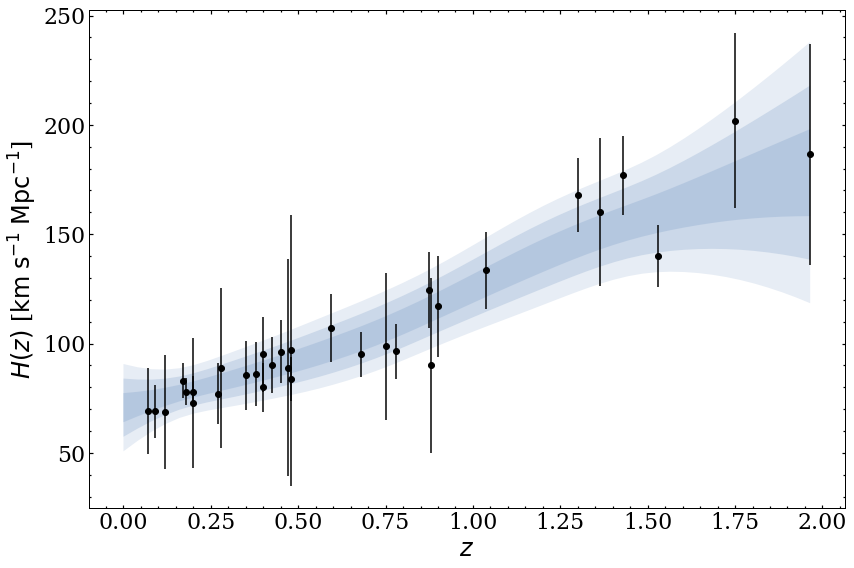
- 利用高斯过程(GPs)对宇宙时钟(CCH)和Pantheon+ Ia型超新星数据进行 $M(z)$、$\Omega_k(z)$ 和 $r_d(z)$ 的重建,实现模型无关推断。
- 利用6dFGS、BOSS、eBOSS、WiggleZ和DES Y3的BAO数据,在每个红移点测量 $r_d$,以检验内部一致性。
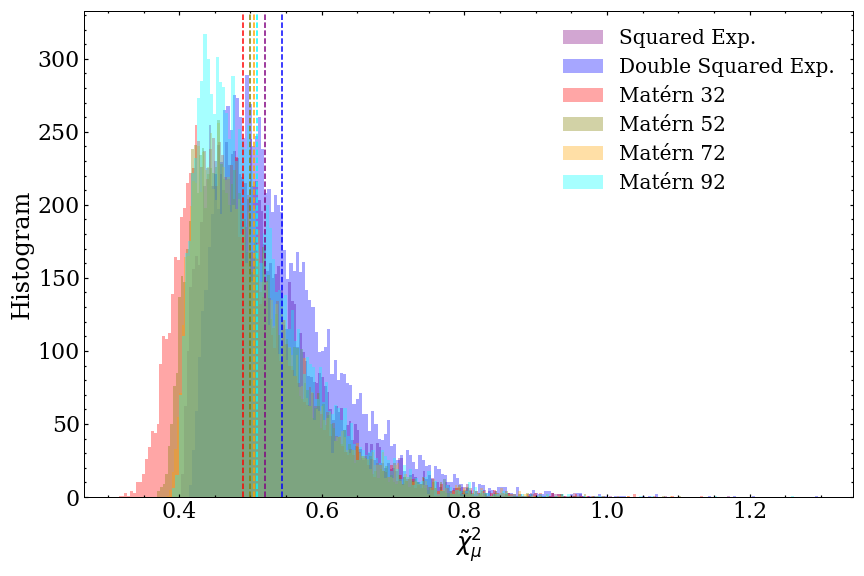
- 通过数据拟合度和光滑性标准,客观选择最合适的GP核(Matérn 3/2)。
- 通过使用替代核(如高斯核、Matérn 5/2)进行稳健性检验,验证结果在核选择下的稳定性。
- 在宇宙学原理、度规引力和标准物理假设下,约束恒定参数 $M$、$r_d$、$\Omega_k$ 和 $H_0$,但不假设特定宇宙学模型。
- 比较包含和不包含通过造父变星校准的SH0ES Ia型超新星数据的结果,以评估其对 $H_0$ 和校准器值的影响。
实验结果
研究问题
- RQ1在当前CCH和Ia型超新星数据的精度下,Ia型超新星绝对星等 $M$ 在低红移范围($z \lesssim 2$)是否为恒定值?
- RQ2曲率参数 $\Omega_k(z)$ 和声学尺度 $r_d(z)$ 在 $z \lesssim 2$ 范围内是否与恒定值一致?
- RQ3宇宙时钟能否提供一种模型无关的测距梯子校准方法,避免依赖CMB或基于造父变星的梯级?
- RQ4推断出的 $M$、$r_d$ 和 $H_0$ 值与SH0ES和Planck的结果相比如何?这对Hubble张力意味着什么?
- RQ5未来巡天(如Euclid、LSST)在多大程度上能提升这些模型无关校准的精度?
主要发现
- 重建的 $M(z)$、$\Omega_k(z)$ 和 $r_d(z)$ 在68%可信区间内均与恒定值一致,支持分析中对恒定性的假设。
- 排除SH0ES宿主星系Ia型超新星后,研究得出 $M = (-19.314^{+0.086}_{-0.108})$ mag,$r_d = (142.3 \pm 5.3)$ Mpc,$\Omega_k = (-0.07^{+0.12}_{-0.15})$,$H_0 = (71.5 \pm 3.1)$ km/s/Mpc(68% C.L.)。
- 包含通过造父变星校准的SH0ES Ia型超新星后,结果调整为 $M = (-19.252^{+0.024}_{-0.036})$ mag,$r_d = (141.9^{+5.6}_{-4.9})$ Mpc,$\Omega_k = (-0.10^{+0.12}_{-0.15})$,$H_0 = (74.0^{+0.9}_{-1.0})$ km/s/Mpc(68% C.L.)。
- 结果在不同GP核选择下具有稳健性,仅在误差条和中心值上出现微小变化,证实了推断的稳定性。
- 该方法在未来的数据支持下有望解决Hubble张力,因为CCH不确定性降低3/2可使校准器误差减少30–40%。
- 本研究提供了不依赖校准的 $H_0$ 估计,避免了CMB和测距梯子第一级的主要张力来源,为检验Hubble张力提供了新路径。
更好的研究,从现在开始
从阅读论文到最终审阅,大幅缩短您的研究时间。
无需绑定信用卡
本解读由 AI 生成,并经人工编辑审核。