
[论文解读] Cosmology with 6 parameters in the Stage-IV era: efficient marginalisation over nuisance parameters
本文提出了一种高效的拉普拉斯近似方法,用于在宇宙学参数推断中解析地对大量噪声参数进行积分,特别适用于第四阶段的测光巡天。该方法在实现接近暴力计算精度的同时,实现了3–10倍的速度提升,使得尽管噪声参数空间维度很高,仍能实现多个巡天的可扩展联合分析。
The analysis of photometric large-scale structure data is often complicated by the need to account for many observational and astrophysical systematics. The elaborate models needed to describe them often introduce many ``nuisance parameters'', which can be a major inhibitor of an efficient parameter inference. In this paper we introduce an approximate method to analytically marginalise over a large number of nuisance parameters based on the Laplace approximation. We discuss the mathematics of the method, its relation to concepts such as volume effects and profile likelihood, and show that it can be further simplified for calibratable systematics by linearising the dependence of the theory on the associated parameters. We quantify the accuracy of this approach by comparing it with traditional sampling methods in the context of existing data from the Dark Energy Survey, as well as futuristic Stage-IV photometric data. The linearised version of the method is able to obtain parameter constraints that are virtually equivalent to those found by exploring the full parameter space for a large number of calibratable nuisance parameters, while reducing the computation time by a factor 3-10. Furthermore, the non-linearised approach is able to analytically marginalise over a large number of parameters, returning constraints that are virtually indistinguishable from the brute-force method in most cases, accurately reproducing both the marginalised uncertainty on cosmological parameters, and the impact of volume effects associated with this marginalisation. We provide simple recipes to diagnose when the approximations made by the method fail and one should thus resort to traditional methods. The gains in sampling efficiency associated with this method enable the joint analysis of multiple surveys, typically hindered by the large number of nuisance parameters needed to describe them.
研究动机与目标
- 应对在测光大尺度结构数据宇宙学分析中日益增长的高维噪声参数空间挑战。
- 克服由红移分布误差和本征对齐等系统误差引起的大量噪声参数导致的MCMC采样计算瓶颈。
- 开发一种快速且可解析处理的方法,对噪声参数进行积分,同时不牺牲宇宙学约束的准确性。
- 通过显著减少采样时间,实现对多个未来巡天(如LSST、Euclid、Roman)的稳健、可扩展的联合分析。
- 在真实数据场景下,量化该近似方法相对于传统采样方法的精度及其失效条件。
提出的方法
- 在似然函数中应用拉普拉斯近似,对噪声参数进行解析积分,从而降低参数空间的维度。
- 利用理论预测对噪声参数(如偏置、本征对齐)的解析导数,高效计算拉普拉斯近似。
- 提出该方法的线性化变体,适用于可校准的系统误差,其中理论模型对噪声参数呈线性依赖,从而简化近似过程。
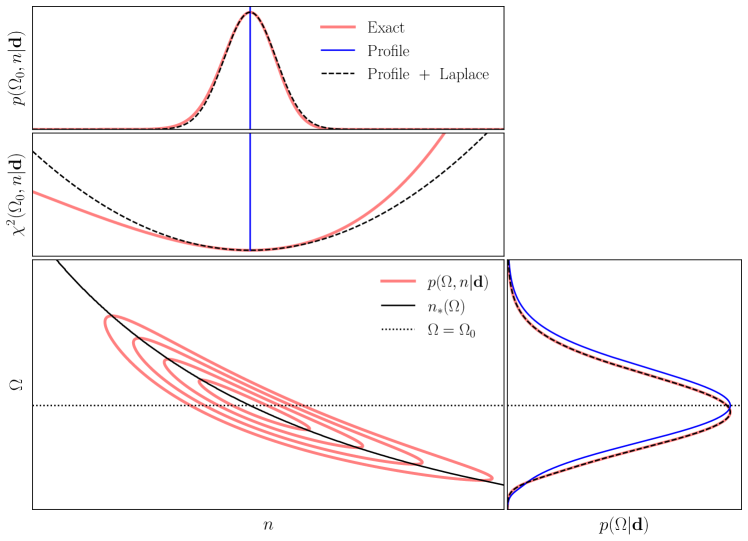
- 利用拉普拉斯近似捕捉积分中的体积效应,这对准确的不确定性估计和避免偏差至关重要。
- 基于似然函数的非高斯性和非二次行为,使用简单准则诊断近似失效的情况,以判断何时需回退至完整采样。
- 将该方法集成至MCMC流程中,由于参数空间维度降低和高效梯度访问,实现2–15倍的收敛速度提升。
实验结果
研究问题
- RQ1基于拉普拉斯近似的解析积分方法是否能在显著降低计算成本的同时,实现接近暴力计算的精度,用于宇宙学参数推断?
- RQ2在真实DES数据和模拟的第四阶段数据中,该拉普拉斯近似方法在精度和速度方面与传统MCMC采样相比表现如何?
- RQ3在何种参数范围内拉普拉斯近似会失效?有哪些诊断工具可可靠识别此类情况?
- RQ4当理论模型对噪声参数呈线性依赖时,该方法的线性化版本在多大程度上能保持精度?其在噪声参数数量增加时的可扩展性如何?
- RQ5该方法是否能通过缓解高维噪声参数空间带来的计算负担,实现多个测光巡天的联合分析?
主要发现
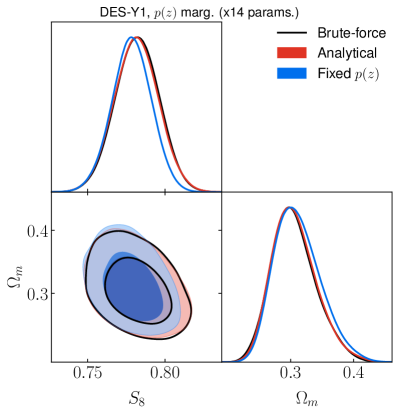
- 线性化拉普拉斯近似在可校准系统误差下,其参数约束几乎与完整MCMC采样无法区分,且计算时间减少3–10倍。
- 非线性化拉普拉斯方法能准确再现宇宙学参数的边缘不确定性以及积分中的体积效应,在大多数情况下与暴力计算结果一致。
- 由于参数空间维度降低和高效梯度计算,该方法使MCMC收敛时间减少2–15倍。
- 在测试设置中,轮廓似然方法给出了无偏估计,而边缘分布则存在偏差,凸显了体积效应的重要性。
- 作者提供了诊断规则,用于检测近似失效的情况,例如在非高斯数据或非二次似然情况下,此时仍需依赖传统采样方法。
- 该方法通过克服高维噪声参数空间带来的计算瓶颈,实现了多个测光巡天的可扩展联合分析。
更好的研究,从现在开始
从阅读论文到最终审阅,大幅缩短您的研究时间。
无需绑定信用卡
本解读由 AI 生成,并经人工编辑审核。