
[论文解读] Cross Domain Iterative Detection for Orthogonal Time Frequency Space Modulation
本文提出了一种正交时频空间(OTFS)调制的跨域迭代检测算法,通过在时域交替应用线性最小均方误差(L-MMSE)均衡与在时延-多普勒(DD)域的符号级检测,利用域间酉变换实现。该方法在存在分数多普勒偏移的情况下,仍能以低复杂度实现接近最大似然的性能,并通过DD域非高斯星座约束显著提升误码性能,且被证明具有收敛性。
Recently proposed orthogonal time frequency space (OTFS) modulation has been considered as a promising candidate for accommodating various emerging communication and sensing applications in high-mobility environments. In this paper, we propose a novel cross domain iterative detection algorithm to enhance the error performance of OTFS modulation. Different from conventional OTFS detection methods, the proposed algorithm applies basic estimation/detection approaches to both the time domain and delay-Doppler (DD) domain and iteratively updates the extrinsic information from two domains with the unitary transformation. In doing so, the proposed algorithm exploits the time domain channel sparsity and the DD domain symbol constellation constraints. We evaluate the estimation/detection error variance in each domain for each iteration and derive the state evolution to investigate the detection error performance. We show that the performance gain due to iterations comes from the non-Gaussian constellation constraint in the DD domain. More importantly, we prove the proposed algorithm can indeed converge and, in the convergence, the proposed algorithm can achieve almost the same error performance as the maximum-likelihood sequence detection even in the presence of fractional Doppler shifts. Furthermore, the computational complexity associated with the domain transformation is low, thanks to the structure of the discrete Fourier transform (DFT) kernel. Simulation results are consistent with our analysis and demonstrate a significant performance improvement compared to conventional OTFS detection methods.
研究动机与目标
- 为解决在存在分数多普勒偏移的高速移动环境中,OTFS检测复杂度过高的问题,其中传统基于DD域稀疏性的方法失效。
- 通过利用时域信道稀疏性与DD域符号星座约束,提升OTFS的误码性能。
- 设计一种稳定且迭代的检测算法,避免基于消息传递方法中常见的收敛问题。
- 通过利用域间酉变换,实现近似最优性能,同时降低计算复杂度。
提出的方法
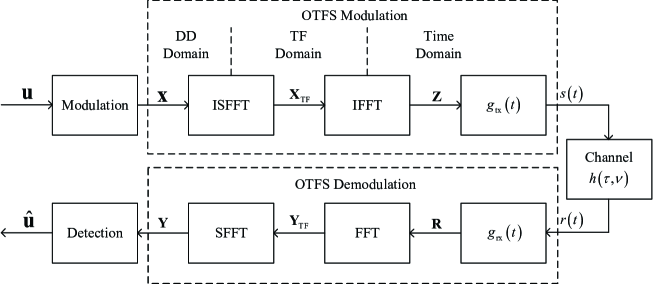
- 该算法通过在时域L-MMSE均衡与DD域符号级检测之间交替进行迭代检测。
- 通过酉变换在域间交换外信息,具体为反辛有限傅里叶变换(ISFFT)及其逆变换。
- 该方法利用时域信道响应的稀疏性以及DD域星座约束的非高斯特性,以抑制误码相关性。
- 推导出状态演化分析,以建模误差方差在迭代过程中的传播,从而实现性能预测。
- 通过Jensen不等式与矩阵迹恒等式,理论证明了算法的收敛性。
- 由于基于DFT的酉变换结构高效,计算复杂度保持较低。
实验结果
研究问题
- RQ1在时域与时延-多普勒域之间进行迭代检测,是否能将OTFS的误码性能提升至超越传统方法的水平?
- RQ2在DD域稀疏性失效的分数多普勒偏移条件下,所提出的跨域方法是否仍具有效性?
- RQ3该迭代算法能否被证明收敛?其稳定性的理论基础是什么?
- RQ4DD域星座约束对性能增益的贡献是什么?与时域稀疏性相比有何差异?
- RQ5所提方法的复杂度与最大似然检测及现有低复杂度替代方案相比如何?
主要发现
- 所提算法即使在存在分数多普勒偏移的情况下,仍能实现接近最大似然的误码性能,而传统基于DD域稀疏性的方法在此情况下失效。
- 性能增益主要归因于DD域的非高斯星座约束,而不仅仅是信道稀疏性。
- 算法被证明收敛,理论状态演化分析证实了误差传播在迭代过程中的稳定性。
- 通过Jensen不等式推导出时域估计方差的下界,表明随着噪声方差减小,性能界限更紧。
- 由于基于DFT的酉变换结构高效,计算复杂度保持较低,使该方法适用于实际实现。
- 仿真结果验证了理论分析,并表明该方法在性能上显著优于传统OTFS检测方法。
更好的研究,从现在开始
从阅读论文到最终审阅,大幅缩短您的研究时间。
无需绑定信用卡
本解读由 AI 生成,并经人工编辑审核。