
[论文解读] Cross-view Transformers for real-time Map-view Semantic Segmentation
本文提出Cross-View Transformers,一种基于注意力机制的实时模型,通过摄像头感知的位置嵌入学习隐式几何映射,实现从多摄像头输入进行鸟瞰图语义分割。该方法在nuScenes数据集上达到最先进性能,单张GPU推理速度达35 FPS,优于先前方法在速度与准确率方面的表现,同时避免了显式深度估计。
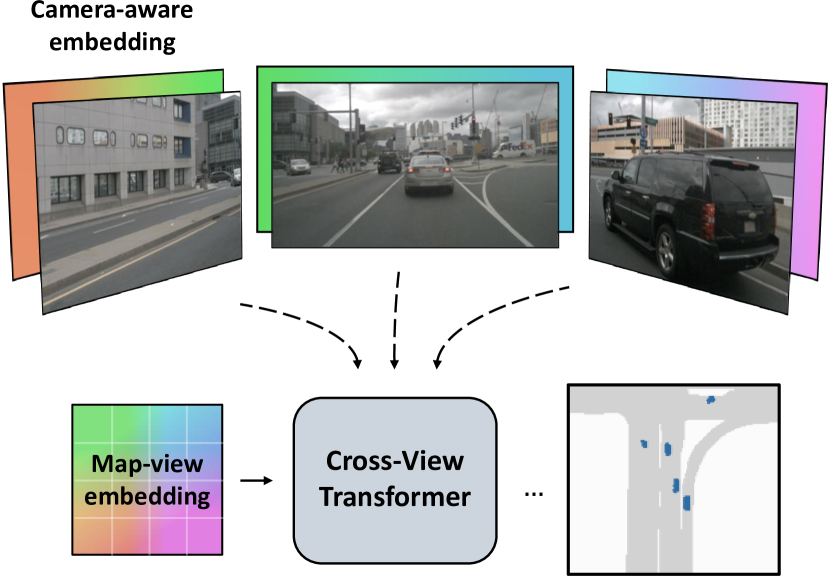
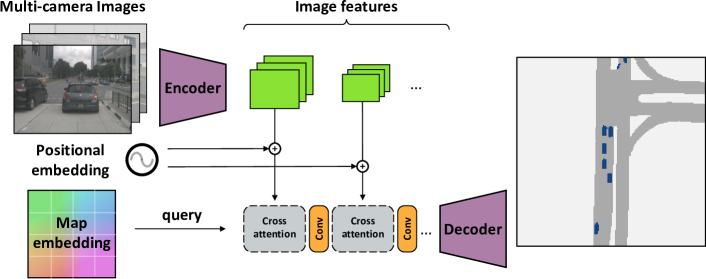
We present cross-view transformers, an efficient attention-based model for map-view semantic segmentation from multiple cameras. Our architecture implicitly learns a mapping from individual camera views into a canonical map-view representation using a camera-aware cross-view attention mechanism. Each camera uses positional embeddings that depend on its intrinsic and extrinsic calibration. These embeddings allow a transformer to learn the mapping across different views without ever explicitly modeling it geometrically. The architecture consists of a convolutional image encoder for each view and cross-view transformer layers to infer a map-view semantic segmentation. Our model is simple, easily parallelizable, and runs in real-time. The presented architecture performs at state-of-the-art on the nuScenes dataset, with 4x faster inference speeds. Code is available at https://github.com/bradyz/cross_view_transformers.
研究动机与目标
- 解决自动驾驶中从多摄像头视角实现鲁棒、实时鸟瞰图语义分割的挑战。
- 消除对显式深度估计的依赖,后者易出错且几何刚性。
- 通过注意力机制学习摄像头视角与标准鸟瞰图之间隐式的几何关系。
- 在保持对传感器失效鲁棒性的前提下,提升现有方法的推理速度与准确率。
- 通过学习的位置嵌入利用标定的摄像头几何关系,无需显式几何建模。
提出的方法
- 模型为每个摄像头视角使用卷积图像编码器提取局部特征。
- 基于相机内参与外参学习摄像头感知的位置嵌入,编码几何关系。
- 跨视角Transformer层使用共享的鸟瞰图位置嵌入,在所有摄像头特征之间执行多头注意力。
- 注意力机制学习将单个摄像头视角的特征映射到统一的鸟瞰图表示,无需显式几何投影。
- 架构通过堆叠多个注意力与MLP模块,逐步优化鸟瞰图表示。
- 模型通过端到端的鸟瞰图分割损失进行训练,隐式学习深度与几何信息,无需显式监督。
实验结果
研究问题
- RQ1基于Transformer的架构是否能在无需显式几何建模或深度监督的情况下,学习准确的跨视角特征映射?
- RQ2与无嵌入或学习嵌入相比,摄像头感知的位置嵌入在鸟瞰图语义分割中表现如何?
- RQ3在传感器失效或遮挡情况下,模型的泛化能力如何?
- RQ4随着距离自车的增加,性能如何退化?
- RQ5注意力机制是否能隐式学习摄像头与鸟瞰图之间的几何对应关系?
主要发现
- 该模型在nuScenes数据集的鸟瞰图语义分割任务中达到最先进性能,准确率与速度均优于先前方法。
- 模型在单张RTX 2080 Ti GPU上实现35 FPS推理速度,比基线方法快4倍。
- 使用随机傅里叶投影的摄像头感知位置嵌入性能最佳,优于学习或线性嵌入。
- 摄像头失效导致性能线性下降,但只要可见区域保持,仍具鲁棒性。
- 与最近似竞争对手FIERY相比,该模型在远距离或遮挡物体上的性能退化更慢,表明其泛化能力更强。
- 可视化结果证实,跨视角注意力机制学习到了有意义的几何对应关系,能突出对鸟瞰图预测有贡献的图像区域。
更好的研究,从现在开始
从阅读论文到最终审阅,大幅缩短您的研究时间。
无需绑定信用卡
本解读由 AI 生成,并经人工编辑审核。