
[论文解读] Data Engineering for Scaling Language Models to 128K Context
本文提出了一种数据工程方法,通过在每源数据上进行长度上采样,对LLaMA-2语言模型进行持续预训练,将上下文长度扩展至128K。实验表明,通过精心设计的数据混合策略——在保持各领域比例的同时,提升每个领域内长序列的权重——可显著提升模型在Needle-in-a-Haystack检索任务上的表现,使性能接近GPT-4 128K,同时保持短上下文下的性能。
We study the continual pretraining recipe for scaling language models' context lengths to 128K, with a focus on data engineering. We hypothesize that long context modeling, in particular extit{the ability to utilize information at arbitrary input locations}, is a capability that is mostly already acquired through large-scale pretraining, and that this capability can be readily extended to contexts substantially longer than seen during training~(e.g., 4K to 128K) through lightweight continual pretraining on appropriate data mixture. We investigate the extit{quantity} and extit{quality} of the data for continual pretraining: (1) for quantity, we show that 500 million to 5 billion tokens are enough to enable the model to retrieve information anywhere within the 128K context; (2) for quality, our results equally emphasize extit{domain balance} and extit{length upsampling}. Concretely, we find that naively upsampling longer data on certain domains like books, a common practice of existing work, gives suboptimal performance, and that a balanced domain mixture is important. We demonstrate that continual pretraining of the full model on 1B-5B tokens of such data is an effective and affordable strategy for scaling the context length of language models to 128K. Our recipe outperforms strong open-source long-context models and closes the gap to frontier models like GPT-4 128K.
研究动机与目标
- 探究如何通过数据工程在不改变模型架构的前提下,有效将语言模型扩展至128K上下文长度。
- 解决在模型原始预训练长度之外任意位置实现精确信息检索的挑战,尤其是在长上下文中的检索。
- 确定在经过大规模预训练后,是否可通过在精选数据上进行最小量的持续预训练,解锁模型已部分具备的长上下文能力。
- 评估在长上下文适应过程中,数据量、领域平衡与序列长度分布之间的权衡。
- 提供一种实用、经济且高效的配方,用于将开源模型扩展至128K上下文,以支持未来的指令微调。
提出的方法
- 在1–50亿token的精选数据上,对LLaMA-2 7B和13B模型进行持续预训练,使用全注意力机制,上下文窗口为64K–80K。
- 应用RoPE位置嵌入基值调整,以在不修改架构的前提下支持更长的上下文长度。
- 设计了一种基于每源的长度上采样策略,在保持原始领域混合比例的同时,增加每个领域内长序列的比例。
- 使用FlashAttention降低显存占用,使在学术级硬件上进行长上下文训练成为可能。
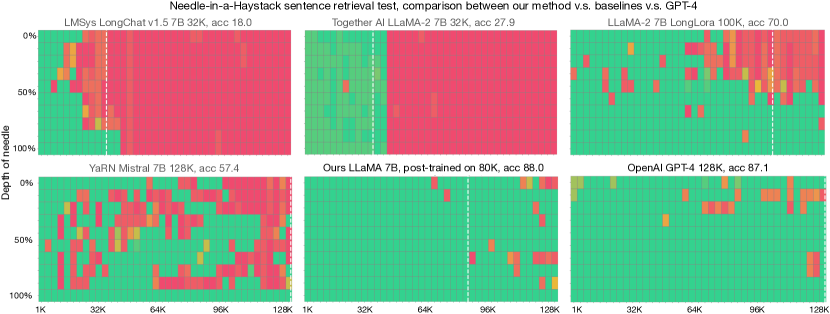
- 使用Needle-in-a-Haystack基准测试评估模型在4K至128K上下文长度范围内的精确检索性能。
- 与YaRN-Mistral 128K和LongLoRA 100K等强基线模型进行比较,以隔离数据混合设计的影响。
实验结果
研究问题
- RQ1在仅用4K上下文预训练的模型上,仅通过在精心筛选的数据上进行少量持续预训练,是否能解锁128K上下文能力?
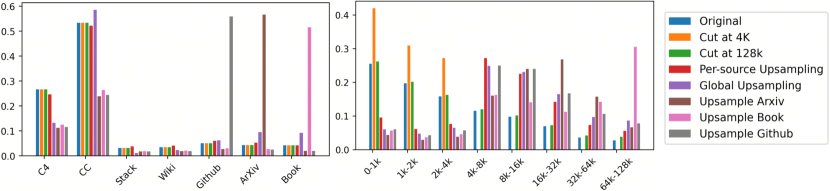
- RQ2在高长度领域(如书籍)中对长序列进行简单上采样,是否会显著降低在代码或网页内容等其他领域中的性能?
- RQ3在每个领域内对长序列进行上采样的同时保持原始领域混合比例,是否比基于领域的上采样策略更有效?
- RQ4数据混合设计如何影响长上下文与短上下文性能之间的权衡?
- RQ5在长上下文建模方面,数据驱动的方法是否能在效率和性能上超越大规模预训练配方?
主要发现
- 仅在1–50亿token的每源长度上采样数据上进行持续预训练,即可使LLaMA-2 7B和13B模型在128K上下文长度的Needle-in-a-Haystack测试中取得优异表现。
- 基于每源的长度上采样策略——在保持领域比例的同时提升各领域内长序列的权重——在各领域间实现了最均衡的性能提升,优于简单的基于领域的上采样方法。
- 简单的基于领域的上采样(如过度代表书籍)会导致代码和网页内容等其他领域性能显著下降,表明数据混合设计存在明显缺陷。
- 采用本研究配方训练的模型在长上下文检索任务上的表现可与GPT-4 128K相媲美,显著优于YaRN-Mistral 128K和LongLoRA 100K等强开源基线模型。
- 仅依赖验证损失不足以检测性能差异;Needle-in-a-Haystack测试揭示了测试损失无法捕捉的关键长上下文检索能力差异。
- 本研究证明,数据工程在实现顶尖长上下文性能方面,其重要性不亚于模型架构或算法创新。
更好的研究,从现在开始
从阅读论文到最终审阅,大幅缩短您的研究时间。
无需绑定信用卡
本解读由 AI 生成,并经人工编辑审核。