
[论文解读] Decentralized Federated Learning for UAV Networks: Architecture, Challenges, and Opportunities
本文提出 DFL-UN,一种用于无人机网络的去中心化联邦学习架构,通过使无人机与邻近无人机协作进行本地聚合,消除了对中心服务器的需求。该方法在动态且不可靠的无人机网络中提升了鲁棒性和可扩展性,初步仿真结果证实其在可行性与有效性方面优于集中式联邦学习。
Unmanned aerial vehicles (UAVs), or say drones, are envisioned to support extensive applications in next-generation wireless networks in both civil and military fields. Empowering UAVs networks intelligence by artificial intelligence (AI) especially machine learning (ML) techniques is inevitable and appealing to enable the aforementioned applications. To solve the problems of traditional cloud-centric ML for UAV networks such as privacy concern, unacceptable latency, and resource burden, a distributed ML technique, extit(i.e.), federated learning (FL), has been recently proposed to enable multiple UAVs to collaboratively train ML model without letting out raw data. However, almost all existing FL paradigms are still centralized, extit{i.e.}, a central entity is in charge of ML model aggregation and fusion over the whole network, which could result in the issue of a single point of failure and are inappropriate to UAV networks with both unreliable nodes and links. Thus motivated, in this article, we propose a novel architecture called DFL-UN (\underline{D}ecentralized \underline{F}ederated \underline{L}earning for \underline{U}AV \underline{N}etworks), which enables FL within UAV networks without a central entity. We also conduct a preliminary simulation study to validate the feasibility and effectiveness of the DFL-UN architecture. Finally, we discuss the main challenges and potential research directions in the DFL-UN.
研究动机与目标
- 为解决集中式联邦学习在无人机网络中的局限性,如单点故障和高延迟。
- 在具有不可靠链路和异构节点的动态无人机网络中,实现隐私保护、节能且低延迟的机器学习。
- 设计一种完全去中心化的联邦学习架构,消除对中心实体进行模型聚合的依赖。
- 通过仿真验证去中心化联邦学习在无人机网络中的可行性和有效性。
- 识别去中心化联邦学习在无人机领域中的关键挑战与未来研究方向。
提出的方法
- 提出 DFL-UN,一种去中心化联邦学习架构,其中每个无人机训练本地模型,并与单跳邻居进行模型聚合,无需中心服务器。
- 通过邻近无人机之间的本地模型聚合,以分布式方式迭代更新全局模型。
- 采用对等通信模型,无人机通过 A2A(空中对空)链路直接交换并融合模型参数。
- 设计一种完全分布式的学习协议,在网络拓扑动态变化和链路间歇性连接的情况下仍能保持模型一致性。
- 构建仿真框架,以在包含移动性和链路不可靠性的现实无人机网络条件下评估 DFL-UN。
- 将标准联邦学习训练流程(如 FedAvg)适配至去中心化环境,采用基于邻居的聚合而非中心化聚合。
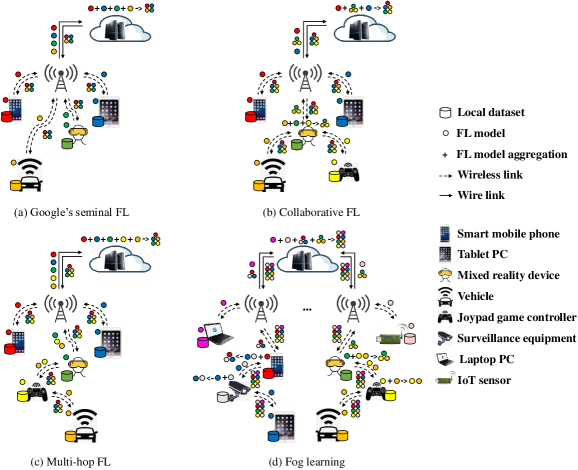
实验结果
研究问题
- RQ1如何在无人机网络中实现联邦学习的完全去中心化,以消除对中心服务器的依赖?
- RQ2在具有动态拓扑和不可靠链路的去中心化无人机联邦学习系统中,维持模型收敛性和鲁棒性的关键挑战是什么?
- RQ3在现实约束条件下,去中心化联邦学习与集中式联邦学习在无人机网络中的性能对比如何?
- RQ4由于广泛的 A2A 模型交换,去中心化无人机联邦学习在通信与能效方面存在哪些权衡?
- RQ5未来哪些研究方向可提升去中心化无人机联邦学习在安全性、可扩展性和效率方面的表现?
主要发现
- DFL-UN 成功实现了在无中心实体参与的无人机网络中进行去中心化联邦学习,仿真结果验证了其可行性。
- 所提出的架构在学习性能上与集中式联邦学习相当,同时显著提升了对节点和链路故障的鲁棒性。
- 初步仿真结果表明,DFL-UN 即使在动态拓扑和间歇性 A2A 链路条件下仍能保持模型收敛。
- 与基于云的机器学习相比,去中心化方法显著降低了延迟和带宽开销,尤其适用于实时无人机应用。
- 该架构通过本地化模型聚合,有效应对无人机在计算、通信和能源资源方面的异构性。
- 本研究识别出关键挑战,如收敛性分析、安全的模型交换以及节能通信,凸显了当前尚未解决的研究问题。

更好的研究,从现在开始
从阅读论文到最终审阅,大幅缩短您的研究时间。
无需绑定信用卡
本解读由 AI 生成,并经人工编辑审核。