
[论文解读] Decentralized Inference with Graph Neural Networks in Wireless Communication Systems
本文提出重传机制以增强无线通信系统中受噪声和快衰落信道影响的去中心化图神经网络(GNN)推理的鲁棒性。通过分析在非编码和编码传输下GNN二分类的表现,作者设计了通过迭代重传提升预测可靠性的协议,并在合成图数据上通过仿真验证了其显著提升的鲁棒性和更低的误分类率。
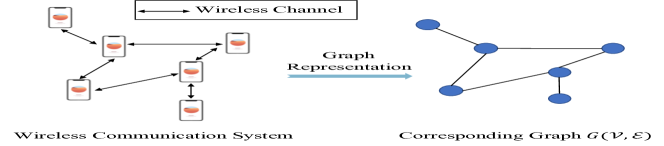
Graph neural network (GNN) is an efficient neural network model for graph data and is widely used in different fields, including wireless communications. Different from other neural network models, GNN can be implemented in a decentralized manner with information exchanges among neighbors, making it a potentially powerful tool for decentralized control in wireless communication systems. The main bottleneck, however, is wireless channel impairments that deteriorate the prediction robustness of GNN. To overcome this obstacle, we analyze and enhance the robustness of the decentralized GNN in different wireless communication systems in this paper. Specifically, using a GNN binary classifier as an example, we first develop a methodology to verify whether the predictions are robust. Then, we analyze the performance of the decentralized GNN binary classifier in both uncoded and coded wireless communication systems. To remedy imperfect wireless transmission and enhance the prediction robustness, we further propose novel retransmission mechanisms for the above two communication systems, respectively. Through simulations on the synthetic graph data, we validate our analysis, verify the effectiveness of the proposed retransmission mechanisms, and provide some insights for practical implementation.
研究动机与目标
- 为解决无线信道损伤导致去中心化GNN推理在无线网络中鲁棒性下降的挑战。
- 开发一种方法论,用于验证在传输条件不完美时GNN预测的鲁棒性。
- 提出专为非编码和编码无线通信系统设计的新型重传机制,以提升预测可靠性。
- 通过在合成图数据上的仿真验证所提机制的有效性。
- 为在真实无线网络中实施基于去中心化GNN的控制与管理提供实用洞见。
提出的方法
- 开发了一种鲁棒性验证方法论,用于判断GNN预测在传输噪声和快衰落下是否保持稳定。
- 分析了在非编码和编码无线传输模型下GNN二分类器的性能,考虑比特级和分组级错误度量。
- 为每类系统设计了重传机制:在非编码系统中,不合格邻居持续重传直至达到鲁棒性;在编码系统中,重传由纠错能力和中断概率度量引导。
- 重传协议以迭代方式实施,每次重传后重新评估鲁棒性,以确保收敛至可靠预测。
- 使用合成图数据模拟多样化的网络拓扑,评估信道条件对GNN推理准确性和鲁棒性的影响。
- 分析中结合了比特误码率(BER)和中断概率作为性能指标,用于比较系统鲁棒性。
实验结果
研究问题
- RQ1当无线传输受损时,如何验证去中心化GNN推理的鲁棒性?
- RQ2在存在信道噪声和快衰落的非编码无线传输下,去中心化GNN二分类器的性能退化程度如何?
- RQ3与非编码传输相比,编码通信如何提升去中心化GNN推理的鲁棒性?
- RQ4何种重传策略能在最大化预测鲁棒性的同时最小化通信开销?
- RQ5系统级因素(如节点特征维度和可扩展性)如何影响去中心化GNN的实际部署?
主要发现
- 所提出的重传机制在非编码和编码无线系统中均显著提升了去中心化GNN推理的鲁棒性。
- 编码通信系统在鲁棒性方面优于非编码系统,实现了更低的误分类率和更少的重传轮次。
- 重传后鲁棒性概率显著提高,误分类节点的百分比明显下降。
- 编码系统中的平均重传轮次更低,表明其在错误恢复方面效率更高。
- 随着节点特征维度的增加,编码系统中去中心化GNN方法的可扩展性更强。
- 仿真结果证实,重传机制能有效缓解无线信道损伤对GNN预测准确性的影响。
更好的研究,从现在开始
从阅读论文到最终审阅,大幅缩短您的研究时间。
无需绑定信用卡
本解读由 AI 生成,并经人工编辑审核。