
[论文解读] Decentralized Zero-Trust Framework for Digital Twin-based 6G
论文提出一个面向数字孪生驱动的6G网络的去中心化零信任安全框架,整合区块链、AI与分布式学习,以同时保护物理设备及其数字孪生。
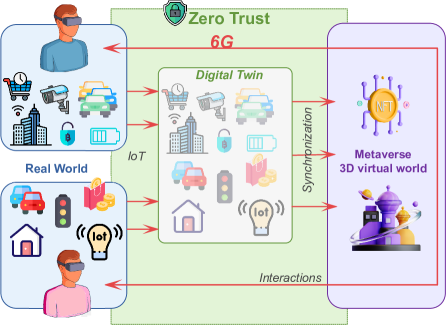
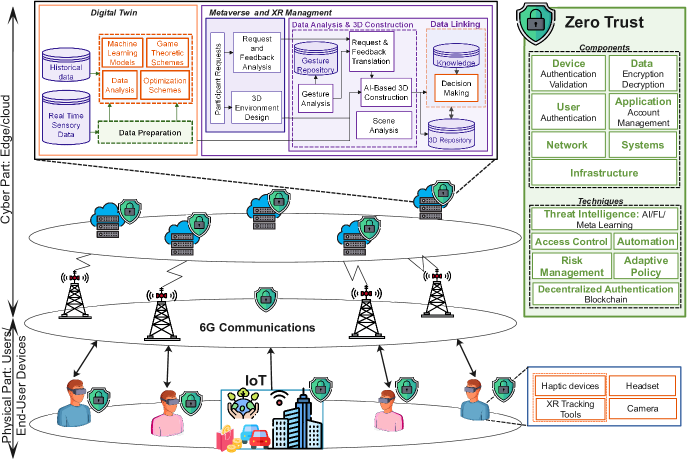
The Sixth Generation (6G) network is a platform for the fusion of the physical and virtual worlds. It will integrate processing, communication, intelligence, sensing, and storage of things. All devices and their virtual counterparts will become part of the service-provisioning process. In essence, 6G is a purposefully cooperative network that heavily depends on the capabilities of edge and end-devices. Digital Twin (DT) will become an essential part of 6G, not only in terms of providing a virtual representation of the physical elements and their dynamics and functionalities but rather DT will become a catalyst in the realization of the cooperative 6G environment. DT will play a main role in realizing the full potential of the 6G network by utilizing the collected data at the cyber twin and then implementing using the physical twin to ensure optimal levels of accuracy and efficiency. With that said, such a cooperative non-conventional network infrastructure cannot rely on conventional centralized intrusion detection and prevention systems. Zero-trust is a new security framework that aims at protecting distributed data, devices, components and users. This article presents a new framework that integrates the zero-trust architecture in DT-enabled 6G networks. Unlike conventional zero-trust solutions, the proposed framework adapts a decentralized mechanism to ensure the security, privacy and authenticity of both the physical devices and their DT counterparts. Blockchain plays an integral part in the authentication of DTs and the communicated data. Artificial Intelligence (AI) is integrated into all cooperating nodes using meta, generalized and federated learning solutions. The article also discusses current solutions and future outlooks, with challenges and some technology enablers.
研究动机与目标
- 在分布式、无需信任的环境中,推动对6G的安全、可扩展采用,保护物理设备及其数字孪生(DTs)。
- 提出一个去中心化的零信任架构,超越传统的IDS/IPS,安全DT交互与元宇宙通信。
- 以威胁情报、分布式认证和区块链信任机制为核心支柱进行研究。
- 确定在DT使能的6G中实现去中心化零信任的挑战、驱动因素与未来方向。
提出的方法
- 将零信任理念与数字孪生驱动的6G结合,安全地在物理层和虚拟层之间管理设备、DT与数据的交互。
- 提出利用区块链进行去中心化认证,以可扩展方式管理身份和访问。
- 将威胁情报作为跨分布式节点的持续信任评估机制。
- 探索基于AI的解决方案(元学习、联邦学习)以在边缘与终端设备实现分布式、隐私保护的安全性。
- 讨论分层与去中心化学习方法(如FL、元学习、PnP-AI)以在不依赖中央瓶颈的情况下支持可扩展的安全性。
实验结果
研究问题
- RQ1如何将零信任原则有效去中心化,以在设备、DT与数据交互层保护DT使能的6G网络?
- RQ2区块链与威胁情报在去中心化认证与DT生态系统的信任管理中扮演何种角色?
- RQ3分布式AI(如元学习、联邦学习)能否在没有中央权威的情况下,为DT使能的6G提供可扩展、隐私保护的安全性?
主要发现
- 该框架强调威胁情报与去中心化认证作为DT使能的6G中去中心化零信任的核心使能因素。
- 区块链被定位为去中心化认证与跨DT与网络层的安全数据交换的关键组件。
- 分布式学习范式(元学习、联邦学习)被视为在边缘和终端设备实现自适应、隐私保护安全性的机制。
- 本文综述当前趋势与潜在解决方案,提出将智能区块链与混合学习整合进去中心化零信任架构的未来方向。
- 文中未给出经验性结果或定量评估;贡献为概念框架与前景展望。
更好的研究,从现在开始
从论文设计到论文写作,大幅缩短您的研究时间。
无需绑定信用卡
本解读由 AI 生成,并经人工编辑审核。