
[论文解读] Decorrelated Adversarial Learning for Age-Invariant Face Recognition
该论文提出了一种新型深度学习框架——去相关对抗学习(Decorrelated Adversarial Learning, DAL),通过将人脸特征分解为互不相关的身份相关与年龄相关分量,提升年龄不变人脸识别性能。通过使用受批量典型相关分析(Batch Canonical Correlation Analysis, BCCA)启发的模块,对抗性地最小化这两类分量之间的相关性,该方法在FG-NET、MORPH Album 2和CACD-VS数据集上均达到最先进性能,在留一法评估下于FG-NET数据集上实现94.5%的rank-1准确率。
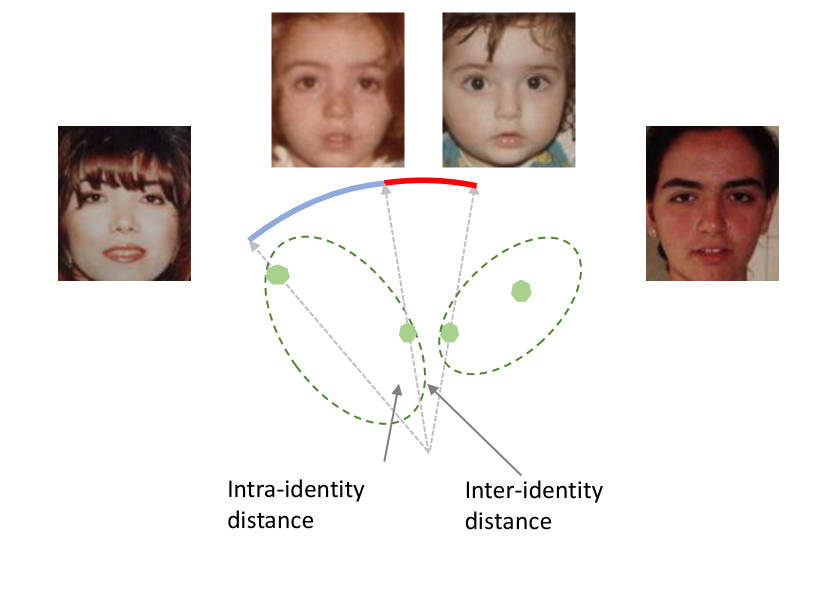
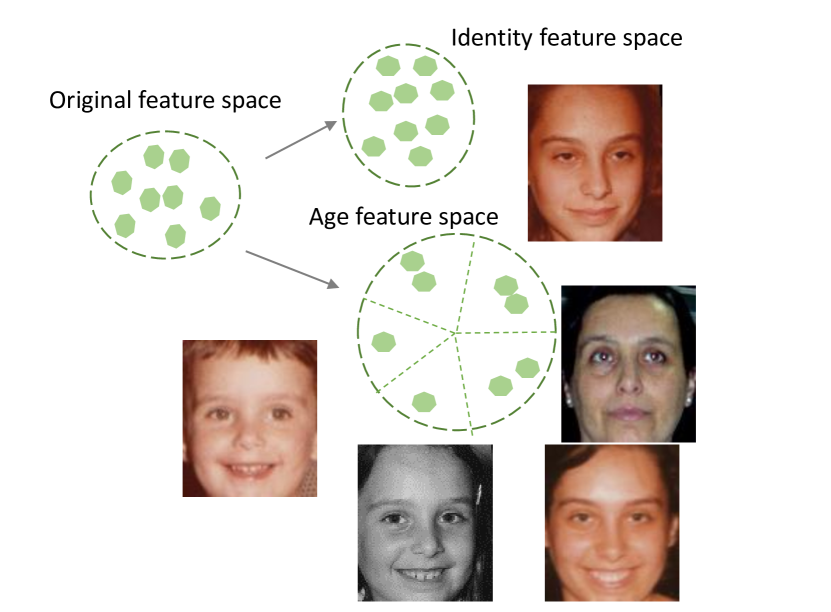
There has been an increasing research interest in age-invariant face recognition. However, matching faces with big age gaps remains a challenging problem, primarily due to the significant discrepancy of face appearances caused by aging. To reduce such a discrepancy, in this paper we propose a novel algorithm to remove age-related components from features mixed with both identity and age information. Specifically, we factorize a mixed face feature into two uncorrelated components: identity-dependent component and age-dependent component, where the identity-dependent component includes information that is useful for face recognition. To implement this idea, we propose the Decorrelated Adversarial Learning (DAL) algorithm, where a Canonical Mapping Module (CMM) is introduced to find the maximum correlation between the paired features generated by a backbone network, while the backbone network and the factorization module are trained to generate features reducing the correlation. Thus, the proposed model learns the decomposed features of age and identity whose correlation is significantly reduced. Simultaneously, the identity-dependent feature and the age-dependent feature are respectively supervised by ID and age preserving signals to ensure that they both contain the correct information. Extensive experiments are conducted on popular public-domain face aging datasets (FG-NET, MORPH Album 2, and CACD-VS) to demonstrate the effectiveness of the proposed approach.
研究动机与目标
- 解决因衰老导致的人脸图像显著外观变化问题,该问题在大年龄跨度下会降低人脸识别性能。
- 克服现有方法中身份特征仍包含残余年龄相关信息的局限性,原因在于分解过程存在相关性。
- 开发一种深度特征分解框架,显式降低学习特征中身份与年龄分量之间的相关性。
- 通过联合使用身份分类与年龄分类信号,确保分解后的两个分量均具有语义意义。
- 在无需在目标数据上微调的情况下,于基准年龄不变人脸识别数据集上实现最先进性能。
提出的方法
- 提出基于残差的特征分解:$\mathbf{x} = \mathbf{x_{id}} + \mathcal{R}(\mathbf{x})$,其中$\mathbf{x_{id}}$为身份相关分量,$\mathbf{x_{age}} = \mathcal{R}(\mathbf{x})$为年龄相关分量。
- 引入典型映射模块(Canonical Mapping Module, CMM),以可微方式估计$\mathbf{x_{id}}$与$\mathbf{x_{age}}$之间的最大相关性。
- 实施对抗性训练策略,使主干网络与分解网络联合优化,以最小化CMM估计的相关性。
- 提出批量典型相关分析(Batch Canonical Correlation Analysis, BCCA),作为CCA的基于随机梯度的扩展,以在小批量中高效计算并反向传播相关性梯度。
- 通过身份分类任务联合监督$\mathbf{x_{id}}$,通过年龄分类任务联合监督$\mathbf{x_{age}}$,以保持两个分量的语义内容。
- 推理阶段仅使用$\mathbf{x_{id}}$进行人脸识别,确保年龄不变的身份匹配。
实验结果
研究问题
- RQ1在身份与年龄分量之间进行对抗性相关性最小化,能否提升年龄不变人脸识别性能?
- RQ2将特征解耦为无相关性的身份与年龄分量,是否能提升在未见年龄跨度下的泛化能力?
- RQ3可微的、基于小批量的相关性估计方法(BCCA)能否有效指导深度神经网络的端到端训练?
- RQ4通过身份与年龄分类的联合监督,对分解特征的质量与解耦程度有何影响?
- RQ5所提方法在标准AIFR基准上的性能相比现有最先进方法提升程度如何?
主要发现
- 所提DAL方法在FG-NET数据集的留一法协议下实现94.5%的rank-1准确率,显著优于先前方法如HFA(69.0%)和OE-CNNs(88.1%)。
- 在FG-NET的MF2协议下,该方法实现60.01%的rank-1准确率,超越此前最先进方法OE-CNNs的53.26%。
- 在LFW与MF1-Facescrub通用人脸识别基准上,模型实现99.47%的验证率与77.58%的rank-1识别率,超过SphereFace与CosFace。
- 消融实验证实,去相关损失显著降低了身份与年龄特征之间的相关性,从而提升了模型鲁棒性。
- 模型在不同数据集间泛化能力良好,在AIFR专用基准(FG-NET、MORPH、CACD-VS)与通用人脸识别数据集(LFW、MF1-Facescrub)上均达到最先进性能。
- BCCA模块有效支持端到端训练,实现稳定的梯度流动,使模型能够学习到解耦表示,而无需依赖生成式图像合成。
更好的研究,从现在开始
从阅读论文到最终审阅,大幅缩短您的研究时间。
无需绑定信用卡
本解读由 AI 生成,并经人工编辑审核。