
[论文解读] Decoupling by local random unitaries without simultaneous smoothing, and applications to multi-user quantum information tasks
本文提出一种新颖的解耦框架,结合局部随机酉操作与望远镜求和技巧,实现对多个量子用户的同步解耦,且无需依赖尚未解决的同步平滑性猜想。通过利用随机通道系数的压缩性与张量化性质,该工作在平滑最小熵与Rényi熵的框架下,建立了紧致的单次与有限块长界,从而为随机性提取、辅助纠缠、量子态合并及多址信道编码等多用户量子任务提供了直接、无需时分复用的可实现性证明——首次为这些问题提供了严格的单次与复合速率公式。
We show that a simple telescoping sum trick, together with the triangle inequality and a tensorisation property of expected-contractive coefficients of random channels, allow us to achieve general simultaneous decoupling for multiple users via local actions. Employing both old [Dupuis et al. Commun. Math. Phys. 328:251-284 (2014)] and new methods [Dupuis, arXiv:2105.05342], we obtain bounds on the expected deviation from ideal decoupling either in the one-shot setting in terms of smooth min-entropies, or the finite block length setting in terms of Rényi entropies. These bounds are essentially optimal without the need to address the simultaneous smoothing conjecture, which remains unresolved. This leads to one-shot, finite block length, and asymptotic achievability results for several tasks in quantum Shannon theory, including local randomness extraction of multiple parties, multi-party assisted entanglement concentration, multi-party quantum state merging, and quantum coding for the quantum multiple access channel. Because of the one-shot nature of our protocols, we obtain achievability results without the need for time-sharing, which at the same time leads to easy proofs of the asymptotic coding theorems. We show that our one-shot decoupling bounds furthermore yield achievable rates (so far only conjectured) for all four tasks in compound settings, that is for only partially known i.i.d. source or channel, which are furthermore optimal for entanglement of assistance and state merging.
研究动机与目标
- 解决多用户量子信息任务中同步解耦的挑战,且不依赖未被证明的同步平滑性猜想。
- 开发一种基于局部随机酉操作与通道压缩性张量化的单次与有限块长解耦通用框架。
- 为多个参与方的解耦误差推导出基于平滑最小熵与Rényi熵的紧致界。
- 在单次与渐近两种情形下,为关键量子信息任务建立直接、无需时分复用的可实现性结果。
- 首次证明局部随机性提取、辅助纠缠、量子态合并与量子多址信道编码的严格单次与复合速率公式。
提出的方法
- 采用望远镜求和技巧,将解耦误差分解为可管理的项,每项通过三角不等式进行有界控制。
- 利用随机通道的期望压缩系数及其张量化性质,独立控制每一项。
- 结合现有方法(Dupuis 等, 2014)与新技巧(Dupuis, 2021),在平滑最小熵与Rényi熵的框架下界化解耦误差。
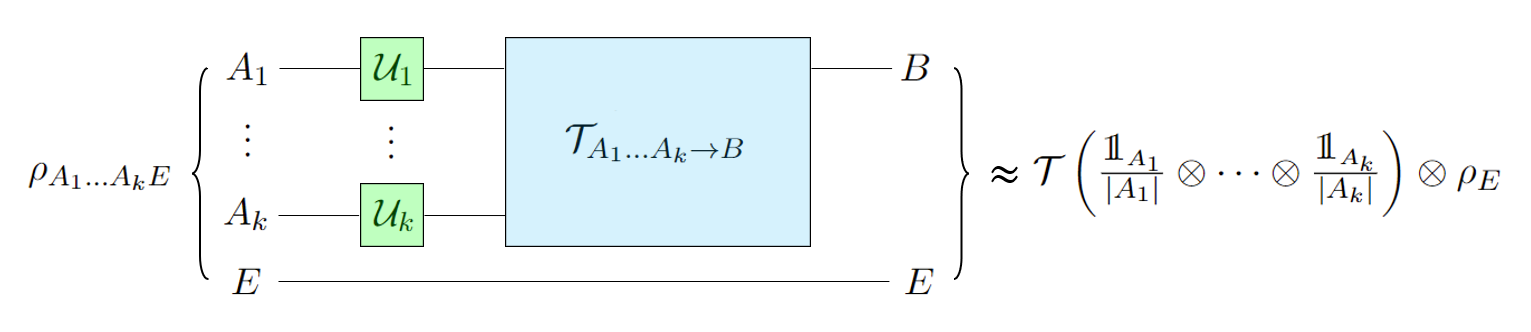
- 构建一个局部随机酉协议,随后接一个固定的完全正定迹保持(cptp)映射,以在多个子系统间实现解耦。
- 利用边界的单次性质,避免时分复用,直接实现最优速率区域。
- 利用边界的鲁棒性,证明在源或信道仅部分已知的复合设置下仍具可实现性。
实验结果
研究问题
- RQ1是否可在不假设同步平滑性猜想的前提下,实现对多个量子用户的同步解耦?
- RQ2多参与方量子系统中,解耦误差的最紧致单次与有限块长界是什么?
- RQ3所提出的框架能否在无需时分复用的情况下,为量子多址信道编码提供直接可实现性结果?
- RQ4局部随机性提取与辅助纠缠的单次与复合速率公式是否可被严格证明为最优?
- RQ5该框架能否扩展至最小熵有限且种子随机性较小的密码学场景?
主要发现
- 本文建立了一个基于局部随机酉操作的多参与方通用单次解耦定理,其误差界以平滑最小熵与Rényi熵表示,且无需依赖同步平滑性猜想。
- 首次证明了量子多址信道编码的严格单次可实现区域,其结果与已知的渐近容量区域一致,并通过量子同步解码器直接实现每个点。
- 该框架为任意数量协作用户的局部随机性提取提供了最优单次与i.i.d.速率区域,推广了此前针对k=2的情形。
- 在多参与方辅助纠缠场景中,该方法在不假设同步平滑性猜想的前提下,证明了猜想的最优速率区域,仅使用2-design实现安全性。
- 单次边界具有足够鲁棒性,可导出所有四项任务的最优复合速率公式,表明协议在理想源或信道邻域内均表现一致良好。
- 该方法可实现渐近编码定理的直接、无需时分复用的证明,简化了先前推导过程,同时保持最优性。

更好的研究,从现在开始
从阅读论文到最终审阅,大幅缩短您的研究时间。
无需绑定信用卡
本解读由 AI 生成,并经人工编辑审核。