
[论文解读] Deep Learning for Accelerated and Robust MRI Reconstruction: a Review
对 MRI 重建的深度学习方法的综合综述,涵盖端到端网络、预训练去噪器、生成先验及自监督方法,并讨论鲁棒性和临床影响。
Deep learning (DL) has recently emerged as a pivotal technology for enhancing magnetic resonance imaging (MRI), a critical tool in diagnostic radiology. This review paper provides a comprehensive overview of recent advances in DL for MRI reconstruction. It focuses on DL approaches and architectures designed to improve image quality, accelerate scans, and address data-related challenges. These include end-to-end neural networks, pre-trained networks, generative models, and self-supervised methods. The paper also discusses the role of DL in optimizing acquisition protocols, enhancing robustness against distribution shifts, and tackling subtle bias. Drawing on the extensive literature and practical insights, it outlines current successes, limitations, and future directions for leveraging DL in MRI reconstruction, while emphasizing the potential of DL to significantly impact clinical imaging practices.
研究动机与目标
- Survey the landscape of DL-based MRI reconstruction techniques and architectures.
- Discuss how DL improves image quality, accelerates scanning, and handles data-related challenges.
- Highlight robustness to distribution shifts and biases, and outline practical strategies for clinical adoption.
提出的方法
- Survey end-to-end neural networks that map measurements to reconstructed images.
- Discuss unrolled network architectures that mimic iterative optimization with learned components.
- Describe pretrained plug-and-play methods using denoisers as priors.
- Summarize generative priors including GANs and diffusion models for reconstruction.
- Explain self-supervised learning approaches that avoid paired ground-truth data.
- Outline un-trained networks and coordinate-based representations as alternative DL strategies.
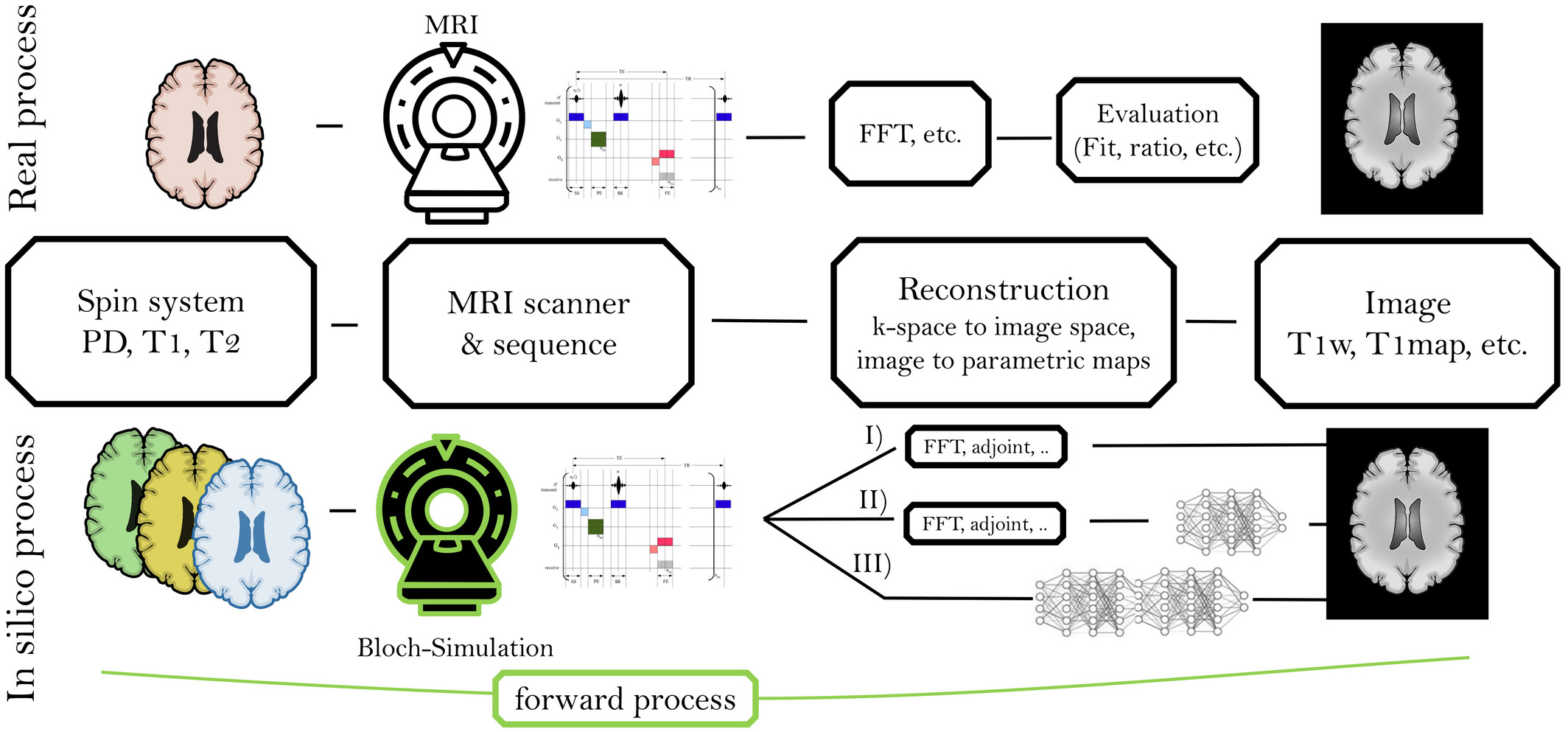
![Figure 1: Example of the input training data for three DL reconstruction methods. The fully-supervised MoDL method [ 24 ] receives var-dens sampled data as input and uses the entire k-space for supervision. The self-supervised SSDU method [ 121 ] receives var-dens data as input, splits it into two s](https://ar5iv.labs.arxiv.org/html/2404.15692/assets/samp_comp.png)
实验结果
研究问题
- RQ1What DL architectures and training paradigms are most effective for accelerated MRI reconstruction?
- RQ2How do end-to-end, unrolled, PnP, and generative priors compare in addressing data undersampling and artifacts?
- RQ3What are the robustness challenges (distribution shifts, instabilities, bias) in DL-based MRI and how can they be mitigated?
- RQ4What role do self-supervised and un-trained methods play when ground-truth data are limited?
- RQ5How can diffusion models and other generative priors be leveraged for uncertainty quantification in MRI reconstruction?
主要发现
- DL 方法显著提升图像质量并在多种架构中实现更快的 MRI。
- Unrolled networks 与 variational-inspired designs 在数据一致性和去噪块的结合下提供了强大性能。
- Pretrained denoisers in plug-and-play frameworks enable flexible handling of arbitrary forward models.
- Generative priors (GANs, diffusion models) offer high-quality reconstructions with uncertainty quantification and adaptability to forward-model changes.
- Self-supervised approaches (SURE-based, Noise2Noise variants) can approach supervised performance when paired data are unavailable.
- Untrained networks and coordinate-based representations offer data-free or low-data alternatives with varying trade-offs.
更好的研究,从现在开始
从论文设计到论文写作,大幅缩短您的研究时间。
无需绑定信用卡
本解读由 AI 生成,并经人工编辑审核。