
[论文解读] Deep Learning for Cross-Domain Few-Shot Visual Recognition: A Survey
本综述 formalizes cross-domain few-shot learning (CDFSL),提供全面的分类与数据集基准,并分析四类方法及对 TSERM 挑战和未来方向的讨论。
While deep learning excels in computer vision tasks with abundant labeled data, its performance diminishes significantly in scenarios with limited labeled samples. To address this, Few-shot learning (FSL) enables models to perform the target tasks with very few labeled examples by leveraging prior knowledge from related tasks. However, traditional FSL assumes that both the related and target tasks come from the same domain, which is a restrictive assumption in many real-world scenarios where domain differences are common. To overcome this limitation, Cross-domain few-shot learning (CDFSL) has gained attention, as it allows source and target data to come from different domains and label spaces. This paper presents the first comprehensive review of Cross-domain Few-shot Learning (CDFSL), a field that has received less attention compared to traditional FSL due to its unique challenges. We aim to provide both a position paper and a tutorial for researchers, covering key problems, existing methods, and future research directions. The review begins with a formal definition of CDFSL, outlining its core challenges, followed by a systematic analysis of current approaches, organized under a clear taxonomy. Finally, we discuss promising future directions in terms of problem setups, applications, and theoretical advancements.
研究动机与目标
- 定义并形式化 CDFSL 问题及其与小样本学习(FSL)与迁移学习的关系。
- 识别域间差异与目标端监督有限性所带来的独特挑战。
- 提供 CDFSL 方法的统一分类,并总结关键数据集与基准。
- 提出未来在问题设置、应用与理论方面的研究方向。
提出的方法
- 回顾并形式化 CDFSL 的定义与问题陈述。
- 提出四类分类:实例引导、参数化、特征后处理与混合方法。
- 将两阶段经验风险最小化(TSERM)作为 CDFSL 的核心挑战进行分析。
- 对经过验证的 CDFSL 方法、数据集与基准进行调研。
- 讨论 CDFSL 研究的实际指导和未来方向。

实验结果
研究问题
- RQ1跨域小样本学习的正式定义是什么,与相关问题如小样本学习(FSL)、领域自适应(DA)和领域泛化(DG)有何区别?
- RQ2CDFSL 独特的核心挑战是什么,尤其是域差异和目标数据有限性方面?
- RQ3知识如何在不同领域之间有效转移,哪一个分类最能组织现有方法?
- RQ4哪些数据集与基准能够恰当地评估 CDFSL 的进展,未来工作有哪些未解方向?
主要发现
- CDFSL 被定义为利用来自带标签源域的先验知识,在目标域和任务中以有限标注数据学习。
- 一个独特的两阶段经验风险最小化(TSERM)框架支撑 CDFSL,通过学习共享特征表示和目标特定假设。
- 现有 CDFSL 的工作最佳归类为四种:实例引导、参数化、特征后处理和混合方法。
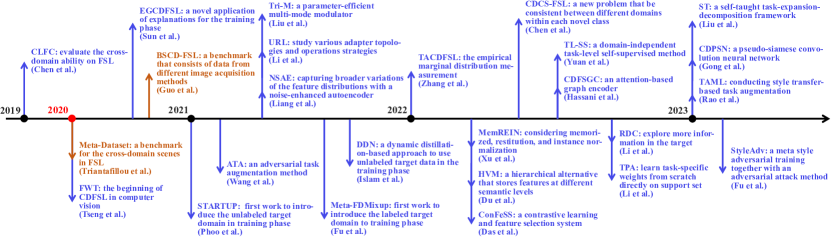
- 综述整理并解释相关数据集与基准(如 Meta-Dataset 和 BSCD-FSL),并分析它们对方法评估的含义。
- 本文在问题设置、应用与理论基础方面勾画了有前景的未来方向。
更好的研究,从现在开始
从论文设计到论文写作,大幅缩短您的研究时间。
无需绑定信用卡
本解读由 AI 生成,并经人工编辑审核。