
[论文解读] Deep Metric Learning for Unsupervised Remote Sensing Change Detection
该论文提出了一种基于深度度量学习的无监督遥感变化检测方法,通过无监督相似性-相异性损失联合优化深度变化概率生成器(D-CPG)和深度特征提取器(D-FE)。该方法在三个基准数据集上实现了最先进性能,且无需标注训练数据,显著优于现有的有监督和无监督方法。
Remote Sensing Change Detection (RS-CD) aims to detect relevant changes from Multi-Temporal Remote Sensing Images (MT-RSIs), which aids in various RS applications such as land cover, land use, human development analysis, and disaster response. The performance of existing RS-CD methods is attributed to training on large annotated datasets. Furthermore, most of these models are less transferable in the sense that the trained model often performs very poorly when there is a domain gap between training and test datasets. This paper proposes an unsupervised CD method based on deep metric learning that can deal with both of these issues. Given an MT-RSI, the proposed method generates corresponding change probability map by iteratively optimizing an unsupervised CD loss without training it on a large dataset. Our unsupervised CD method consists of two interconnected deep networks, namely Deep-Change Probability Generator (D-CPG) and Deep-Feature Extractor (D-FE). The D-CPG is designed to predict change and no change probability maps for a given MT-RSI, while D-FE is used to extract deep features of MT-RSI that will be further used in the proposed unsupervised CD loss. We use transfer learning capability to initialize the parameters of D-FE. We iteratively optimize the parameters of D-CPG and D-FE for a given MT-RSI by minimizing the proposed unsupervised ``similarity-dissimilarity loss''. This loss is motivated by the principle of metric learning where we simultaneously maximize the distance between change pair-wise pixels while minimizing the distance between no-change pair-wise pixels in bi-temporal image domain and their deep feature domain. The experiments conducted on three CD datasets show that our unsupervised CD method achieves significant improvements over the state-of-the-art supervised and unsupervised CD methods. Code available at https://github.com/wgcban/Metric-CD
研究动机与目标
- 解决遥感变化检测中大规模标注数据集稀缺的挑战。
- 通过开发完全无监督的方法,克服有监督模型中的领域偏移问题,实现跨领域泛化。
- 提升对多时相遥感图像中季节性和色彩变化的鲁棒性。
- 实现在新数据集上无需微调的可迁移与自适应变化检测。
- 开发一种自监督训练范式,利用度量学习原理区分变化与非变化像素。
提出的方法
- 该方法使用两个深度神经网络:用于预测变化/非变化概率图的深度变化概率生成器(D-CPG),以及用于从双时相图像中提取分层深度特征的深度特征提取器(D-FE)。
- D-FE 通过在 ImageNet 预训练模型上的迁移学习进行初始化,以提升特征质量与收敛速度。
- 提出一种无监督相似性-相异性损失,旨在最大化图像空间与深度特征空间中不同类别(变化)之间的距离,同时最小化同一类别(非变化)之间的距离。
- 损失函数由三部分组成:图像级相似性-相异性损失($\mathcal{L}_{\text{img}}$)、特征级损失($\mathcal{L}_{\text{feat}}$)和上下文一致性损失($\mathcal{L}_{\text{ctx}}$),以强制实现空间一致性。
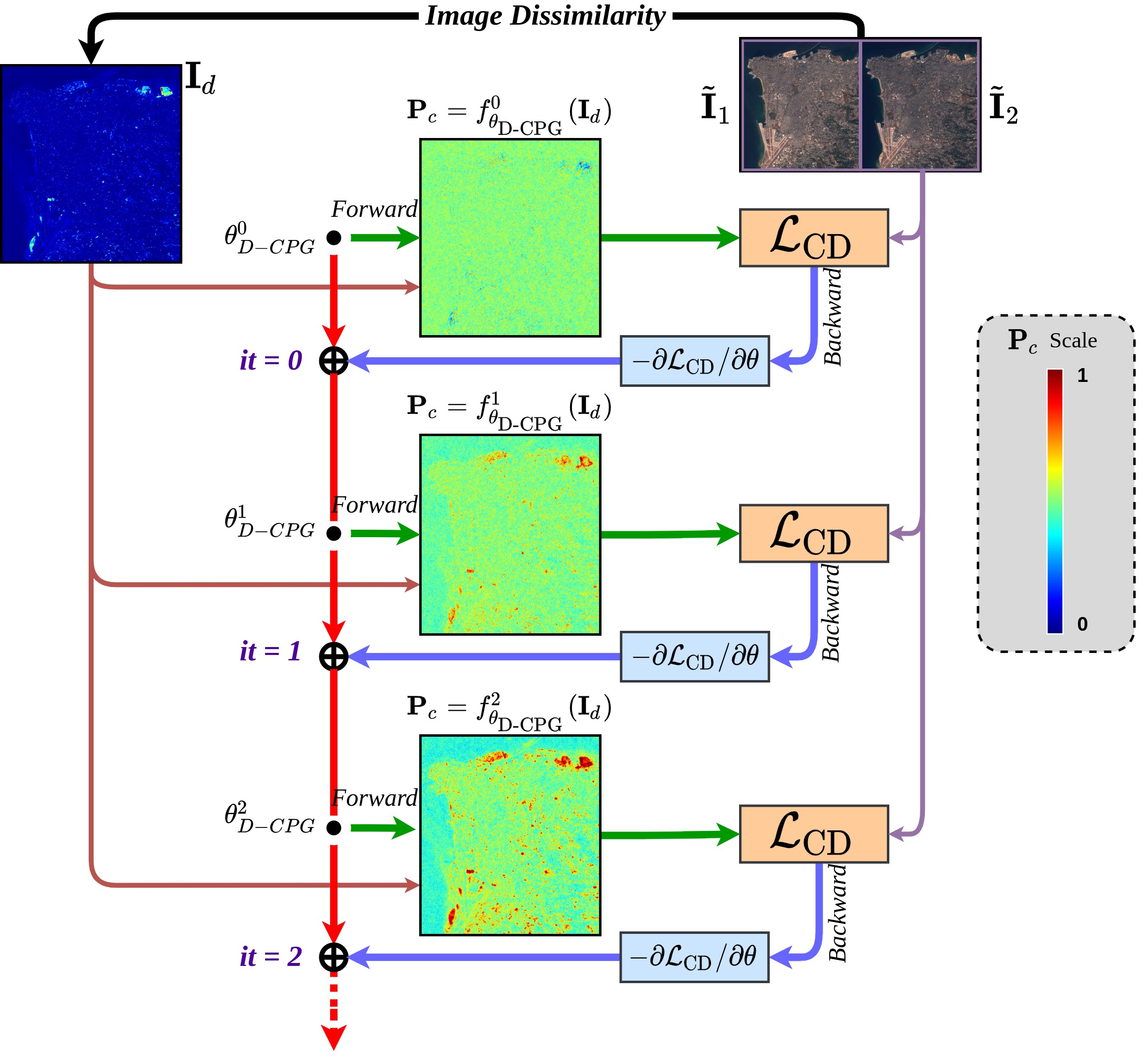
- 通过反向传播联合迭代优化 D-CPG 与 D-FE,以精炼变化概率图与特征表示。
- 该方法利用 VGG-16 的多尺度特征(尺度 $l=1$ 和 $l=2$)实现最优性能,消融实验表明使用更深的特征层会导致性能下降。
![Figure 1: How our deep metric learning-based CD method differs from the state-of-the-art CD methods. (a) Supervised CD : In this case, MT-RSIs and the corresponding change masks are available for training the CD model [ 53 , 11 , 32 ] . (b) Self-supervised CD : In this case, change masks are not ava](https://ar5iv.labs.arxiv.org/html/2303.09536/assets/imgs_up/intro2.jpeg)
实验结果
研究问题
- RQ1深度度量学习能否在无需标注训练数据的情况下,有效应用于无监督遥感变化检测?
- RQ2联合优化变化概率生成器与特征提取器在多大程度上提升了对色彩与季节性变化的检测鲁棒性?
- RQ3图像级、特征级与上下文一致性损失在提升变化检测性能方面的相对贡献是什么?
- RQ4网络架构与特征尺度的选择如何影响最终检测精度?
- RQ5自监督度量学习方法是否能在标准基准上超越现有有监督与无监督最先进方法?
主要发现
- 所提方法在 OSCD 数据集上达到 0.937 的 AUC,显著优于以往最先进的无监督与有监督方法。
- 在 D-CPG 中使用含 32 个残差块的 ResNet 可获得最高 AUC(0.937),优于 U-Net、Hourglass 与浅层 ResNets。
- 图像级、特征级与上下文一致性损失($\mathcal{L}_{\text{img}}$、$\mathcal{L}_{\text{feat}}$、$\mathcal{L}_{\text{ctx}}$)的组合在 OSCD 上实现最佳 F1 分数(0.325)与 OA(0.958)。
- 利用 VGG-16 的前两个特征尺度($l=1,2$)可获得最优性能,而使用更深的特征层则导致性能下降。
- 特征级相似性-相异性损失($\mathcal{L}_{\text{feat}}$)对性能提升的贡献大于图像级损失($\mathcal{L}_{\text{img}}$),AUC 从 0.821 提升至 0.879。
- 该方法能稳定收敛至最优变化概率图,如 OSCD 数据集中贝鲁特图像对的收敛曲线所示。
更好的研究,从现在开始
从阅读论文到最终审阅,大幅缩短您的研究时间。
无需绑定信用卡
本解读由 AI 生成,并经人工编辑审核。