
[论文解读] Deep neural operator for learning transient response of interpenetrating phase composites subject to dynamic loading
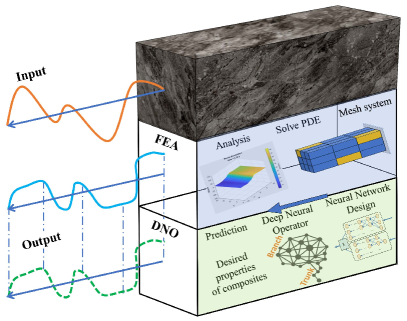
该论文提出了一种深度神经算子(DNO),用于替代有限元分析(FEA),以预测在动态载荷下互穿相复合材料(IPCs)的瞬态机械响应。该DNO在JAX中通过增量序列到序列学习方法,基于5,000组随机应变载荷进行训练,预测反应力和应力分布的准确率达到98%,用时不足一秒——比标准DeepONet模型快100倍——实现了对3D打印IPC的快速、精确且鲁棒的设计探索。
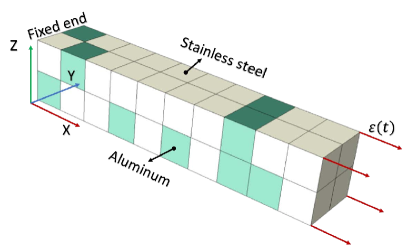
Additive manufacturing has been recognized as an industrial technological revolution for manufacturing, which allows fabrication of materials with complex three-dimensional (3D) structures directly from computer-aided design models. The mechanical properties of interpenetrating phase composites (IPCs), especially response to dynamic loading, highly depend on their 3D structures. In general, for each specified structural design, it could take hours or days to perform either finite element analysis (FEA) or experiments to test the mechanical response of IPCs to a given dynamic load. To accelerate the physics-based prediction of mechanical properties of IPCs for various structural designs, we employ a deep neural operator (DNO) to learn the transient response of IPCs under dynamic loading as surrogate of physics-based FEA models. We consider a 3D IPC beam formed by two metals with a ratio of Young's modulus of 2.7, wherein random blocks of constituent materials are used to demonstrate the generality and robustness of the DNO model. To obtain FEA results of IPC properties, 5,000 random time-dependent strain loads generated by a Gaussian process kennel are applied to the 3D IPC beam, and the reaction forces and stress fields inside the IPC beam under various loading are collected. Subsequently, the DNO model is trained using an incremental learning method with sequence-to-sequence training implemented in JAX, leading to a 100X speedup compared to widely used vanilla deep operator network models. After an offline training, the DNO model can act as surrogate of physics-based FEA to predict the transient mechanical response in terms of reaction force and stress distribution of the IPCs to various strain loads in one second at an accuracy of 98%. Also, the learned operator is able to provide extended prediction of the IPC beam subject to longer random strain loads at a reasonably well accuracy.
研究动机与目标
- 为了加速预测在动态载荷下互穿相复合材料(IPCs)的瞬态机械响应,当前该类模拟通常需要FEA或实验手段耗时数小时甚至数天。
- 开发一种数据驱动的代理模型,能够跨多样化的3D微观结构和动态应变载荷泛化,从而实现增材制造IPC的快速设计迭代。
- 通过训练单一深度神经算子(DNO)克服重复FEA带来的计算瓶颈,实现对任意动态载荷输入的瞬时响应预测。
- 评估DNO模型在噪声数据和超出训练窗口的延长载荷持续时间下的鲁棒性与泛化能力。
- 证明在JAX中采用增量学习和序列到序列训练可显著加速DNO训练,相比标准DeepONet实现具有明显优势。
提出的方法
- DNO在5,000组由高斯过程核生成的时间相关应变载荷上进行训练,模拟在具有两种金属(杨氏模量比为2.7)的3D IPC梁上施加的动态载荷条件。
- 采用有限元分析(FEA)计算每种载荷工况下的真实反应力和应力场,构成训练数据集。
- 在DNO训练过程中应用增量学习策略,将具有高相似性的相邻单元按顺序进行训练,以提升收敛性和准确性。
- 在JAX中实现序列到序列训练,以建模机械响应的时间演化过程,实现输入输出动态关系的端到端学习。
- 通过未见的载荷类型(包括更长持续时间的随机过程、正弦输入和分段线性序列)对DNO进行评估,以测试其泛化能力。
- 通过在训练期间向输出数据注入高斯白噪声(β = 0.05至0.2),测试其在数据污染下的预测准确性,评估鲁棒性。
实验结果
研究问题
- RQ1能否训练一个深度神经算子(DNO),以准确且快速地预测在任意动态应变载荷下3D互穿相复合材料(IPCs)的瞬态机械响应?
- RQ2基于单元相似性的增量学习如何提升DNO模型的训练效率和预测准确性?
- RQ3DNO在多大程度上能泛化至未见的载荷类型(如正弦或分段线性应变输入),超出其训练数据分布?
- RQ4DNO模型对噪声输出数据的鲁棒性如何?其在保持高预测准确率的前提下可容忍多大程度的噪声?
- RQ5DNO模型能否在超出训练持续时间(例如,从1秒的训练窗口预测2秒的响应)的情况下实现可接受的准确率外推?
主要发现
- DNO模型在不到一秒内实现反应力和应力分布98%的预测准确率,支持IPC的实时设计探索。
- 在JAX中采用增量学习训练的DNO模型,其训练速度约为在TensorFlow中实现的标准DeepONet模型的100倍。
- 该模型对未见载荷类型(包括正弦和分段线性应变输入)具有良好的泛化能力,在多种输入模式下均保持高准确率。
- 对于噪声数据,当噪声水平低于β = 0.15时,DNO保持超过90%的准确率;在β = 0.2时仍保持86.48%的准确率,表现出强鲁棒性。
- DNO成功实现对更长载荷持续时间(最长达2秒)的外推,表明其在无需微调的情况下具备长期预测潜力。
- 当训练遵循单元相似性时,模型性能得到增强,表明输入域中的结构一致性可提升学习效率与准确性。
更好的研究,从现在开始
从阅读论文到最终审阅,大幅缩短您的研究时间。
无需绑定信用卡
本解读由 AI 生成,并经人工编辑审核。