
[论文解读] Deep Rib Fracture Instance Segmentation and Classification from CT on the RibFrac Challenge
该论文提出FracNet+,一种用于CT扫描中肋骨骨折3D实例分割与分类的深度学习框架,基于RibFrac挑战赛数据集。通过整合基于点的肋骨分割与大规模预训练3D神经网络,该方法在骨折检测方面达到最先进性能,某些情况下甚至优于人类专家,尽管对如嵌插骨折等细微类型分类仍具挑战性。
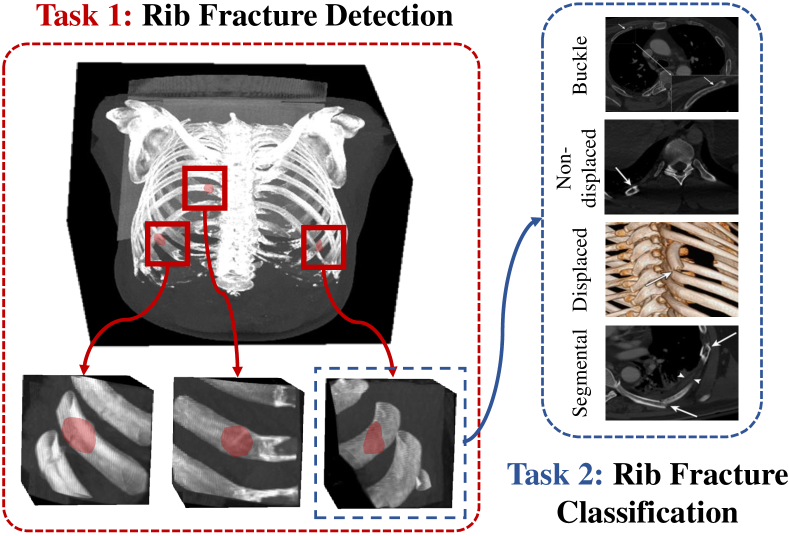
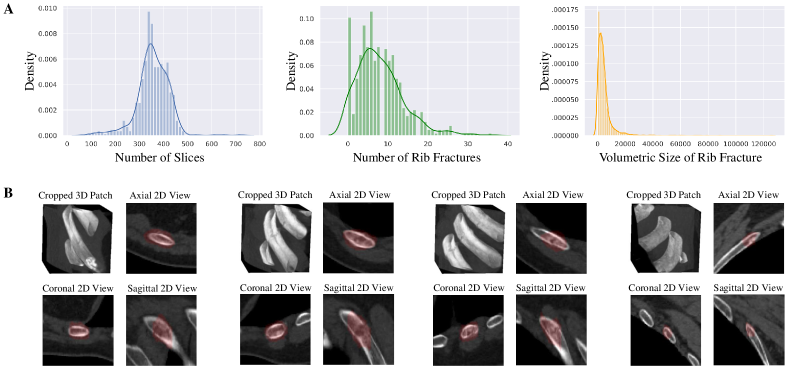
Rib fractures are a common and potentially severe injury that can be challenging and labor-intensive to detect in CT scans. While there have been efforts to address this field, the lack of large-scale annotated datasets and evaluation benchmarks has hindered the development and validation of deep learning algorithms. To address this issue, the RibFrac Challenge was introduced, providing a benchmark dataset of over 5,000 rib fractures from 660 CT scans, with voxel-level instance mask annotations and diagnosis labels for four clinical categories (buckle, nondisplaced, displaced, or segmental). The challenge includes two tracks: a detection (instance segmentation) track evaluated by an FROC-style metric and a classification track evaluated by an F1-style metric. During the MICCAI 2020 challenge period, 243 results were evaluated, and seven teams were invited to participate in the challenge summary. The analysis revealed that several top rib fracture detection solutions achieved performance comparable or even better than human experts. Nevertheless, the current rib fracture classification solutions are hardly clinically applicable, which can be an interesting area in the future. As an active benchmark and research resource, the data and online evaluation of the RibFrac Challenge are available at the challenge website. As an independent contribution, we have also extended our previous internal baseline by incorporating recent advancements in large-scale pretrained networks and point-based rib segmentation techniques. The resulting FracNet+ demonstrates competitive performance in rib fracture detection, which lays a foundation for further research and development in AI-assisted rib fracture detection and diagnosis.
研究动机与目标
- 为解决CT扫描中因复杂肋骨解剖结构和细微骨折类型导致的肋骨骨折漏诊临床挑战。
- 开发一种稳健的深度学习框架,用于体素CT数据中肋骨骨折的3D实例分割与分类。
- 通过RibFrac挑战赛建立人工智能辅助肋骨骨折诊断的基准,提供大规模、带有体素级掩码与临床标签的标注数据集。
- 相比人工阅片,提高检测准确率并减少解读时间,尤其针对复杂或易被忽略的骨折类型。
- 识别分类中的关键技术障碍,如几何复杂性与类别不平衡,并为未来方法改进提供指导。
提出的方法
- 该方法采用基于点的肋骨分割技术,提取解剖结构并指导后续骨折检测。
- 整合大规模预训练3D卷积神经网络(如基于MONAI的架构),并在RibFrac数据集上微调以提升特征学习能力。
- 使用3D实例分割头在多张CT切片中实现对单个肋骨骨折的定位与体素级分割。
- 分类头预测四种临床类别:嵌插骨折(BK)、无移位骨折(ND)、移位骨折(DP)和节段性骨折(SG)。
- 通过结合检测与分类目标的多任务损失函数进行端到端训练,并采用数据增强以提升鲁棒性。
- 挑战赛后改进包括改进的数据采样与损失权重分配,以应对类别不平衡与几何变异性问题。
实验结果
研究问题
- RQ1深度学习模型是否能在多样化的CT扫描体数据中实现人类水平或更优的肋骨骨折检测性能?
- RQ2几何复杂性与可变的肋骨方向如何影响3D CNN在肋骨骨折检测中的表现?
- RQ3为何当前模型在检测性能较强的情况下,仍难以对如嵌插骨折和节段性骨折等细微类型进行分类?
- RQ4引入基于点的肋骨分割在多大程度上提升了骨折检测的准确率与鲁棒性?
- RQ5集成肋骨标注、中心线提取与骨折诊断的统一框架,是否能优于专用任务的流水线?
主要发现
- RibFrac挑战赛中多个表现优异的模型在检测性能上达到或超过人类放射科医生水平,尤其在识别复杂或漏诊的骨折方面表现突出。
- 嵌插骨折的预测感知F1分数显著提升,表明假阴性减少,但因外观细微,分类仍具挑战。
- 节段性骨折因依赖局部感受野且缺乏长程结构上下文,检测效果较差,凸显当前方法的关键局限。
- 数据集中骨折类型的分布存在不平衡,节段性与嵌插骨折数量较少,这增加了模型泛化难度并提高错误率。
- 所提出的FracNet+框架通过利用预训练3D网络与基于点的肋骨分割,在检测方面展现出具有竞争力的性能,为未来研究奠定了坚实基线。
更好的研究,从现在开始
从阅读论文到最终审阅,大幅缩短您的研究时间。
无需绑定信用卡
本解读由 AI 生成,并经人工编辑审核。