
[论文解读] DeepTensor: Low-Rank Tensor Decomposition with Deep Network Priors
DeepTensor 提出了一种自监督深度学习框架,用于低秩张量与矩阵分解,利用深度生成网络(DNs)的隐式正则化,超越了 SVD 和 PCA 等经典方法。该方法在非高斯噪声和低信噪比条件下表现出鲁棒性能,在泊松噪声去噪中实现高达 6 dB 的信噪比增益,并且在 3D 张量分解方面比 3D 卷积网络快 60 倍。
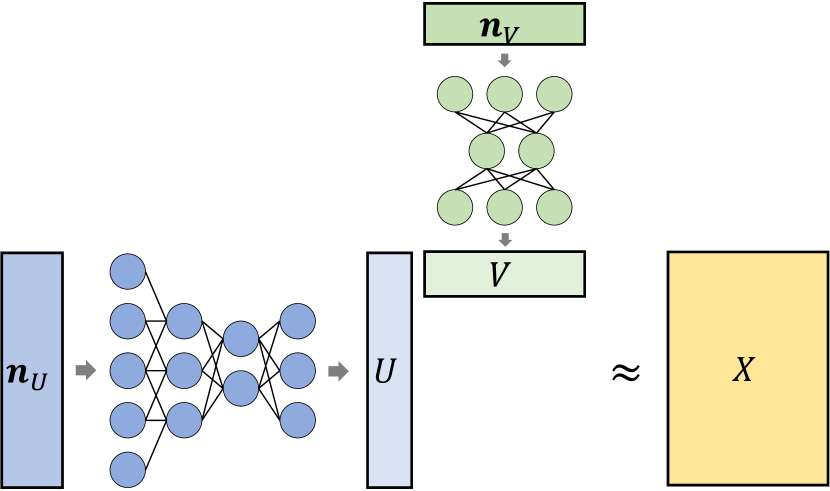
DeepTensor is a computationally efficient framework for low-rank decomposition of matrices and tensors using deep generative networks. We decompose a tensor as the product of low-rank tensor factors (e.g., a matrix as the outer product of two vectors), where each low-rank tensor is generated by a deep network (DN) that is trained in a self-supervised manner to minimize the mean-squared approximation error. Our key observation is that the implicit regularization inherent in DNs enables them to capture nonlinear signal structures (e.g., manifolds) that are out of the reach of classical linear methods like the singular value decomposition (SVD) and principal component analysis (PCA). Furthermore, in contrast to the SVD and PCA, whose performance deteriorates when the tensor's entries deviate from additive white Gaussian noise, we demonstrate that the performance of DeepTensor is robust to a wide range of distributions. We validate that DeepTensor is a robust and computationally efficient drop-in replacement for the SVD, PCA, nonnegative matrix factorization (NMF), and similar decompositions by exploring a range of real-world applications, including hyperspectral image denoising, 3D MRI tomography, and image classification. In particular, DeepTensor offers a 6dB signal-to-noise ratio improvement over standard denoising methods for signals corrupted by Poisson noise and learns to decompose 3D tensors 60 times faster than a single DN equipped with 3D convolutions.
研究动机与目标
- 开发一种对非高斯噪声和信号分布具有鲁棒性的低秩分解框架,以应对经典线性方法(如 SVD 和 PCA)失效的场景。
- 利用深度生成网络的隐式归纳偏差,作为矩阵与张量分解的强大、数据驱动正则化器。
- 创建一种计算高效、可直接替换标准分解技术(如 SVD、PCA 和 NMF)的实用框架,适用于真实世界应用。
- 通过学习更精确的低维信号表示,提升下游任务(如图像分类与去噪)的性能。
- 展示在可扩展性与速度方面的优势,特别是在 3D 张量分解方面,相较于端到端 3D 卷积网络具有显著优势。
提出的方法
- 将低秩张量因子表示为通过自监督学习训练的深度生成网络(DNs)的输出,以最小化重构张量与输入张量之间的均方误差(MSE)。
- 采用可分离架构,使用 1D 或 2D 卷积滤波器,实现高效的 3D 张量分解,避免全 3D 卷积带来的计算开销。
- 使用反向传播与 MSE 损失函数训练 DNs,其中重构结果为生成的低秩因子的乘积。
- 利用 DNs 架构带来的隐式正则化,捕捉非线性信号结构(如流形),这是线性方法无法建模的。
- 通过 ReLU 或 softplus 激活函数集成非负性约束,适用于 NMF 等任务,支持半 NMF 与全 NMF 变体。
- 采用两阶段训练流程:首先在自监督重构目标上预训练 DNs,然后针对特定分解任务进行微调。

实验结果
研究问题
- RQ1深度生成网络能否在非高斯噪声分布下,作为低秩张量分解的有效先验?
- RQ2当信噪比较低或噪声为非高斯分布(如泊松噪声)时,DeepTensor 与 SVD 和 PCA 的性能相比如何?
- RQ3DeepTensor 对秩的过估计有多大的鲁棒性?与 SVD 相比,其对秩选择的敏感性如何?
- RQ4DeepTensor 是否能在保持高精度的同时,实现显著的 3D 张量分解加速,相比 3D 卷积网络?
- RQ5使用 DNs 作为先验是否能提升下游任务性能(如图像分类或去噪),相比经典因子分解方法?
主要发现
- 在受泊松噪声污染的高光谱图像上应用时,DeepTensor 相较于标准去噪方法实现了 6 dB 的信噪比(SNR)增益。
- 在非高斯噪声的低信噪比环境下,DeepTensor 表现优于 SVD 和 PCA,后者在非高斯噪声假设下性能显著下降。
- 与 SVD 相比,DeepTensor 对秩过估计的敏感性显著降低:SVD 的精度随秩增加而下降,而 DeepTensor 在广泛秩范围内保持稳定性能。
- 在 3D 张量分解方面,由于采用结合 1D 与 2D 卷积的可分离架构,DeepTensor 的速度比单个 3D 卷积网络快 60 倍。
- 在语音谱图的非负矩阵分解(NMF)中,使用 ReLU 激活的 DeepTensor 实现了 8.8 dB 的平均 PSNR,优于基线 NMF 方法(4.6–4.7 dB)。
- 在基于特征脸的人脸识别任务中,DeepTensor 学习到的主成分噪声低于 PCA 或 ICA,从而在线性 SVM 分类器上实现了更高的分类准确率。
更好的研究,从现在开始
从阅读论文到最终审阅,大幅缩短您的研究时间。
无需绑定信用卡
本解读由 AI 生成,并经人工编辑审核。