
[论文解读] DeformUX-Net: Exploring a 3D Foundation Backbone for Medical Image Segmentation with Depthwise Deformable Convolution
DeformUX-Net 提出了一种用于医学图像分割的3D基础主干网络,通过深度可分离可变形卷积统一了长距离依赖、自适应空间聚合与计算效率。通过引入并行多层感知机分支进行三平面偏移学习,并采用结构重参数化启发式设计,该方法在四个公开数据集上实现了最先进性能,且参数量少于当前最先进模型的视觉Transformer(ViTs)。
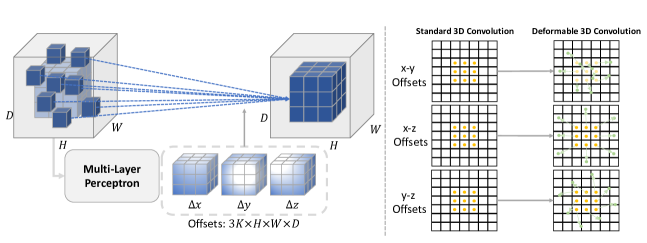
The application of 3D ViTs to medical image segmentation has seen remarkable strides, somewhat overshadowing the budding advancements in Convolutional Neural Network (CNN)-based models. Large kernel depthwise convolution has emerged as a promising technique, showcasing capabilities akin to hierarchical transformers and facilitating an expansive effective receptive field (ERF) vital for dense predictions. Despite this, existing core operators, ranging from global-local attention to large kernel convolution, exhibit inherent trade-offs and limitations (e.g., global-local range trade-off, aggregating attentional features). We hypothesize that deformable convolution can be an exploratory alternative to combine all advantages from the previous operators, providing long-range dependency, adaptive spatial aggregation and computational efficiency as a foundation backbone. In this work, we introduce 3D DeformUX-Net, a pioneering volumetric CNN model that adeptly navigates the shortcomings traditionally associated with ViTs and large kernel convolution. Specifically, we revisit volumetric deformable convolution in depth-wise setting to adapt long-range dependency with computational efficiency. Inspired by the concepts of structural re-parameterization for convolution kernel weights, we further generate the deformable tri-planar offsets by adapting a parallel branch (starting from $1 imes1 imes1$ convolution), providing adaptive spatial aggregation across all channels. Our empirical evaluations reveal that the 3D DeformUX-Net consistently outperforms existing state-of-the-art ViTs and large kernel convolution models across four challenging public datasets, spanning various scales from organs (KiTS: 0.680 to 0.720, MSD Pancreas: 0.676 to 0.717, AMOS: 0.871 to 0.902) to vessels (e.g., MSD hepatic vessels: 0.635 to 0.671) in mean Dice.
研究动机与目标
- 解决3D医学图像分割中全局-局部注意力机制与大感受野卷积之间的权衡问题。
- 开发一种计算高效、自适应的主干网络,能够捕捉长距离依赖关系,且不依赖于自注意力机制。
- 探索3D深度可分离可变形卷积作为体积分割基础算子的可行性。
- 通过可学习的、通道感知的偏移量,改进特征通道间的自适应空间聚合。
- 建立一种新型基于CNN的基础模型,其性能超越当前最先进视觉Transformer(ViTs),在参数效率方面更具优势。
提出的方法
- 提出3D DeformUX-Net,一种类似U-Net的架构,在编码器模块中使用深度可分离可变形卷积,以扩展有效感受野。
- 采用并行分支,通过1×1×1卷积生成三平面可变形偏移量,实现在所有通道上的自适应空间聚合。
- 借鉴结构重参数化原理,通过多层感知机(MLP)计算可变形偏移量,提升特征表示能力与模型效率。
- 采用线性缩放策略结合MLP增强空间特征聚合,性能优于深度缩放策略。
- 应用三平面偏移计算以捕捉多方向的空间依赖关系,其性能因解剖结构而异。
- 在四个公开的3D医学影像数据集上以端到端监督方式训练模型,以便与当前最先进方法进行直接比较。

实验结果
研究问题
- RQ13D深度可分离可变形卷积是否能有效替代3D医学分割中的全局-局部自注意力机制与大感受野卷积?
- RQ2三平面偏移计算在不同解剖结构(如器官和血管)上的性能影响如何?
- RQ3采用可学习的、并行分支设计进行偏移量生成,是否能提升自适应空间聚合能力,同时减少参数量?
- RQ4基于MLP的偏移量计算是否在体积分割任务中优于固定核或标准可变形卷积?
- RQ5基于CNN的主干网络若结合可变形操作,是否能实现超越视觉Transformer(ViTs)的SOTA性能,且参数量更少?
主要发现
- 在KiTS数据集(肾脏、肿瘤、囊肿)上,DeformUX-Net实现了0.720的平均Dice分数,优于现有SOTA模型。
- 在MSD胰腺数据集上,其平均Dice达到0.717,展现出在器官分割任务中的强大性能。
- 在AMOS多器官分割数据集上,DeformUX-Net的平均Dice达到0.902,超越当前SOTA的ViTs与CNN模型。
- 在肝血管分割任务中,其平均Dice为0.671,表现出对小而复杂结构的鲁棒性。
- MLP驱动的三平面偏移量在所有数据集上均一致提升性能,其中x-z平面在血管分割中效果最佳。
- 该模型在参数量少于基于Transformer的模型前提下实现了SOTA性能,证实了其计算效率与可扩展性。
更好的研究,从现在开始
从阅读论文到最终审阅,大幅缩短您的研究时间。
无需绑定信用卡
本解读由 AI 生成,并经人工编辑审核。